Strengthening civil society for climate action in the Comoros
05 August, 2026
Strengthening civil society for climate action in the Comoros
05 August, 2026
Meet the conservationist: Anne-Isabelle Bonifassi
23 July, 2026
Tuesday 30 december 2025
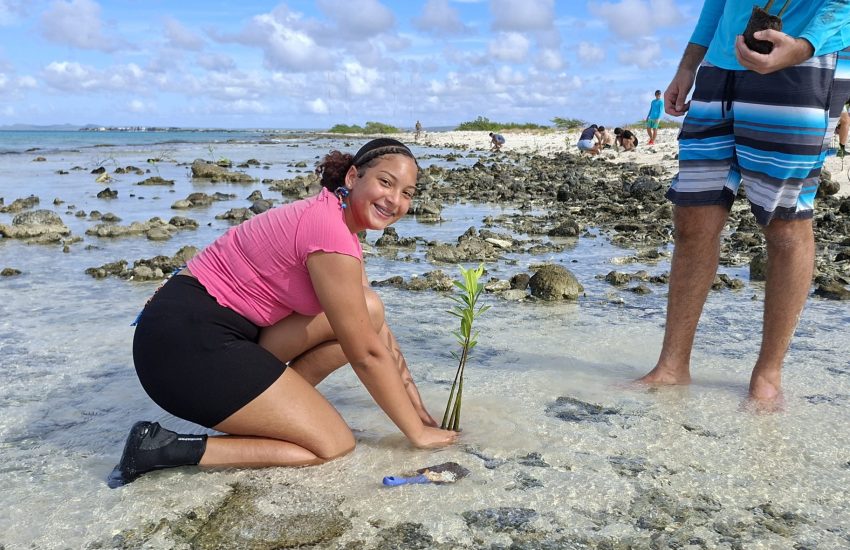
Header photo: Student planting mangrove along the coast © Sabine Engel
Bonaire is a small island heavily impacted by overgrazing from free-roaming goats and donkeys; an estimated 32 thousand goats roam the island freely. This overgrazing has severely degraded the vegetation, causing excessive erosion. The topsoil washes away with rain, causing long-term damage that is not easily reversed even if grazers are removed. Where in the past there was a healthy tropical dry forest, large parts are now very degraded, with vegetation dominated by cacti, a hard compacted soil that allows little water infiltration. Additionally, Bonaire is experiencing rapid and somewhat uncontrolled growth, including substantial tourism, which adds pressure to natural resources.
Sabine Engel has worked on Bonaire for nearly three decades. For the last fifteen years, she has focused her work on mangrove restoration on the island. Mangroves are important allies in helping to mitigate the effects of climate change like sea-level rise and extreme weather events by sequestering carbon. They also provide important habitat for many species and act as natural water purifiers, maintaining the clarity and quality of the surrounding waters. Lac Bay, which is one of the two target areas of the project, has one of the best-preserved mangrove forests in the Dutch Caribbean, serving as a crucial habitat for a variety of marine species and birds. Lac Bay is home to the threatened conch and sea turtles and the mangroves around the bay help keep the waters clear by anchoring the sediments.
Unfortunately, in some parts of the island, mangroves are in a bad state. ‘In those fifteen years that I’ve been working on mangroves, I’ve realised that water circulation is really important, but what has an even bigger impact on mangroves is erosion,’ says Engel. ‘And unfortunately, erosion is increasing.’
This worsening erosion is due to overgrazing, development, and climate change effects such as altered rainfall patterns, causing more surface runoff. Increased sediment loads in the backwaters smother the mangroves and cause a die off. People living on the island depend on healthy mangroves for the benefits (or services) they provide: the nursery function for fisheries, high biodiversity, eco-tourism, coastal protection and more. Therefore, addressing these issues is vital, especially in the face of worsening climate change.
The project consists of two major efforts to combat these issues, reducing erosion and coastal protection. Firstly, the project will aim to a create a water management system through a series of dams and reforestation efforts at the land bordering the mangroves, to help minimise surface flow into the forest. In doing so, Internos and Mangrove Maniacs hopes to create better conditions for mangroves to thrive. ‘We have already seen in some areas where we work that once you restore the conditions for mangroves to grow, they will come back on their own, without having to plant them,’ says Engel.
Secondly, through planting mangroves along the southern coast of the island, a natural barrier will be created to protect the salt pans from storm surges and sea level rise.
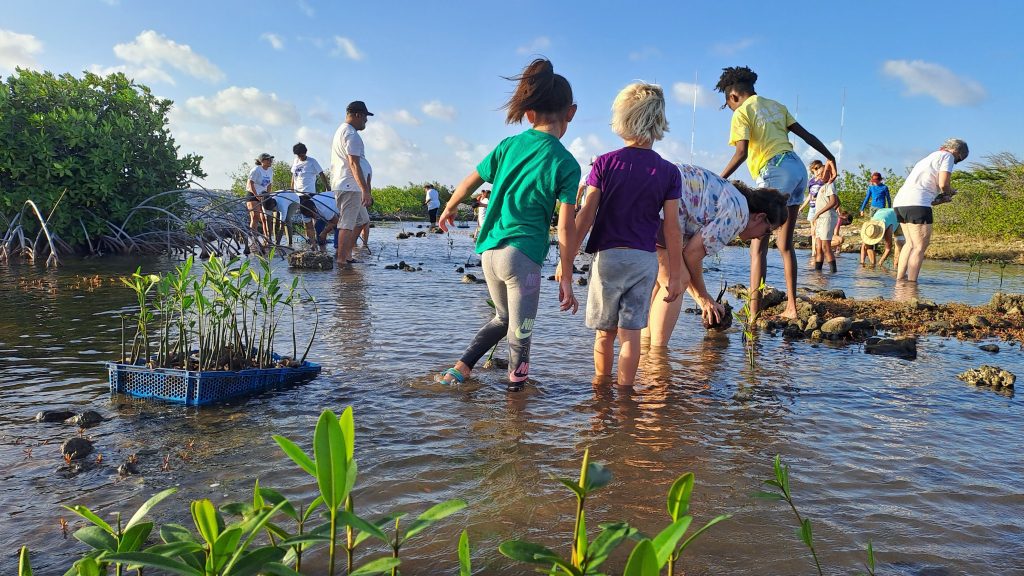
Children planting mangroves © Sabine Engel
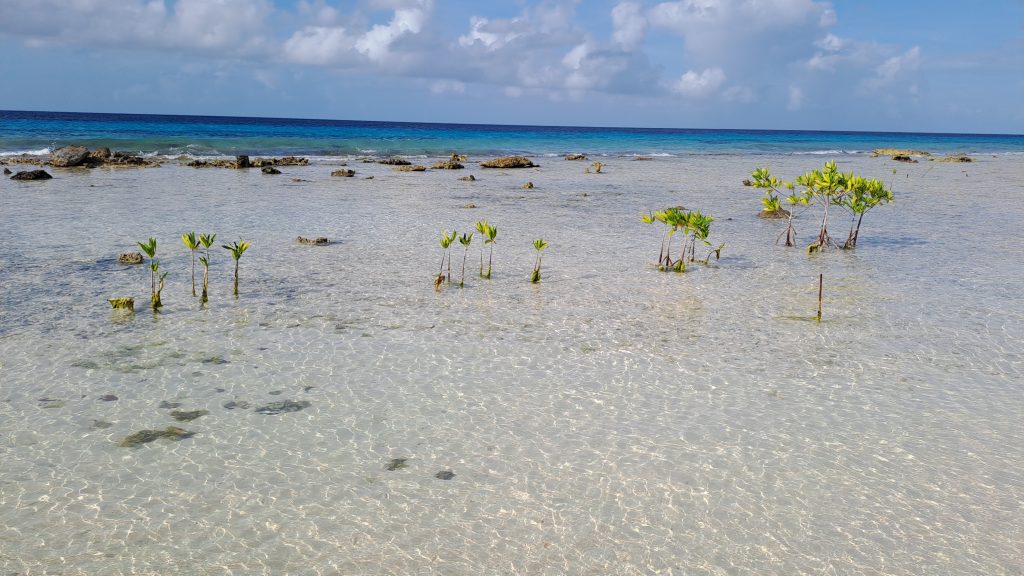
Newly planted mangroves © Sabine Engel
What makes Internos’ and Mangrove Maniacs’ approach unique is the cultivation of mangroves within natural mangrove areas using biodegradable bags in crates, reducing the need for external nurseries and minimising care requirements. Once mature, these mangroves are transplanted to vulnerable coastal zones, especially along the southwest coast where the mangrove belt is narrow. This approach also serves as a visible nature-based solution to coastal protection and carbon sequestration, with potential to involve a wide range of participants, ranging from children to adults.
Involving local communities is an important aspect of the project. ‘Our primary focus is on the people of Bonaire, because we believe that the collective well-being of the community is tied to the health of its surroundings,’ says Engel. Internos and Mangrove Maniacs aim to engage and involve everyone, to raise awareness and gain support for the sustainable management of the area. ‘To achieve this, we focus on local groups, whoever wants to join us in the mangroves. That have been schoolkids, football clubs and volunteer organisations like the Kiwani’s. We’ve found that once we contact them, they are very excited to see the mangroves and learn more about them.’
Bonaire’s population is growing rapidly. Many newcomers reside on the island only temporarily (a few years) or split time between Bonaire and other countries, mostly the Netherlands and the United States. There is also a large influx from immigrants, for instance from Haiti, Colombia and the Dominican Republic. ‘We should have more contact with those communities as well,’ acknowledges Engel, ‘and make a start with the schoolkids that represent the whole scala of Bonaire residents.’
Internos has also started working with primary schools, teaching children about mangroves and taking them on excursions. ‘Once you take them to the mangroves, it really starts coming to life. It’s very different from sitting in a classroom and merely learning about them. We have classes that wanted to take it even further, who’ve started to help with planting mangroves as well.’
As of right now, the project is waiting for approval for permits for dam construction to combat erosion, which preparations ready to commence work quickly upon approval. And only a few weeks ago, Internos organised a workshop on Nature Based Solutions for Climate for the wider Caribbean with mangrove restoration being a very important component. ‘The workshop was mainly regional and local, focusing on promoting the concept and explaining what to do, how to do it, etcetera.’, Engel says. ‘We try to look at regional cooperation as much as possible. The Caribbean islands have contacts with all islands that have mangroves, and we try to learn from and support each other.’
The project has a team of dedicated field workers who contribute to raising awareness by informing visitors and conducting educational activities. But Engel hopes that in the future, these roles can become more formalised. ‘There are passionate people on the island who are doing great work, but right now it’s not very structured. It would be amazing if it were more formalised, as it would build a lot of local capacity on the island, and ensure more long-term sustainability of the work we are doing on mangrove restoration and climate resilience.’
This project is part of the BESTLIFE2030 programme. It is funded by the EU LIFE-programme, a European environmental and climate action grant programme. BESTLIFE 2030 provides funding for projects that work on nature conservation and restoration in overseas countries and territories of the European Union to stop and reverse global biodiversity loss.
IUCN NL is the focal point for Aruba, Bonaire, Curaçao, Saba, St. Eustatius and St. Maarten. These islands have a high biodiversity, but are among the places that are the most vulnerable to climate change and environmental pressures.


05 August, 2026
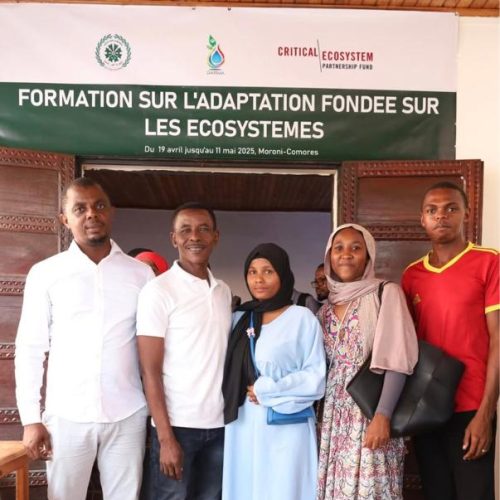
Photo header: Participants during a training session © DAYIMA Madagascar and the Indian ocean islands are a biodiversity hotspot -…
23 July, 2026
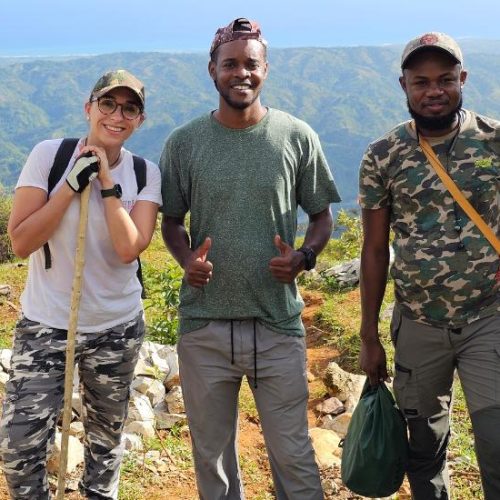
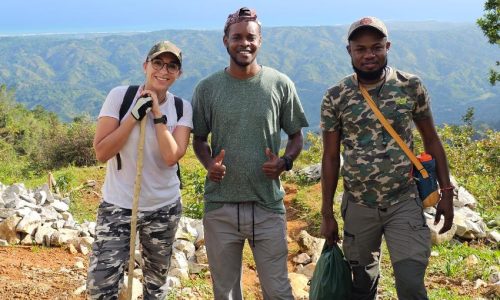
Growing up surrounded by animals, Anne-Isabelle Bonifassi always dreamed of a career in conservation. Today, as Executive Director of Haiti…