Statement: Invest in local leadership for tropical forest…
20 March, 2026
Statement: Invest in local leadership for tropical forest…
20 March, 2026
Meet the conservationist: Dr. Amelaid follows in the…
12 March, 2026
Tuesday 18 november 2025
Mangrove forests are crucial ecosystems that protect vulnerable coasts, provide local communities with livelihood resources, and harbour rich biodiversity. Yet a global assessment of the IUCN found that more than half of the world’s mangrove ecosystems are currently at risk of collapsing. This loss is especially concerning because mangroves capture and store large amounts of carbon. There is therefore growing interest in protecting and restoring these vital ecosystems, which can be partly funded through carbon credits. Blue carbon programmes can support the restoration and protection of mangrove habitats, contribute to climate change mitigation, and generate financial resources to scale-up these nature-based solutions.
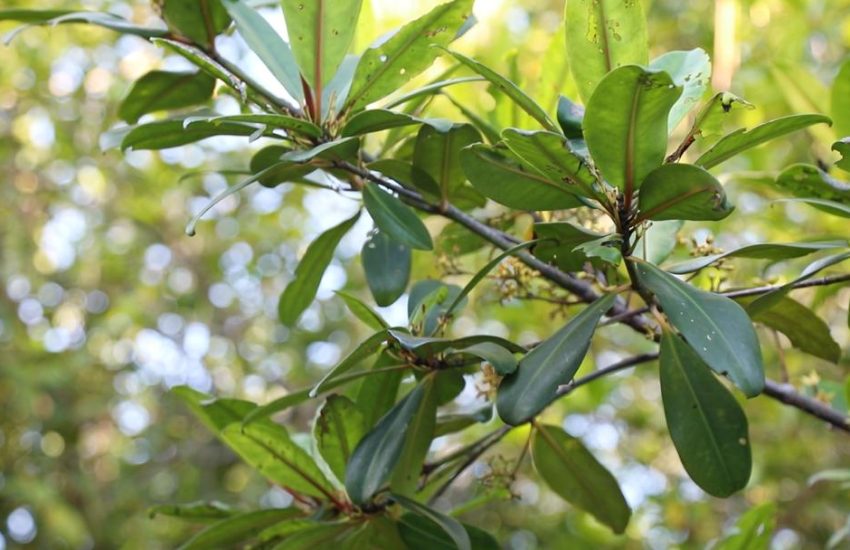
Header photo: Mangrove tree © Daniel Aboki
Mangroves are broad-leaved trees that thrive in salty water. Their submerged roots create a protected refuge for countless and often unique and rare animal and plant species, while the canopy provides nesting and foraging opportunities for birds and insects. More than 1,500 species depend on mangrove forests for food or as breeding grounds, and 15% of these species are threatened with extinction. [1]UNEP. (2023). Decades of mangrove forest change: what does it mean for nature, people and the climate?
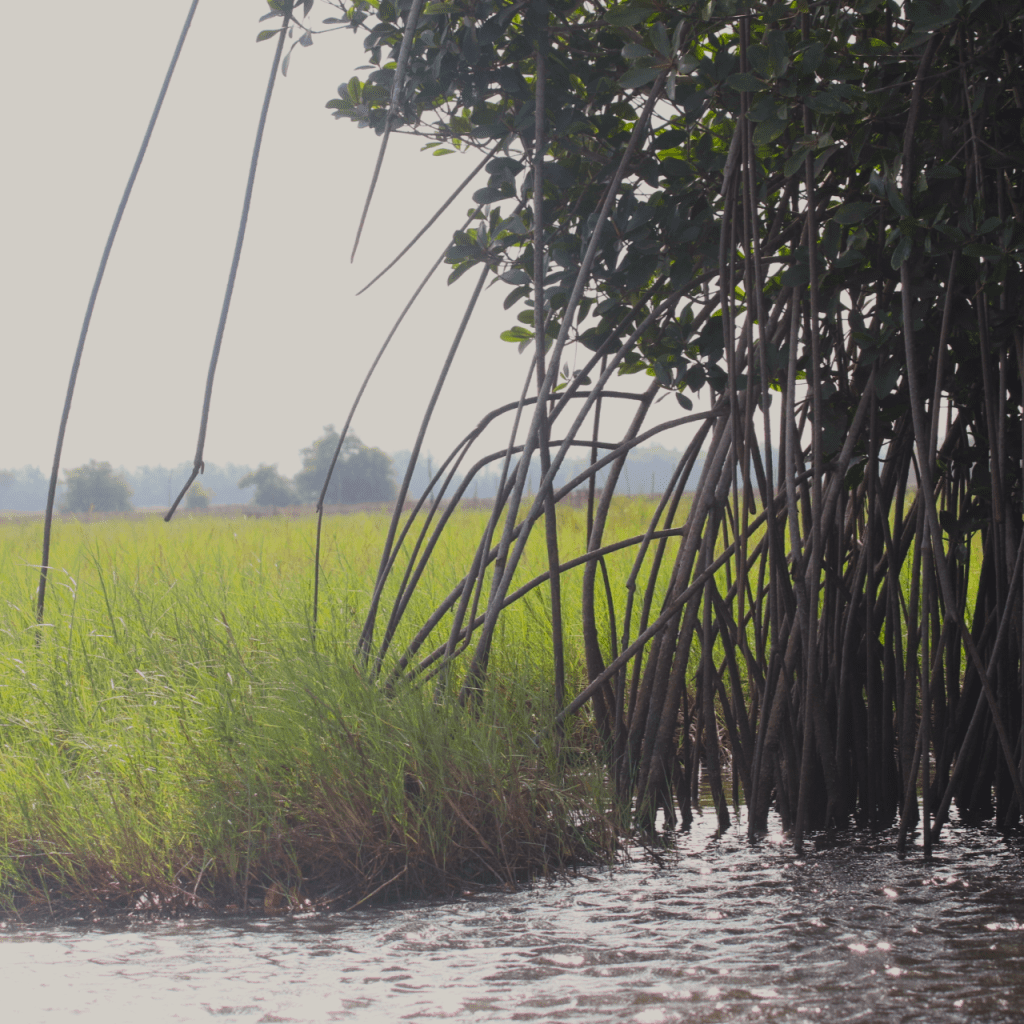
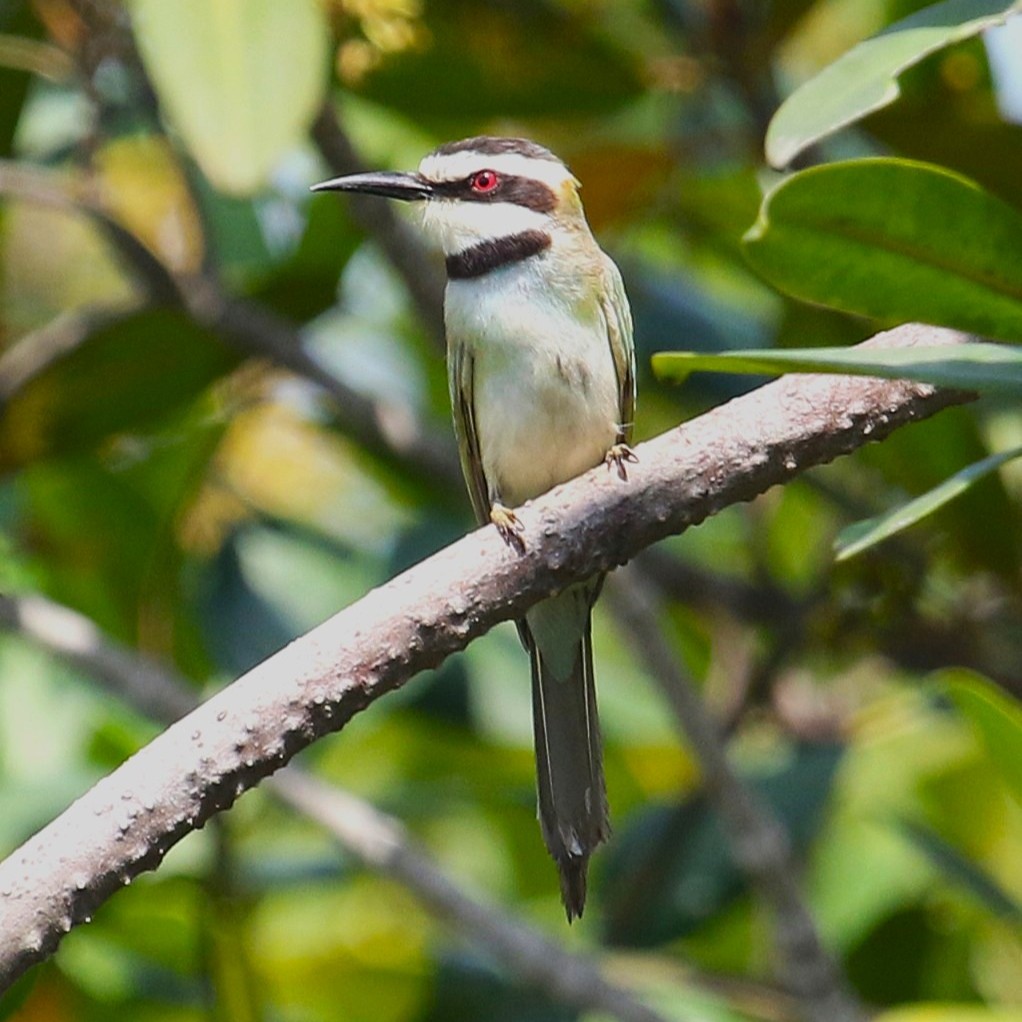
Besides supporting biodiversity, coastal ecosystems – such as mangrove forests, salt marshes, and seagrass meadows – serve as natural defence against storms, rising sea levels, and coastal erosion. They also improve water quality by filtering nutrients and sediment and enhance the livelihoods of local communities whose food security depends on the rich fishing grounds. [2]UNEP. (2023). An inside look at the beauty and benefits of mangroves
Mangrove forests play a crucial role in climate mitigation by absorbing high amounts of carbon and storing it for a long period of time in their trees, roots, and soils. At the same time, they help communities adapt to the unavoidable impacts of climate change. They are vital for the economic prosperity and wellbeing of coastal communities worldwide. That is why restoring and protecting these ecosystems is now more important than ever.
‘By protecting and restoring coastal ecosystems, IUCN NL not only helps mitigating climate change but also contributes to the resilience of local communities and the preservation of vital habitats.’
- Jan Willem den Besten, senior expert conservation finance
A remarkable feature of mangrove forests is their ability to store enormous amounts of carbon. Like terrestrial forests, mangroves capture CO₂ from the atmosphere as they grow. However, coastal ecosystems store even more carbon in their sediment, surpassing even tropical forests in carbon storage capacity. [3]NOAA Climate.gov. (2022). Understanding blue carbon. Despite covering only 2% of the Earth’s surface, coastal habitats account for 50% of global carbon storage. [4]IUCN. (2009). The Management of Natural Coastal Carbon Sinks.
There are several reasons why coastal ecosystems store much more carbon:
Overall, the combination of rapid uptake of carbon, sediment cover, oxygen-depleted soils, and stable storage make coastal ecosystems so efficient at carbon storage. [5]NOAA Climate.gov. (2022). Understanding blue carbon. This carbon that is stored in mangroves, seagrass meadows, and salt marshes is known as blue carbon. Protecting and restoring these habitats is therefore considered a nature-based solution to mitigate climate change, as it captures carbon that would otherwise stay in the atmosphere and contribute to global warming.
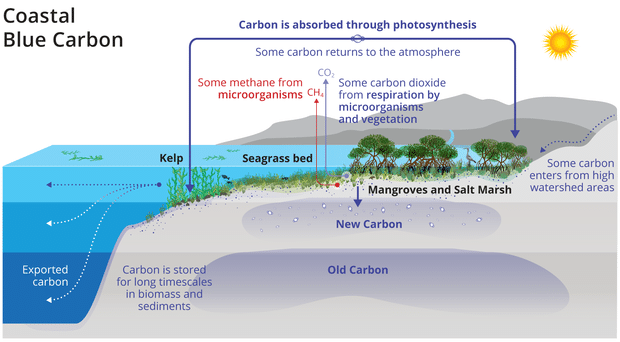
Blue carbon has great potential for capturing CO₂ from the atmosphere, and this has not gone unnoticed. The coastal carbon deposits can be seen as an important, large ecosystem service. But because it often does not formally have economic value, it is vulnerable to neglect, over-exploitation, and even meaningless destruction. This realisation triggered organisations depending on these ecosystem services to look for ways in which a price could be put on services such as carbon storage.
Organisations that, for example, after reducing their CO₂ emissions still have a rest emission may be interested in paying for these services to compensate some of their own CO₂ emissions. By paying for the protection of these natural repositories of carbon in the form of blue carbon credits, they help ensure that the mangroves are not destroyed. More than that, they can contribute to local communities having their rights to the use of products from the mangroves formalised and that their traditional use of these ecosystems is respected, expanded, and even paid for. If well organised, this approach can lay the foundation for restoration.
This is what Eco-Benin, IUCN NL’s partner in Benin, has introduced with its blue carbon project as part of the over-arching programme aimed at supporting the restoration and protection of mangrove forests in the African country. This locally-led organisation can then sell carbon credits for every ton of CO₂ that this mangrove project captures and stores in the stems and in the soil. Such credits, like other credits generated through the restoration and protection of water- and coastal ecosystems, are called blue carbon credits. The term carbon credits is used for carbon that is sequestrated through projects that restore and protect terrestrial natural ecosystems such as forests, soils, and grasslands.
For IUCN NL, using carbon credits is one of many innovative ways to combine climate action with biodiversity protection, community appraisal, and coastal ecosystem conservation. In the past years, we have worked with Eco-Benin on its blue carbon project for mangrove restoration in the Bouche du Roy Reserve, part of the Mono Biosphere Reserve. A 2023 feasibility study of the Bouche du Roy Reserve projected that the reserve has the potential to certify approximately 402,841 tonnes of CO₂-equivalent over the next 30 years.
In an EU-funded project, IUCN NL continues its collaboration with Eco-Benin and the West and Central Africa office of IUCN (IUCN PACO). The project area is important for both local people and nature. The Mono Biosphere Reserve has impressive and diverse ecosystems, with fertile deltas, rich fishing grounds, mangrove forests, and bird diversity. The reserve is especially important for local wintering waders and other water birds, many of which yearly migrate to Europe in summer for breeding and fostering their young.
Jan Willem den Besten, senior expert conservation finance at IUCN NL, shares the following about his work on the blue carbon project: ‘By protecting and restoring these coastal ecosystem, IUCN NL not only helps mitigating climate change but also contributes to the resilience of local communities and the preservation of vital habitats.’ To ensure that these projects have a positive impact, strict rules apply. ‘We follow strict rules, regulations and commitments to develop projects that involve local communities, with special attention for rights. They should adhere to the obligation to allow the communities to consider giving or withholding their consent in full freedom and based on un-biased information.’
When working on blue carbon projects and other nature-based solutions , we apply the IUCN standard for Nature-based Solutions and we encourage all projects to do so. The Science Based Targets initiative (SBTi) has set out criteria for companies and organisations that want to incorporate Nature-based solutions for climate change mitigation. These criteria specify that CO₂ compensation is only accepted if a company or organisation 1) shows that they are not a means to avoid emissions; 2) reduces their emissions and; 3) only compensates a rest-emission that is unavoidable. [6]UNEP and IUCN (2021). Nature-based solutions for climate change mitigation.
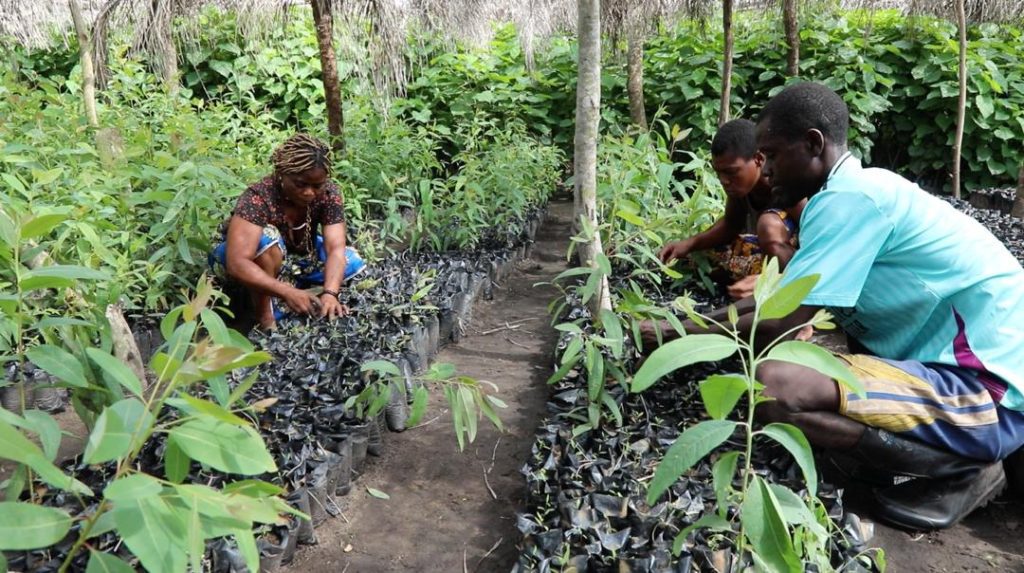
In the Mono Biosphere Reserve in Benin, IUCN NL works together with local organisation Eco-Benin and IUCN PACO to engage communities, businesses, government agencies, and other actors in on long-term sustainable management and financing of the reserve and the surrounding marine protected area, including a blue carbon project component. Other activities include developing business cases for projects, supporting companies in implementing a Social and Environmental Responsibility (CSR) Charter, and raising the profile of the reserve and marine protected area.



| ↑1 | UNEP. (2023). Decades of mangrove forest change: what does it mean for nature, people and the climate? |
|---|---|
| ↑2 | UNEP. (2023). An inside look at the beauty and benefits of mangroves |
| ↑3, ↑5 | NOAA Climate.gov. (2022). Understanding blue carbon. |
| ↑4 | IUCN. (2009). The Management of Natural Coastal Carbon Sinks. |
| ↑6 | UNEP and IUCN (2021). Nature-based solutions for climate change mitigation. |
20 March, 2026
The undersigned organisations call on the Dutch government to supplement its policies and legislation with investments in inclusive, locally led…
12 March, 2026
Amelaïd Houmadi grew up on an island in the Comoros. At his parental house, nestled at the foot of a…