Meet the conservationist: Dr. Amelaid follows in the…
12 March, 2026
Meet the conservationist: Dr. Amelaid follows in the…
12 March, 2026
8 million euros for biodiversity in Europe’s overseas…
11 March, 2026
Monday 06 january 2025
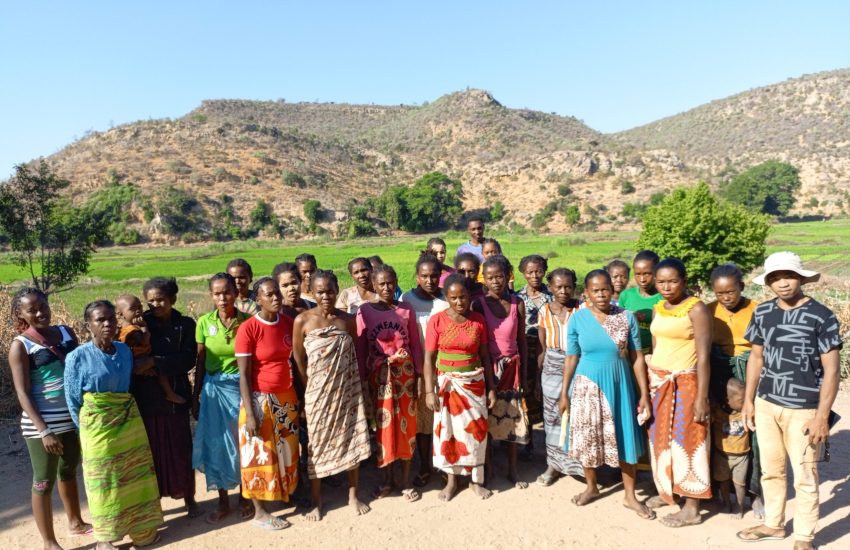
Header photo: group photo GEC Maroamalona Ⓒ Henintsoa, Money for Madagascar
Between July 2023 and December 2024, Money for Madagascar delivered an ambitious and impactful project aimed at strengthening both community livelihoods and biodiversity conservation in Madagascar. Funded by CEPF, the initiative focused on building local capacity to manage natural resources across three key biodiversity areas: Amoron’i Onilahy,Lake Ihotry-Mangoky Delta Complex, and Tsinjoarivo.
At the heart of the project was a commitment to local empowerment. Seventy-five young people, 59% of them young women, were trained to become development agents within their own communities. These youth, drawn from remote areas with limited access to further education, gained the skills to provide guidance on agroecological farming practices and climate resilience. Their work reached more than 2,500 farmers, contributing to both improved livelihoods and stronger environmental stewardship.
The project also focused on organizational development within 19 community-based organizations (VOIs). Each VOI was restructured into smaller, participatory units – known as village savings and loan associations (VSLAs) – which improved internal governance, encouraged member engagement, and ensured transparent financial management. The result was a 40% increase in VOI revenue, enabling activities such as regular forest patrols and reforestation efforts that had previously been sporadic or impossible.
“When youth are empowered, they become powerful allies for conservation”
This involvement of younger generations is crucial in achieving long-term conservation goals. Other CEPF grantees have also shown the power of youth engagement. In 2024, the Madagascar Flora and Fauna Group organized a football tournament where teams were conditioned to planting trees to participate – resulting in 11,553 trees planted by 277 young people. Similarly, The Aspinall Foundation created a football team for marginalized young men, who later led a reforestation initiative after feeling more valued and included. These creative, community-based approaches show that when youth are empowered, they become powerful allies for conservation.
The Critical Ecosystem Partnership Fund (CEPF) is a joint initiative of l’Agence Française de Développement (AFD), Conservation International, the European Union (EU), Fondation Hans Wilsdorf, the Global Environment Facility, the Government of Canada, the Government of Japan, and the World Bank. Its fundamental objective is to ensure that civil society is engaged in biodiversity conservation.
Thanks to funding from the Green Climate Fund (GCF) through AFD as an accredited entity for the GCF, and from the EU through AFD as a fiduciary agent, CEPF has established and manages a 10-year program of US$50 million to support civil society organizations in promoting ecosystem-based adaptation in Madagascar and the Indian Ocean Islands Biodiversity Hotspot. Under the auspices of the Ministries of Environment in the Comoros, Environment and Sustainable Development in Madagascar, Finance, Economic Planning and Development in Mauritius, and Agriculture, Climate Change and Environment in the Seychelles, the program’s activities are being implemented in the Comoros, Madagascar, Mauritius, and the Seychelles. Madagascar receives additional support from the Franklinia Foundation for the conservation of Madagascar’s endangered trees.
CEPF has enlisted a consortium of nongovernmental organizations to be its regional implementation team (RIT) in the hotspot. Coordinated by IUCN NL, the RIT includes SAF/FJKM for Madagascar, ID-ONG for Comoros, FORENA for Mauritius and SeyCCAT for Seychelles. These organizations are working with CEPF to implement a five-year conservation strategy for the hotspot and build local civil society capacity.
12 March, 2026
Amelaïd Houmadi grew up on an island in the Comoros. At his parental house, nestled at the foot of a…
11 March, 2026
The second call for proposals from BESTLIFE2030 has mobilised more than 8 million euros for 81 new projects. IUCN NL…
