Investing in the next generation of conservationists
24 September, 2026
Investing in the next generation of conservationists
24 September, 2026
Growing corals is only half the work
23 September, 2026
Friday 13 june 2025
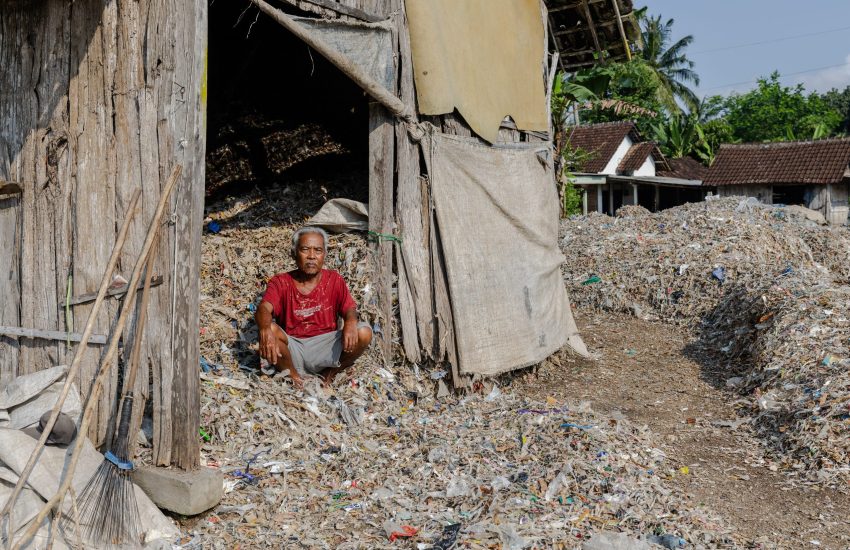
Header photo: Sapi’i, 63, poses for a photo in his hut filled with imported plastic waste in Sumberejo village, Malang Regency, East Java, Indonesia, May 30, 2025. © Garry Lotulung
IUCN has raised the alarm regarding the world’ plastic pollution[2]https://iucn.org/sites/default/files/2024-05/plastic-pollution-issues-brief-may-2024-update.pdf : ‘Discarded improperly, plastic waste pollutes and harms the environment, becoming a widespread driver of biodiversity loss and ecosystem degradation. It threatens human health, affects food and water safety, burdens economic activities, and contributes to climate change. That impact is disproportionately felt by islands, developing countries, Indigenous peoples, local communities, women, and children. This problem is deepened by the global trade of plastic products and waste to locations where infrastructure is not sufficient for safe and environmentally sound management.’
Abdul Ghofar, manager of the National WALHI Pollution and Urban Campaign, states that Indonesia is currently in a waste emergency, aggravated by the import of waste and by the industry producing fast moving consumer goods (FMCG) at relatively low prices[3]https://mongabay.co.id/2025/04/19/sasaran-limbah-impor-indonesia-tong-sampah-dunia/ .
Indonesia produces approximately 7.8 million tons of plastic waste per year[4]World Bank 2021. Plastic Waste Discharges from Rivers and Coastlines in Indonesia. Marine Plastics Series, East Asia and Pacific Region. Washington DC. … Continue reading. The World Bank estimates that 63% (4.9 million tons) of this plastic waste can be categorised as Mismanaged Plastic Waste (MPW). The bulk (92%) of MPW is due to uncollected waste (4.5 million tons/year). The remaining 8% is disposed of in open dumpsites and a relatively small fraction is leaking from improperly controlled landfills. MSW is expected to account for most of the plastic waste inputs into the sea.
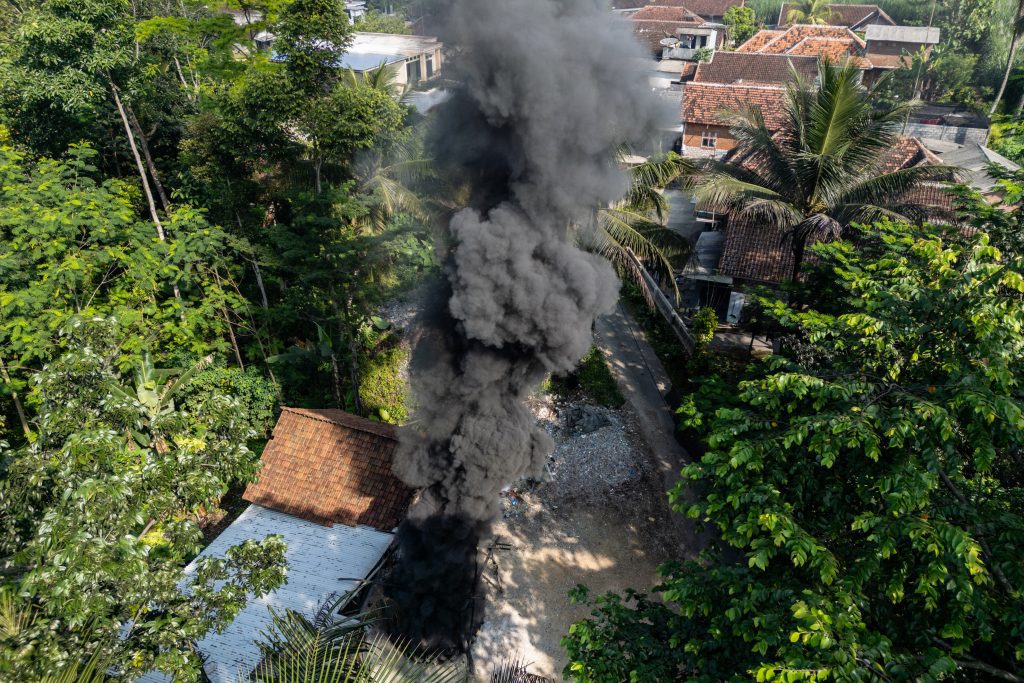
The bulk of uncollected plastic in Indonesia is burned or buried. It is estimated that more than 80% of the uncollected plastic waste is burned, although this practice is strictly prohibited by law. The rest is discarded directly into waterways resulting in canals and rivers being clogged with dense masses of bottles, bags and other plastic packaging. In Indonesia, plastic is omnipresent. An explosive spread of plastic containers and wrapping have replaced natural biodegradable packaging such as banana leaves. The widespread use of plastic bags and disposable bottles, coupled with a lack of awareness about the environmental harm caused by plastic waste, is likely contributing[5]https://www.fairplanet.org/story/indonesia-plastic-crisis-river-jakarta/ to the plastic problem. The plastic waste dumped in the waterways flows into the rivers and finally the sea. Up to 1.29 million metric tons of Indonesian plastic waste ends up in the ocean each year[6]https://www.science.org/doi/10.1126/sciadv.aaz5803; it is the world’s fifth-largest contributor to plastic waste in the ocean, and accounts for a tenth of global marine plastic waste.
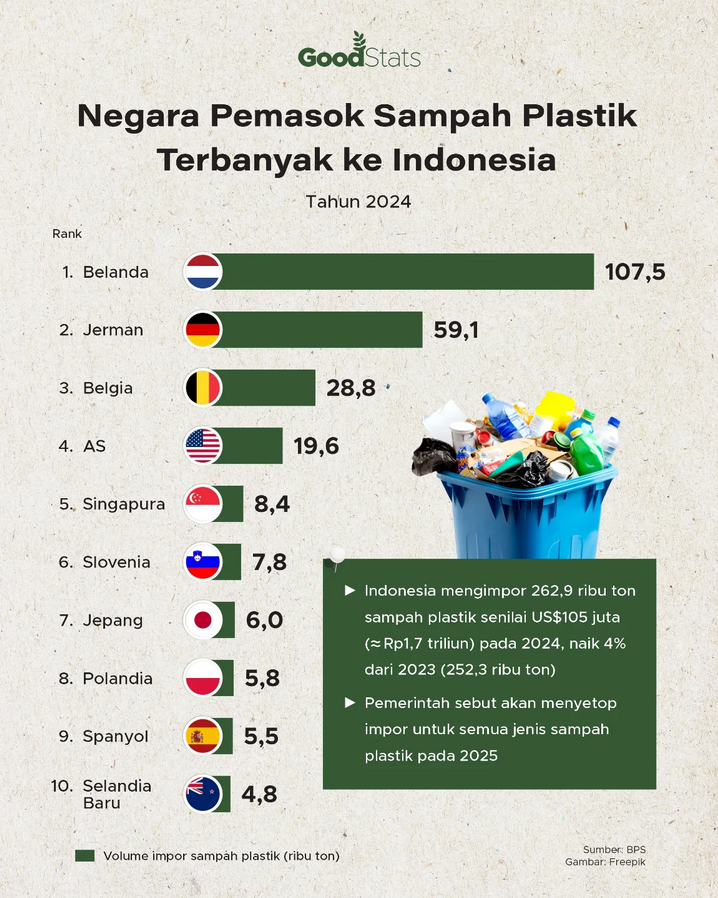
Countries that export the most plastic waste to Indonesia, with the Netherlands, Germany and Belgium leading, followed by the US, Australia, other EU countries and Asian high-income countries. © BPS
Ever-growing waste production in Europe and North America, coupled with very limited waste-disposal capacity, has made the export of waste a necessity. After China banned plastic waste imports in 2018, Indonesia saw a surge in incoming waste exported by the European Union, North America, Australia and Asian high-income countries. Indonesia’s Central Statistics Agency (BPS) reports that in 2024, the country imported a total of 262.9 thousand tons of plastic waste, valued at approximately US$105 million. Local waste suppliers are claiming they cannot meet industrial demands and that the imported waste is needed to serve as raw material for the recycling industry. Behind these economic justifications lies a deeper concern. Prigi Arisansi, Founder of Ecological Observation and Wetland Conservation (ECOTON), suspects that countries of the Global North throw garbage into countries of the Global South as a shortcut: ‘The cost of managing waste is more expensive, so it is easier to just throw it away to other countries.'[7]https://mongabay.co.id/2025/04/19/sasaran-limbah-impor-indonesia-tong-sampah-dunia/ This great power imbalance can be labelled as ‘waste colonialism'[8]https://globalinitiative.net/wp-content/uploads/2021/10/GITOC-Plastic-for-Profit.pdf .
Although Environment Minister Hanif Faisol stated that Indonesia will officially stop importing plastic waste, the industry can still import waste, including plastics, because the policy related to this import is regulated by the Ministry of Industry and the Ministry of Trade, and cannot be solely decided unilaterally by the Ministry of Environment[9]https://goodstats.id/article/indonesia-terima-kiriman-sampah-dari-eropa-ada-plastik-hingga-kertas-Tpiyv.
Mounds of plastic waste are clearly visible in the middle of residential areas in Gedangrowo Village, Sidoarjo Regency in East Java[10]The paragraphs on villages in East Java are based on an article by Primagung Dary Riliananda. Gedangrowo is among several villages in East Java that have become dumping grounds for imported waste, funnelled through local paper factories. The waste is delivered by trucks to residents’ homes. It includes a mix of paper pulp, plastic food and beverage packaging, and even electronic waste.
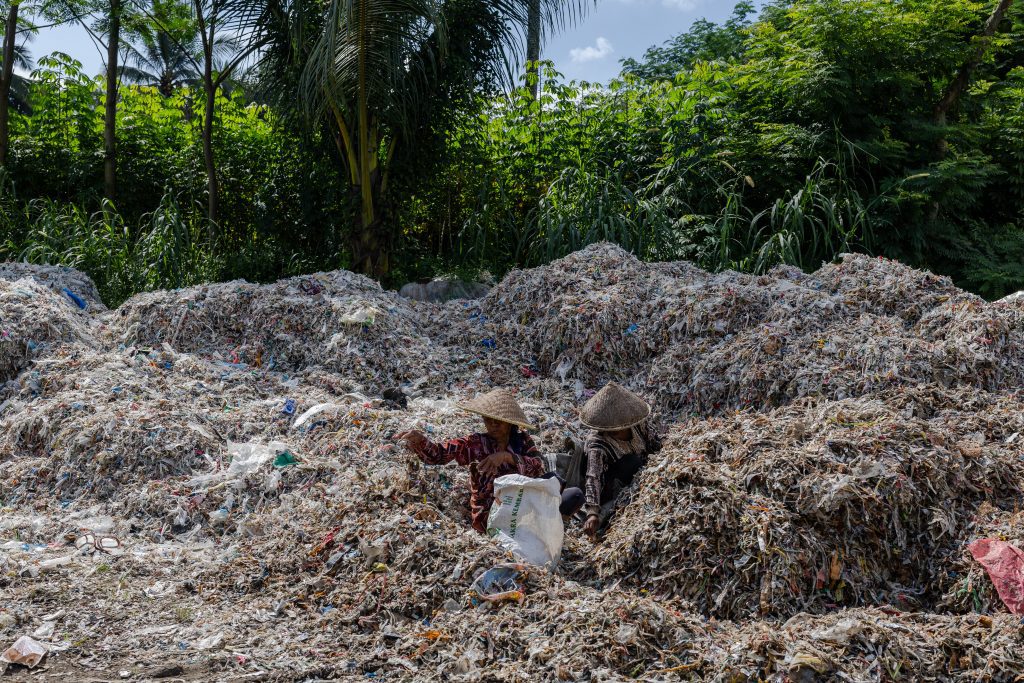
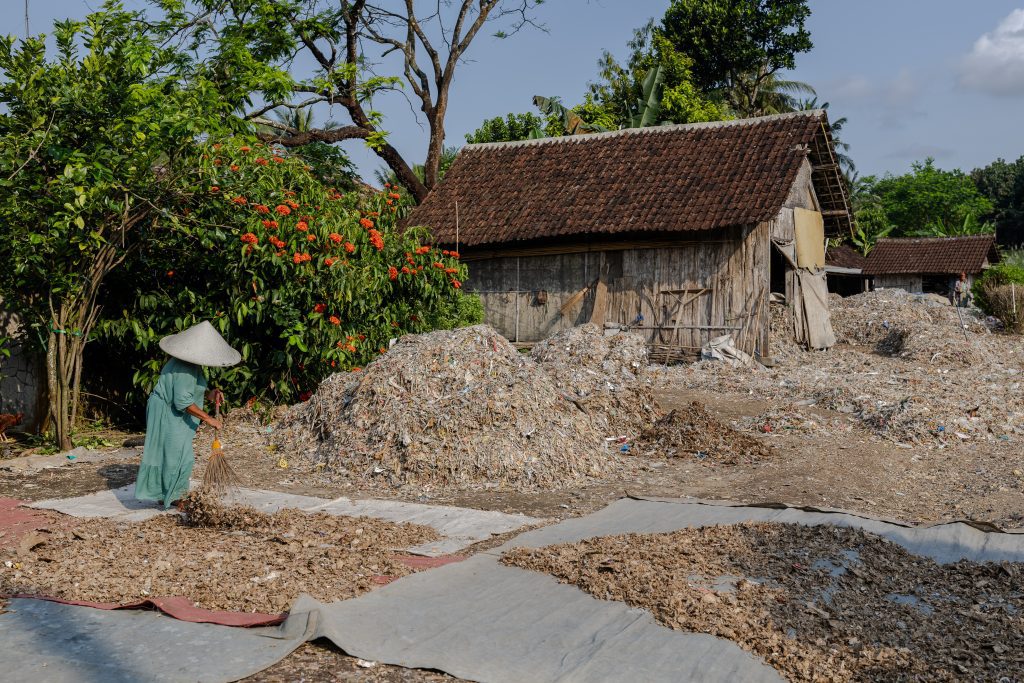
In Bangun Village in Mojokerto Regency some villagers are seen dumping unsorted garbage next to their homes, while others leave it to dry by the roadside. The residents seem accustomed to this garbage, routinely collecting, sorting, and stuffing recyclable items into sacks. Three hundred meters from the heaps of sorted garbage, a tall wall separates them from a massive factory, the large national paper mill of PT Pakerin.
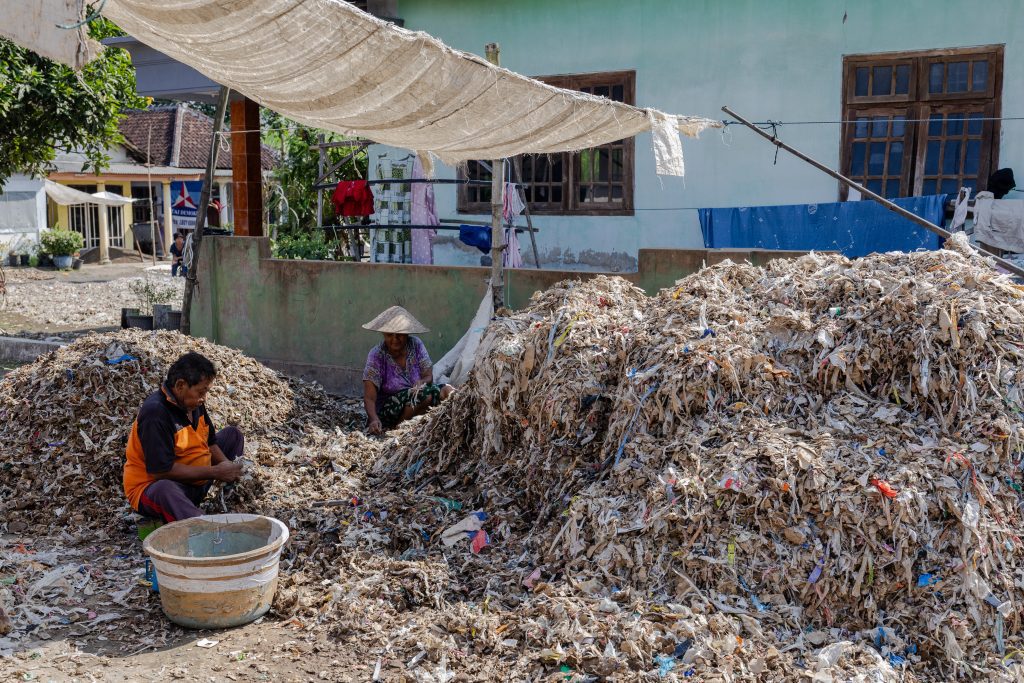
Similar scenes can be found in Sumberrejo Village, Malang Regency. Here, the villagers do not use the streets in front of their homes to sun-dry for drying the waste but their yards. Sapi’i and Siyah are working along the village road that is nearly buried in garbage. Since returning from Jakarta in 1992, Sapi’i has relied on these garbage piles for a living. The waste, purchased from PT Ekamas Fortuna – a nearby paper factory – is sorted by material: paper and plastic. ‘Each truck usually requires a delivery fee of Rp150,000,’ says Sapi’i as he continues sorting. It takes Sapi’i and Siyah over a month to process a single batch. If the weather is clear, drying is faster. The sorted paper waste is sold back to the factory. The dried plastic is sold to other middlemen for Rp250,000 per truckload. ‘Lately the income has been uncertain because of the frequent rain, sometimes we only manage three kilograms a day,’ Sapi’i adds.
Many local residents are unaware that the waste they sort and handle may be contaminated with hazardous substances, either during shipment or at the factory, posing long-term health risks. ‘Most of them sort through the trash without any personal protective equipment,’ says Aeshnina Azzahra Aqilani, a teenage environmental activist. Known as Nina, she has expressed concern about the residents’ deteriorating health conditions if they continue to ignore safety precautions. Still, Nina refrains from fully blaming the community. ‘They’re just trying to make a living from the waste around them. Yes, they earn money, but they’re also sacrificing their health,’ she says.
Plastic waste, ranging from microplastics to large debris, are a severe threat to our ecosystems. From entanglement and ingestion by water species to the disruption of food chains, plastic pollution wreaks havoc on life. The situation is further exacerbated by the persistence of plastics, which can take hundreds of years to degrade, exacerbating the long-term environmental impact. Plastic waste will gradually fragment into particles called microplastics (<5 mm) which will pollute river and marine ecosystems. The presence of microplastics in aquatic ecosystems with their small size can be easily consumed by water organisms and eventually end up in the bodies of animals (including humans) higher in the food-chain.
A 2023 field study by ECOTON[11]IUCN NL and ECOTON have collaborated on, among others, a River Biodiversity Survey found alarming evidence of contamination in the rivers. Researchers collected a 250-milliliter water sample from the Porong River, a Brantas tributary, and discovered approximately 1,449 microplastic particles, 15 times higher than normal concentrations found in other rivers. ’These particles vary in size, with some as small as plankton,’ said ECOTON researcher Rafika Aprilianti. ’That’s what makes them so dangerous, they can be easily ingested by river fish’. According to Aprilianti, toxic compounds found in plastic have the potential to disrupt the endocrine system in organisms, both humans and animals. This can result in disruptions in normal hormonal function, reproductive development, as well as an increased risk of developing serious diseases such as cancer, heart disease, diabetes, obesity and other health conditions[12]https://ecoton.or.id/sampahmu-menenggelamkan-kami-sampah-impor-australia-dan-jepang-memperburuk-lingkungan-jawa-timur/ .
ECOTON’s environmental expedition findings in various regions of East Java revealed that microplastics are now found in drinking water, river fish, and sediment deposits. ‘These findings serve as a reminder that the microplastic issue has reached an environmental emergency,’ says Arisandi[13]https://en.tempo.co/read/2023527/ecoton-research-finds-microplastics-in-drinking-water-and-river-fish-in-east-java . Dewi Gunawati, environmental law lecturer at Sebelas Maret University (UNS), emphasized the importance of legal awareness in society. She stated that the management of plastic waste must be accompanied by law enforcement and community-based advocacy. In addition, the right to a healthy environment is part of the constitutional rights of citizens. ’The aspects of law enforcement and community-based advocacy remain weak points in efforts to reduce plastic waste in Indonesia.'[14]Ibid


24 September, 2026
Madagascar and the Indian ocean islands are a biodiversity hotspot - a group of islands with incredible species diversity and…

23 September, 2026
With new support from BESTLIFE2030, marine biologist Kelly Latijnhouwers and her foundation REACT are realizing an idea on Curaçao: the…