Strengthening civil society for climate action in the Comoros
05 August, 2026
Strengthening civil society for climate action in the Comoros
05 August, 2026
Meet the conservationist: Anne-Isabelle Bonifassi
23 July, 2026
Thursday 06 november 2025
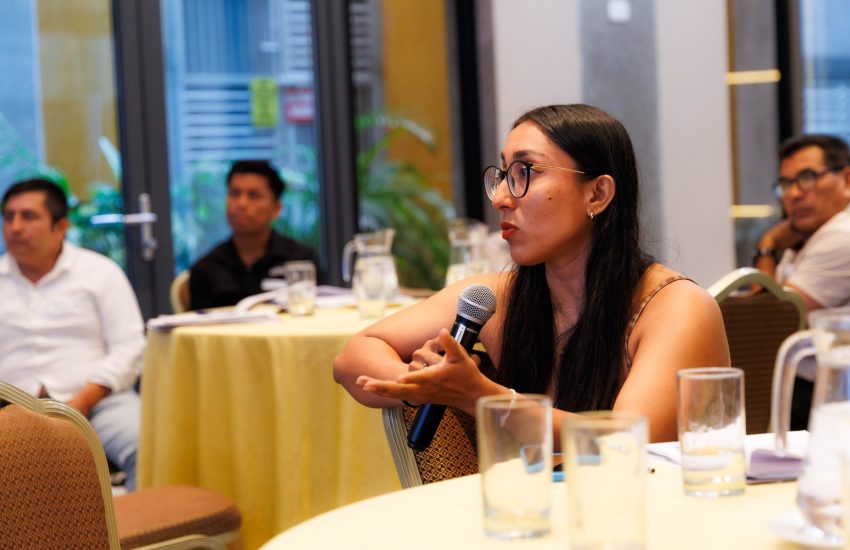
Header photo: Participant in the course © SPDA
Peru is among the ninth most dangerous countries in the world for those who defend the environment and human rights; 62 environmental defenders have been killed in Peru in the past twelve years. At the same time, the country’s civic space is shrinking, and repressive measures are increasing in number[1]https://www.icnl.org/resources/civic-freedom-monitor/peru[2]https://monitor.civicus.org/country/peru/.
In this context, strengthening the protection of environmental defenders is more urgent than ever. The course aims to reduce the risks faced by environmental defenders by emphasising the value of their work and promoting legal protection and practical tools.
In Loreto, around 50 Indigenous leaders, park rangers, and specialists from the public and private sectors participated in the second edition of the course “Environmental Defenders: Rights and Mechanisms for Their Protection.” Developed in participatory consultation with environmental defenders, Amazonian organisations, and specialist institutions, the course ensures content is relevant in the territory and for its people, and applicable in real-life risk situations.
The program integrates theory and practice, strengthening participants’ capacity to proactively engage in policymaking and protection processes while equipping them to report abuses and activate protection mechanisms when needed.
Over two immersive days, participants were divided into two groups: one comprising environmental defenders from the Indigenous and local communities of Loreto, and another consisting of professionals from organisations working to protect environmental defenders. For this edition, the professional group was selected from more than 100 applications based on their experience. All participants who successfully completed the four-module course, taught by SPDA specialists and professors from the Institute of Democracy and Human Rights of the Pontifical Catholic University of Peru, received a certificate recognising their training.
During the course, they shared experiences and strengthened their knowledge on how to protect forests, their communities, and the rights of those who defend them. ‘For me, this has been a wonderful experience filled with valuable lessons. I’m deeply grateful because I didn’t know my rights before,’ said a young environmental defender. ‘We have the right to life and health, rights that are constantly under attack. Now we are learning how to defend them,’ said a women environmental defender in Loreto.
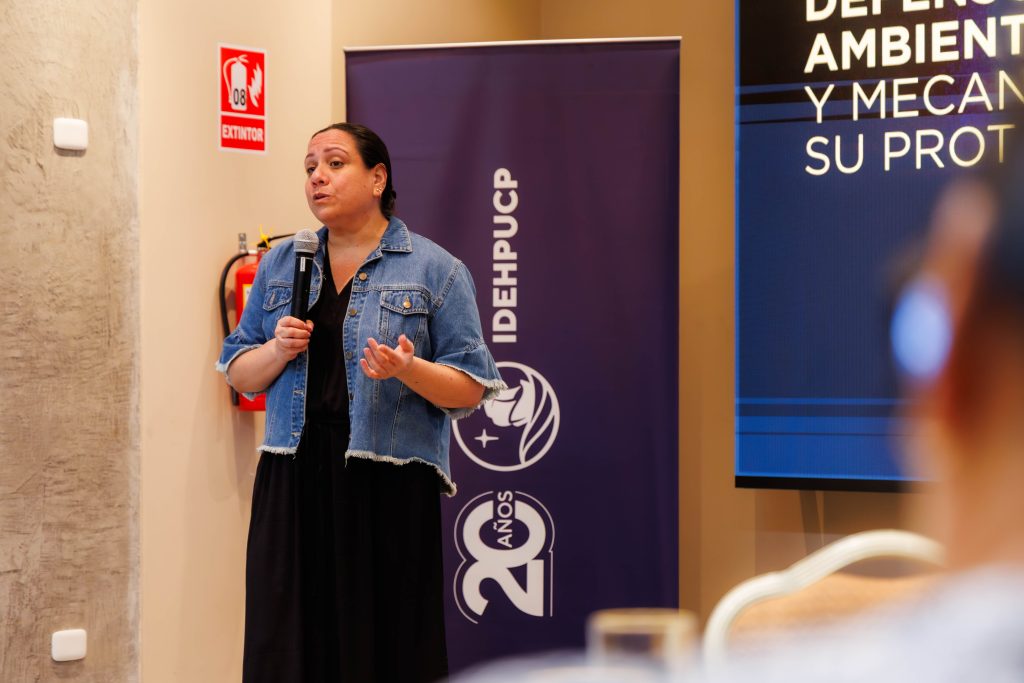
Participants in the course in Loreto. © SPDA
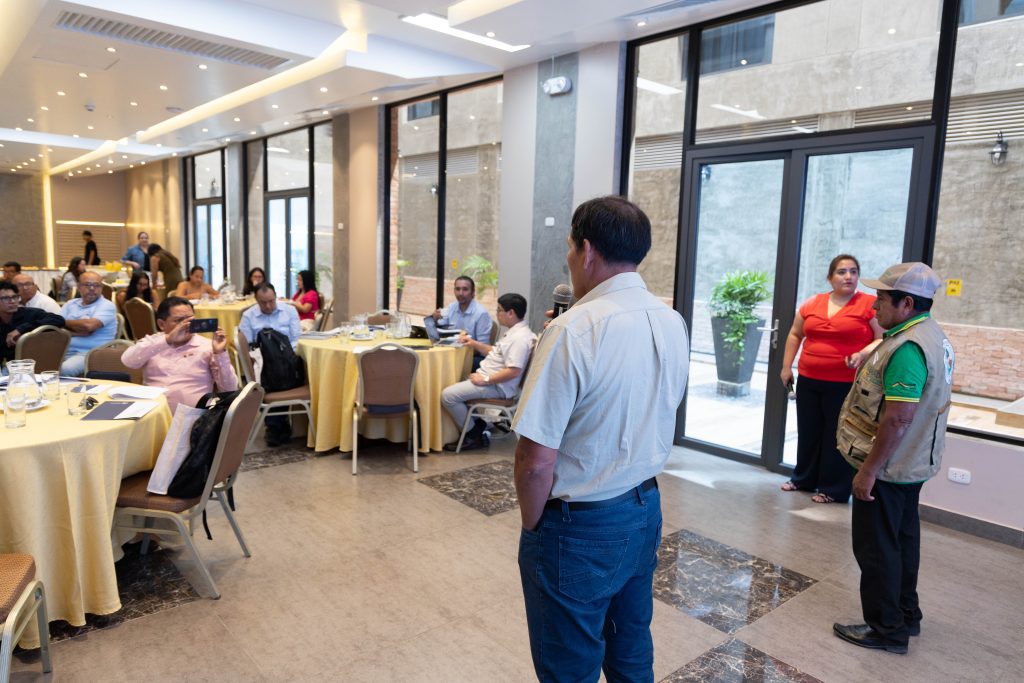
In addition, the group of professionals was able to share and learn first-hand about the experiences of environmental defenders from other regions of the country that are highly threatened by illegal mining. ‘The Amazon is going through a critical situation, and environmental defenders are mainly being threatened for protecting their territory,’ said a government official. ‘I believe this course helps us monitor the environmental situation in Loreto more effectively. The issue of environmental defenders is central to our governance commitments,’ said another government official.
The first edition of the course ‘Environmental defenders: rights and mechanisms for their protection’ was held in May this year in Madre de Dios. Having now proven effective in Madre de Dios and Loreto, the course holds strong potential for replication in other Peruvian regions and elsewhere.
‘We must continue to strengthen the capacities of defenders and those who have a duty to protect them,’ said the director of SPDA’s Biodiversity and Indigenous Peoples Programme. This course will be replicated in the Ucayali and Lima regions in the coming months.
Environmental defenders take many risks protecting nature and the communities that depend on it. Globally, every week people get killed because they stand up for their natural environments and human rights. Women, Indigenous and peasant communities, as well as other marginalised groups are often at the forefront of defending environmental human rights, while at the same time being more at risk. With the support of the French Development Agency, Sociedad Peruana de Derecho Ambiental and IUCN NL strengthen the work of environmental defenders in Madre de Dios in Peru, applying a gender and intercultural approach.


05 August, 2026
Photo header: Participants during a training session © DAYIMA Madagascar and the Indian ocean islands are a biodiversity hotspot -…
23 July, 2026
Growing up surrounded by animals, Anne-Isabelle Bonifassi always dreamed of a career in conservation. Today, as Executive Director of Haiti…
