Keeping Indigenous knowledge alive in Palawan
01 October, 2026
Keeping Indigenous knowledge alive in Palawan
01 October, 2026
Three years of impact in Bottom Line!: putting…
29 September, 2026
Friday 01 may 2026
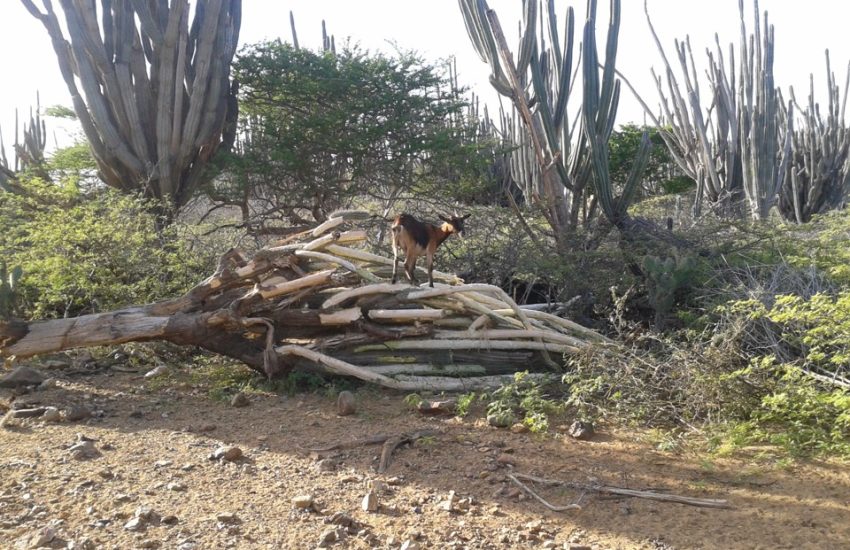
Header photo: One goat of many © STINAPA (2026)
When Caren Eckrich, Ecology Advisor and team member at Stichting Nationale Parken Bonaire (STINAPA), gets disheartened by the sheer scale of the work ahead, her colleague Paulo Bertuol, Ecology Advisor and project lead, sends her something to hold onto: photos and videos of baby trees, hundreds of them, sprouting up across the forest floor. ‘We did this,’ he tells her. And they did.
STINAPA recently received a new grant through the BESTLIFE2030 programme, the EU-funded biodiversity initiative coordinated by IUCN Europe, with IUCN NL serving as the regional focal point for the Dutch Caribbean. For Caren and her small but tireless team, the timing is critical. The grant will directly support Proyekto Parke Bunita or “Pretty Park Project” in Papiamentu.
The project entails STINAPA’s multi-year effort to remove invasive feral grazers from the Washington Slagbaai Park, the vast protected wilderness that covers roughly 17% of the island of Bonaire. After a difficult stretch of reduced national government funding, the BESTLIFE2030 support gives the project the capacity it needs to keep moving forward.
In 1969, Washington became the first nature sanctuary in the Netherlands Antilles. Slagbaai was added in 1979 to create the 4,286-hectare protected area in the northwest of Bonaire, as it exists today. It is home to flamingos, sea turtles, the endangered Yellow-shouldered Amazon parrot, as well as a remarkable dry tropical forest. But for most of its existence as a park, this forest has been under quiet, relentless assault from animals that arrived with European colonisers four centuries ago.
‘When the Europeans came, they brought goats and pigs,’ Caren explains. ‘They released them because they wanted a food source when they kept coming back to the islands.’ Bonaire was known as the farm island. Goats were raised as livestock and to sustain plantation economies. The park itself was once two working plantations; Washington and Slagbaai (formerly known as “America”), where goat herding was central to daily life. When those plantations ended and the land became protected territory, the goats remained – and went feral.
Currently, population studies estimated a goat density of 2.7 goats per hectare in the national park, corresponding to an abundance of around 11,000 animals. The ecological consequences have been severe.
Overgrazing by feral goats causes a shift from diverse vegetation, including native trees, shrubs, orchids, and bromeliads – to a much less diverse landscape dominated by cactus and acacia thorn scrub. Overgrazing increases erosion and runoff, which delivers greater amounts of sediments and nutrients to the marine park, contributing to reduced water quality and threatening the health of the coral reefs.
‘We’re living in like an ancient forest,’ Caren says. ‘The large trees are there, but they’re not being regenerated. The goats eat all the baby trees. They eat the grasses, so you get massive erosion during heavy rainfall, and that brings sediment and nutrients onto the reef. And reefs don’t like sediments and nutrients.’ The damage is not just terrestrial. Every rainstorm that strips the denuded hillsides of Bonaire’s interior washes directly into one of the most celebrated coral reef systems in the Caribbean.
For decades, awareness of the problem grew slowly. ‘It follows a classic case of shifting baselines, where each generation accepts a degraded landscape as the norm. I think unless you’re really monitoring it, you don’t realise,’ Caren continues. It was only when fenced exclosure areas showed dramatic vegetation recovery, that the scale of what had been lost and what could be regained came into view. Policy followed: the Nature and Environment Policy Plan and the Coral Action Plan, developed around 2020, identified invasive grazer removal as a national priority, creating both the obligation and the mandate to act.
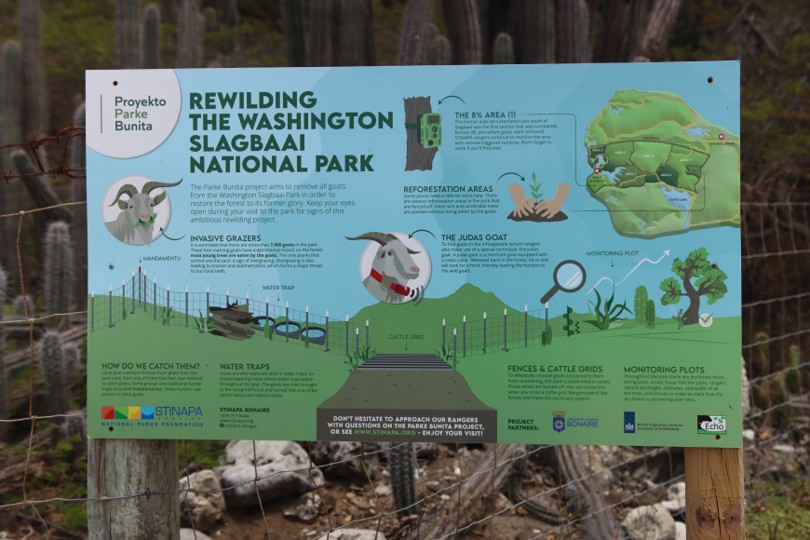
Rewilding The Washington Slagbaai National Park sign © STINAPA (2026)
‘People had to struggle so hard for food, and goats have always been their go-to in times of hardship.’
- Caren Eckrich, The Washington Slagbaai National Park, Bonaire
STINAPA’s approach under Proyekto Parke Bunita is methodical and built on hard-won experience. There is immense respect for the animals, so culling goats is seen as an absolute last resort. For years, conventional live-capture methods such as funnel fences and rounding teams produced limited results, though. The park is simply too vast, the terrain too brutal, and the goats too reproductive. ‘One female can have two kids, and then six to eight months later have another two kids,’ Caren notes. ‘We were just unsuccessful.’
The breakthrough came when the team shifted to a zoned removal model: dividing the park into isolated, fenced areas and working through them one by one. This approach, combined with a pragmatic mix of methods – volunteer catch-and-removal teams, conservation hunting for the most inaccessible animals, GPS-collared “Judas goats” to locate the final stragglers, and motion-sensitive camera traps – has finally tilted the odds in STINAPA’s favour.
The cultural dimension of the approach is equally deliberate. Goat meat is not just food on Bonaire; it is a symbol of resilience and community identity. ‘People had to struggle so hard for food, and goats have always been their go-to in times of hardship,’ Caren explains. Depending solely on wholesale aerial culling, as practised in places like the Galápagos, was never an option here. Instead, STINAPA organises volunteer teams from the community who are permitted to enter the park and take live goats for personal use or sale. Animals caught by the STINAPA team are donated to local foundations, churches, and community organisations. ‘We’ve been walking a delicate line,’ Caren says, ‘and doing probably much better than any other island removal I’ve ever read about, in terms of respect for the animals and the local community.’
The project’s current focus, supported by the BESTLIFE2030 grant, is completing the removal of the remaining goats in Area 4, which is in its final confirmation phase, and dramatically reducing densities in Area 6. Together, Areas 1 through 4 cover roughly half of the Slagbaai portion of the park. Once Area 6 follows, more than half of the entire Slagbaai section will be effectively grazer-free. An extraordinary milestone for a team that at times has just two and a half staff working in the field.
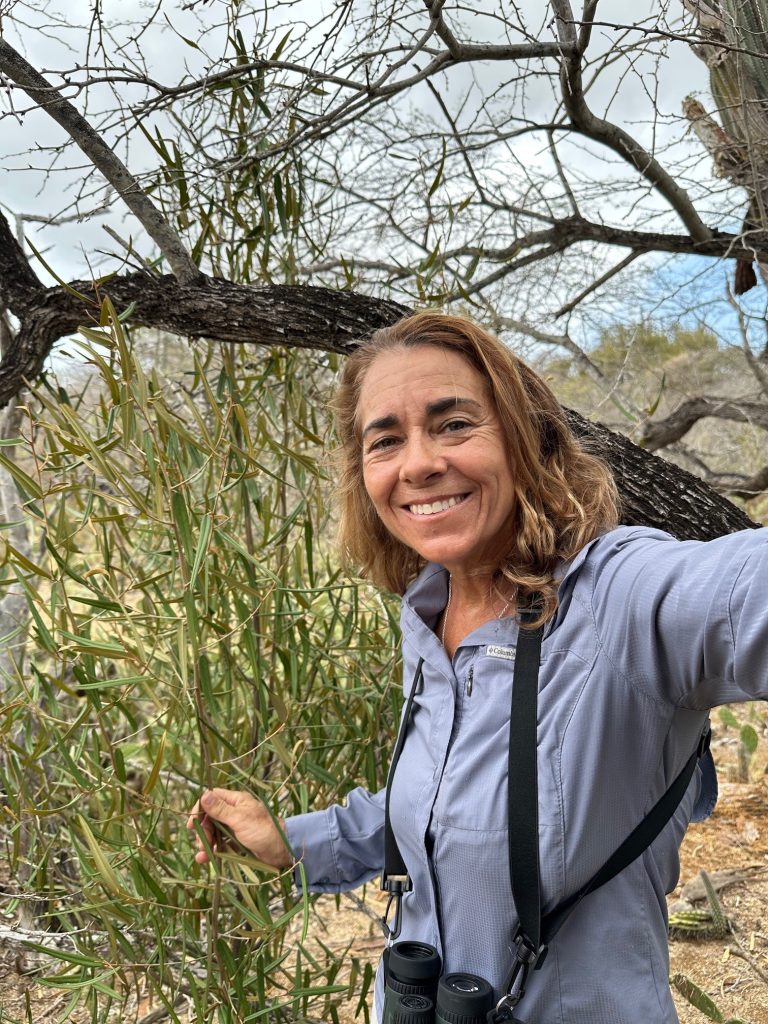
Caren Eckrich © STINAPA (2026)
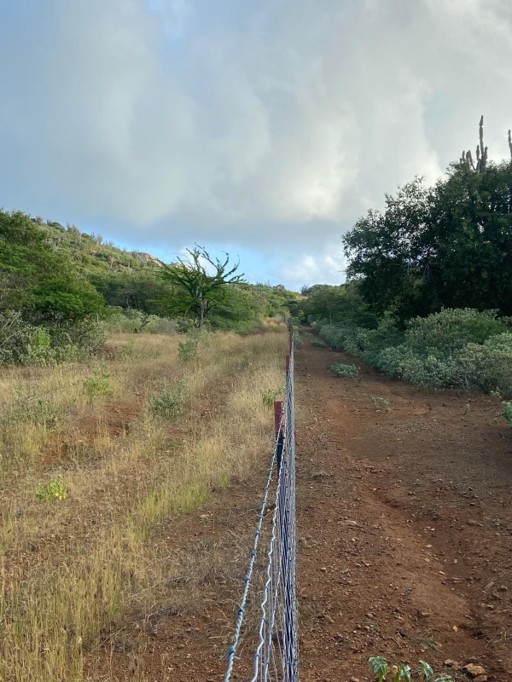
Park fencing for zoned removal model © STINAPA (2026)
Caren is candid about what makes this work so difficult. The park’s landscape – dense cactus scrub, barely traversable without thick protective clothing, a vast interior with few roads or trails – gives the final, most stubborn goats an enormous natural advantage. ‘The really smart goats end up in those crazy areas where you basically can’t go,’ she says. Her colleague Paulo has even developed a trail-density index: a formula for calculating exactly how many metres of roads and paths an area requires before removal can succeed.
Building that infrastructure takes money. So does equipment, weapons permits (difficult to obtain), and the time of a team that is perpetually too small for the task at hand. A promise of multi-phase national government funding did not materialise in full. ‘We got a promise for three phases,’ says Paulo, who joined the interview midway, ‘and at the end we didn’t get the last two.’ STINAPA’s saving grace was a leadership decision in the first phase to build all critical fencing while funding was available. Without those fences already in the ground, the project’s gains could not be protected.
The cultural challenge runs deeper than any fence. Many people from Bonaire still perceive goats as part of the natural landscape rather than as an invasive species. ‘The perception of invasive species is not here yet,’ Paulo explains. ‘People understand it well for lionfish, but for domestic animals like goats, cats, donkeys, it’s a different story.’ Changing that perception, particularly among younger generations, is a long-term effort. STINAPA’s Junior Ranger programme and school excursions to the recovering forest areas are part of that investment. ‘Tomorrow we have a big group of kids going to the park to see the new trail, the seedlings and saplings,’ Caren mentions. ‘We’re trying at all angles; the elderly, the youngsters, the working class.’
There are also structural vulnerabilities: heavy rains can damage fencing, political winds can shift, and funding gaps can pause momentum. The elegance of the isolated-area model is that it offers protection against exactly these risks. ‘Even if we have a project pause or political discussions,‘ Paulo notes, ‘we have those areas done. We can safeguard the work we’ve already done.‘
Stand on either side of the fence dividing a cleared area from the surrounding park and the difference is immediate and visceral. ‘You can see which side probably doesn’t have goats. That’s the side with the grasses,‘ Caren says, recalling a before-and-after photo she showed during the interview. A tree photographed in 2020 and again in 2024 tells the same story: what was just a dead tree standing in barren ground, is now surrounded by hundreds of healthy bright green seedlings and saplings.
Since 2021, STINAPA has been removing more than 1,000 goats per year. A study completed just two months before this interview found three times more seedlings and saplings on the goat-free side of the Slagbaai fence compared with immediately adjacent areas outside. Scientists from the Netherlands visiting to study recovery trends have been ‘astonished at how fast it’s happening,‘ Caren says. Native dry forest trees, dispersed by birds, are regenerating entirely passively, without any replanting effort.
Klein Bonaire, the small uninhabited island just off Bonaire’s coast, offers a glimpse of what the park could eventually look like. The absence of goats for the last forty years has allowed Klein Bonaire’s flora to recover, and the island has become home to a wide variety of local plants and animals, some not even found on Bonaire itself. Curaçao’s Christoffelpark provides another precedent: goats were removed there roughly 25 years ago, and the transformation of the landscape has been, as Caren puts it, ‘unbelievable‘. She is hoping for the same on Bonaire. Given what she is already seeing, that hope seems well-founded.
Poaching inside the park, once a persistent problem, has also declined markedly. A direct result of the community engagement strategy. Giving people a legitimate stake in the process, rather than simply prohibiting access, has built a degree of goodwill that no enforcement programme alone could achieve.
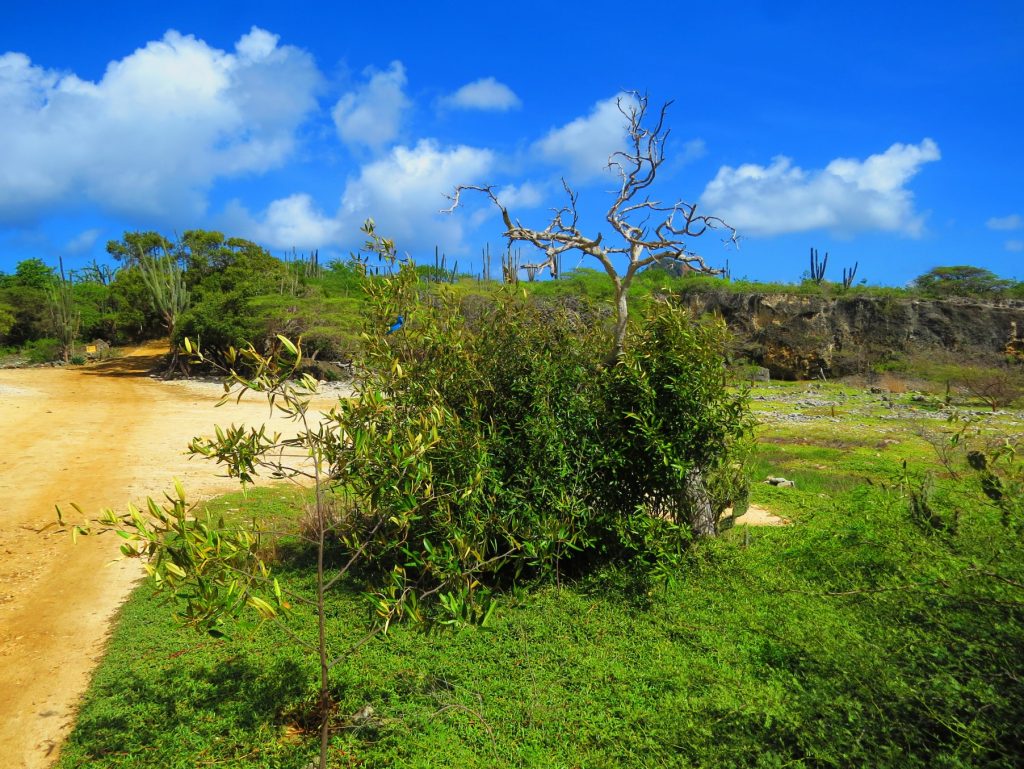
When Caren and Paulo speak about what this project ultimately means, they reach past the data and the fences towards something harder to quantify.
‘Generations of Bonaireans have never seen the tropical dry forest the way it was,‘ Paulo says. ‘We are giving future generations the chance to finally see it. The way it was before the goats arrived four centuries ago, that is.‘ The Caribbean tropical dry forest is among the most threatened ecosystems on the planet. The ambition of Parke Bunita is to restore even a portion of it, from within a living island community, without erasure of cultural history.
The practical targets for the coming years are clear: complete Area 4, push Area 6 to confirmation status, and begin serious work on Areas 5 and 7. When those are done, the Slagbaai half of the park (approximately 1,800 hectares) will be one of the largest grazer-free protected areas in the entire Dutch Kingdom. The second half, the Washington section to the north, represents the next phase.
Longer term, Caren hopes the island moves towards subsidised enclosed goat farming, so that the animals can live without disrupting nature and biodiversity and cultural traditions around the animal can continue in a way that is compatible with a free-roaming landscape. She also points to a related STINAPA project on Klein Bonaire that is exploring ‘limits of acceptable change‘: the science of managing tourism so that the visitors drawn by a recovering, biodiverse park do not inadvertently undo what conservation has built.
The coral reefs that make Bonaire one of the world’s premier dive destinations will benefit too. Every tree that takes root, every hillside that stabilises, is one less pulse of sediment washing into the sea. The land and the ocean here, like everywhere else, are part of the same ecosystem.
‘To know that there are groups, governments, and organisations that support this initiative,‘ Caren reflects, ‘gives us a little bit more meaning and confidence in what we’re doing. To be recognised as doing important work, on this relatively small island, with a just a handful of us… It means a lot.‘
STINAPA’s Proyekto Parke Bunita is supported by BESTLIFE2030, an EU LIFE-funded programme coordinated by IUCN Europe. IUCN NL serves as the regional hub for the Caribbean Netherlands.
The IUCN BESTLIFE2030 programme is co-funded by the European Union. Views and opinions expressed are however those of the author(s) only and do not necessarily reflect those of the European Union or CINEA. Neither the European Union nor the granting authority can be held responsible for them.
Further information about the programme and the projects can be found on the BESTLIFE2030 page.


01 October, 2026
For Indigenous communities in Palawan - known as the last ecological frontier of the Philippines - knowledge about land, forests…
29 September, 2026
The transition to renewable energy is essential, but how we get there matters. As demand for critical minerals such as…