From pledges to locally-led climate action: gender-just Indigenous solutions for forests and climate action

Critical minerals and the western chimpanzee: how bauxite…
24 March, 2026
Tuesday 16 december 2025
Locally-led, gender-just approaches are the most effective path to halt deforestation and advance real climate action, yet Indigenous peoples and local communities, especially women, are often overlooked in decision-making that concerns their land and natural environment. At the Climate Change COP30 in Belem last month, framed as the Forest COP, the Green Livelihoods Alliance (GLA) and the Global Alliance for Green and Gender Action (GAGGA) organised a side event on the topic.
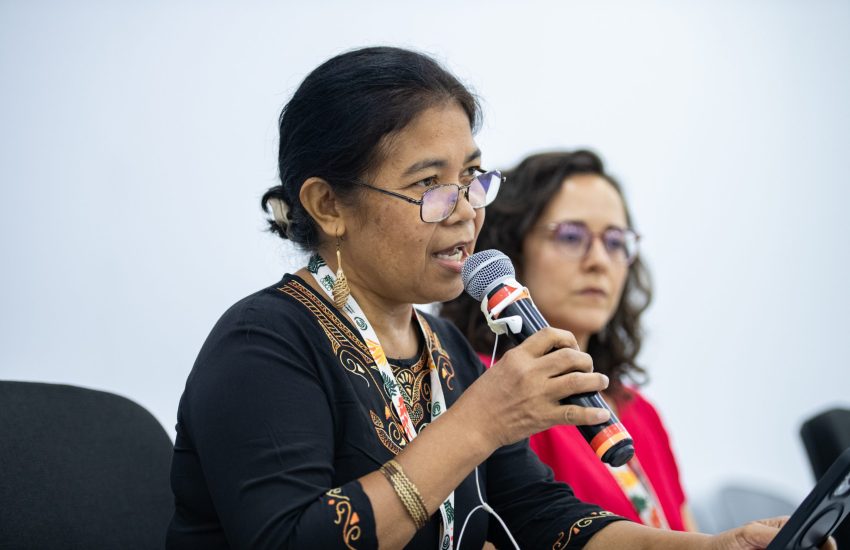
Header photo: (c) GAGGA / GLA
The panel featured high-level representatives from Ireland & the Netherlands, government voices from Suriname and Indigenous & civil society leaders from Central America, Philippines, Thailand & DRC. The event showcased gender-just, Indigenous and locally-led solutions that protect forests and advance climate justice with calls for direct, equitable finance and stronger political commitment to extend and implement the Glasgow Forest Pledge and Locally-Led Adaptation (LLA) Principles beyond 2025.
‘We are not just recipients of these pledges,’ said Norlita Colili, Pala’wan Indigenous woman environmental and human rights defender and landscape coordinator at GLA partner NTFP-EP Philippines, who spoke at the event. ‘We should be involved in designing, creating, and implementing projects out of those pledges. We are not to be considered participants or beneficiaries of project proposals only, but partners in forest governance, in climate actions, and engaged in decision making. We want to be recognised as key players in coming up with solutions to the forest and climate crisis we are facing, not an obstacle or burden.’
‘If we want to understand how locally-led adaptation works in practice, we can look to feminist community-based organisations,’ said Camila Bartelega, Brazilian economist with the Interamerican Association for Environmental Defense (AIDA)’s Climate Programme. ‘They are addressing the climate crisis and advancing solutions grounded in their local knowledge, from sustainable agriculture to forest restoration, from food forests to water management. So, trusting feminist grassroots and Indigenous movements is not optional. It’s the best way we have to respond to the multiple crises we are facing today.’
From pledge to action
There is mounting scientific and practical evidence that locally-led approaches are highly effective in protecting and preserving natural ecosystems, sustaining local livelihoods and building resilience. Yet the people at the heart of protecting forests – Indigenous peoples, local communities, and smallholder farmers, particularly women and youth – continue to receive only a fraction of global climate finance and limited recognition for their approaches.
This is despite pledges made, such as the Glasgow Forest Declaration and the COP26 Pledge to advance support for Indigenous Peoples’ and local communities’ tenure rights and their forest guardianship. Without concrete action, these pledges are at risk of becoming empty promises.
Call for support
In light of this, the Green Livelihoods Alliance published an op-ed, calling for more support and funding for locally-led solutions, after the COP did not deliver the expected global commitments to halt deforestation by 2030. At the same time, while the COP disappointed in terms of a binding deforestation roadmap, it also saw an unprecedented mobilisation and leadership of Indigenous Peoples, women-led groups, local communities, youth and civil society, paving a clear path forward. The task now is to mobilise resources to the communities already safeguarding these landscapes and to invest in the civic space, institutions and alliances that allow their leadership to flourish.
Locally-led Sustainable Development: Insights and Recommendations from GLA Partners
GLA partners developed the report ‘Locally-led Sustainable Development: Insights and Recommendations from GLA Partners’. The report is based on a programme-wide learning trajectory on locally-led sustainable development that was conducted between April 2024 and March 2025 and shows why listening first, valuing local knowledge and adapting methods, funding and project cycles to local realities are essential for lasting impact. It offers clear guidance for civil society organisations, donors and policy makers committed to strengthening local leadership.
There is no shortage of effective, locally rooted solutions. The challenge is to push political leaders to act at the scale required and to press for non-market-based financing architectures that support the solidarity economies we need, rather than perpetuating the ones we have.
COP30: Tropical Forest Fund
At the COP, Brazil launched the Tropical Forest Forever Facility (TFFF) in an effort to halt deforestation of tropical forests. The fund aims to pay tropical forest countries directly for each hectare of standing forest they maintain, with payments decreasing based on any deforestation or fire-related forest degradation[1]https://www.wri.org/insights/financing-nature-conservation-tropical-forest-forever-facility. 20% of the income goes directly to Indigenous communities. $6.7 billion was pledged by a handful of countries at the COP. This is less than a quarter of the USD 25 billion needed for full rollout, and the fund faces major governance and equity concerns, including the fact that Indigenous Peoples and local communities (IP&LCs) have no decision-making power over these resources.
But there are some hopeful developments as well: the Forest Tenure Funders Group extended its landmark COP26 pledge with an additional USD 1.8 billion to strengthen IP&LC land and resource rights, which was reinforced by the Intergovernmental Land Tenure Commitment, aiming to recognise 160 million hectares of customary land by 2030, alongside a USD 2.5 billion pledge for the Congo Basin.
Forests for a Just Future
Through the Forests for a Just Future programme by the Green Livelihoods Alliance, IUCN NL contributes to more sustainable and inclusive governance of tropical forests that supports climate mitigation and adaptation, biodiversity, human rights, and the livelihoods of Indigenous peoples and local communities.
Want to know more? Contact




27 March, 2026
Engaging Stakeholders to Advance Ecosystem-based Adaptation in Mauritius
Madagascar and the Indian ocean islands are a biodiversity hotspot - a group of islands with incredible species diversity and…

24 March, 2026
Critical minerals and the western chimpanzee: how bauxite mining threatens one of West Africa’s last strongholds
In West Africa, the global scramble for critical minerals’ is putting immense pressure on unique ecosystems. As the demand for…