Critical coasts: small island nickel mining and coastal community resilience in Indonesia and the Philippines
What did IUCN NL do for nature in…
13 April, 2026
Tuesday 28 april 2026
Upland mining can harm coastal ecosystems and communities through sedimentation, pollution and disrupted water flows. Yet, coastal communities are often excluded from mining decision-making despite depending on marine ecosystems for their livelihoods and facing delayed, indirect impacts. This article explores the distinct vulnerabilities of coastal communities in Kabaena (Indonesia) and Dinagat (Philippines) and how they respond through adaptation, organisation, and resilience in the face of mining pressures, highlighting the importance of a just transition in which community-rights, autonomy and decision-making are respected.
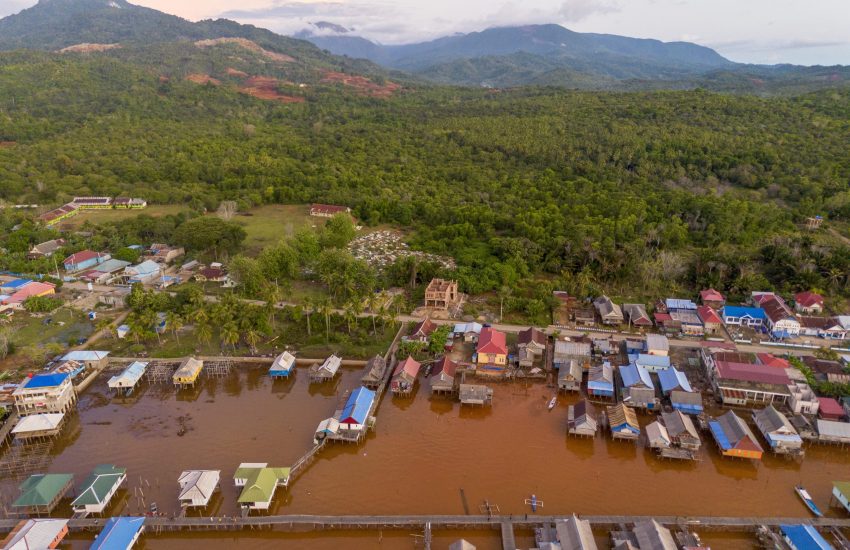
Header photo: An aerial view of the Bajau community in Baliara Village, Southeast Sulawesi, Indonesia, where stilt homes are now surrounded by waters heavily polluted by nickel mining. Current data shows cadmium levels exceeding safe limits by 1,000 times, with nickel and lead concentrations nearly 70 times higher than Indonesia’s marine life standards. © Satya Bumi (2025) / Yusuf Wahil
This article was written by our intern Margherita Monico and does not necessarily reflect the position of IUCN NL.
Critical minerals: nickel in Indonesia and the Philippines
With the energy transition in full swing and digitalisation and defence industries increasing, critical minerals are in high demand. One of these minerals is nickel, used for steel and battery production. Indonesia and the Philippines are leading countries in nickel production, responsible for 57% and 13% of global production respectively[1]Monteleone, D. (2024). Critical Minerals. Critical Minerals. Critical Minerals. Nickel mining has been taking place in both countries for decades, but the increased demand for critical minerals has created new conditions and consequences for those who live on nickel-rich lands, those who inhabit areas downstream of this land, and for the lands, ecosystems, and waters themselves.
Kabaena and Dinigat Islands
Kabaena is a small island off the coast of Southeast Sulawesi, Indonesia. Itis part of the Wallacea Biodiversity Hotspot, characterised by high levels of endemism driven by its isolation, complex topography, and unique habitats. The island has been subjected to mining since 2007. Currently, 73% of the island has been sectioned into mining permits, most of them for nickel. Kabanea’s coast is home to multiple ethic groups and communities, including Bajau and Butonese people, recognised legally as Indigenous peoples.
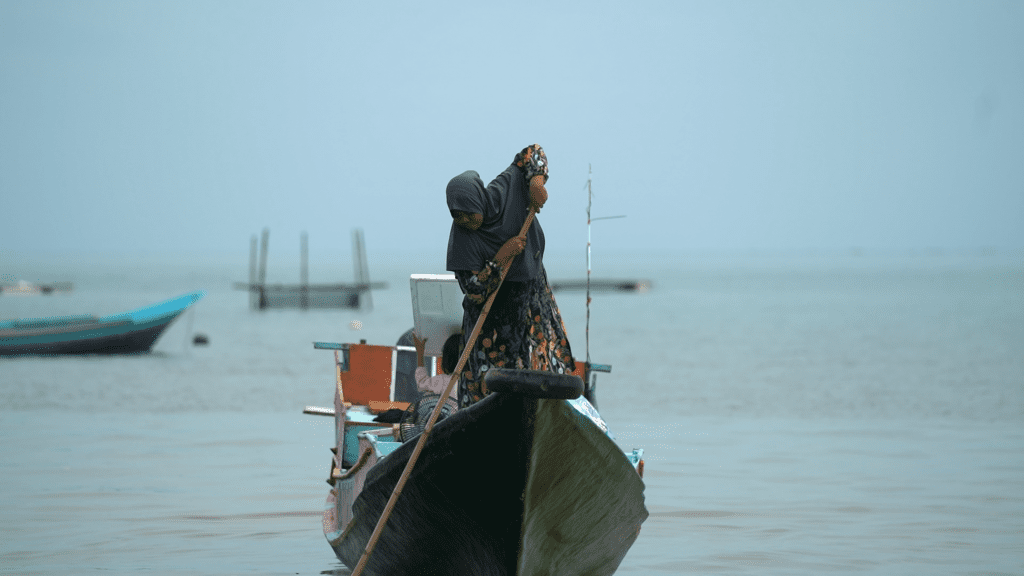
The mining crisis has rewritten the social fabric of Kabaena. Today, Bajau women are forced onto the frontlines of poverty, laboring as fishers and seaweed farmers to sustain households that the ‘nickel boom’ has left behind. © Satya Bumi (2024) / Faiz Zulfikar
The Dinagat Islands are a set of small islands off the coast of northern Mindanao in the Philippines. Known for its lush rainforests, Dinagat is home to 400 plant and over 100 bird species, including the Vulnerable Philippine duck and Mindanao broadbill and the Near Threatened Writhed hornbill. The Dinagats Islands, where the main mineral is nickel, has been declared a mineral reserve since 1939, meaning the state legally owns the minerals within the entire island. This has strong implications for government jurisdiction over the use of land itself. While the island is home to a number of coastal communities, more than half is covered by mining permits and operations[2]Asuncion, A. (2023, March 29): MINING IN DINAGAT ISLAND: The plight for community agency and livelihood. Bantay … Continue reading.
Interviews with partners
The original people of Kabaena and Dinagat are small coastal communities that heavily rely on fishing and farming, as well as some (eco)tourism. Nowadays, mining also has become part of their income. Both peoples are susceptible to natural disasters such as floods and typhoons. To better understand the impacts of nickel mining on coastal communities, Margherita Monico conducted interviews with Indonesian and Philippine partner organisations working closely with affected communities. Satya Bumi provided insights on Kabaena, while Alyansa Tigil Mina (ATM) and Bantay Kita did on Dinagat. Their inputs highlighted observed environmental and social impacts, as well as responses of local communities to mining activities.
Distinguishing the coastal context
Coastal communities in Kabaena and Dinagat experience distinct linkages to, and impacts from, mining operations in both areas. Coastal communities are often not recognised by mining and state authorities as affected populations because of their distance from inland mining sites[3]Jong, H. N. (2025, July 23). Nickel boom on an Indonesian island brings toxic seas, lost incomes, report says. Mongabay Environmental News. … Continue reading. Where mines are located inland, such as in parts of Dinagat, coastal communities may only experience the effects years after operations have started. This can result in low initial awareness of mining activity, followed by the sudden emergence of severe impacts, alongside a lack of clear accountability from companies operating inland.
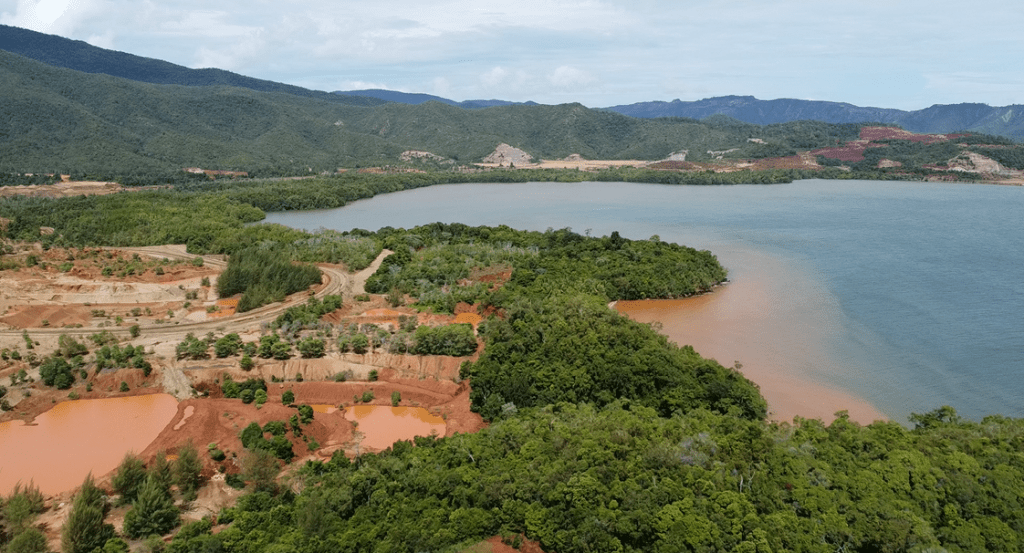
The active mining site of PT Anugerah Harisma Barakah continues to operate despite its link to a major corruption scandal involving the former Governor of Southeast Sulawesi. With estimated state losses of Rp4.3 trillion, this site illustrates the systemic link between administrative failure and environmental destruction in Indonesia. © Satya Bumi (2024) / La Ode Ari Marsha Putra
Coastal communities in Kabaena and Dinagat experience distinct linkages to, and impacts from, mining operations in both areas. Coastal communities are often not recognised by mining and state authorities as affected populations because of their distance from inland mining sites[4]Jong, H. N. (2025, July 23). Nickel boom on an Indonesian island brings toxic seas, lost incomes, report says. Mongabay Environmental News. … Continue reading. Where mines are located inland, such as in parts of Dinagat, coastal communities may only experience the effects years after operations have started. This can result in low initial awareness of mining activity, followed by the sudden emergence of severe impacts, alongside a lack of clear accountability from companies operating inland.
Red alert: nickel mining impacts in the Coral Triangle
The Earth Insight–Auriga Nusantara report Red Alert (2025) highlights how nickel mining in Raja Ampat, part of Indonesia’s Coral Triangle, poses significant risks to some of the world’s most biodiverse marine ecosystems. It documents extensive mining concessions overlapping with forests and coral reefs, alongside rapid expansion of extraction areas. Key impacts include deforestation, sediment runoff affecting coral reefs, threats to marine species such as manta rays and sea turtles, and adverse effects on the livelihoods and food security of Indigenous and local communities. The report also emphasises governance concerns, including absence of “no-go zone” protections.
Serious health impacts
In both Kabaena and Dinagat, nickel mining has already had, and continues to have, significant impacts on coastal communities, including health problems. Airborne dust and heavy metal contamination from mining are associated with serious health risks for exposed populations, including cancer, osteoporosis, chronic obstructive pulmonary disease (COPD), and kidney failure/disease, with some effects potentially extending to future generations[5]Gaa, C., Rao, P. & Calanas, D. (2022). Mining Away Freedoms: Testimonies from Communities Fighting for their Rights in the Philippines. FORUM-ASIA. … Continue reading.
In Kabaena, coastal residents have reported skin irritation when in contact with seawater, and some Bajau communities have been found to have elevated levels of cadmium, zinc, lead, and nickel, all of which pose long-term health risks, as shared during the interviews[6]Jong, H. N. (2025, July 23). Nickel boom on an Indonesian island brings toxic seas, lost incomes, report says. Mongabay Environmental News. … Continue reading.
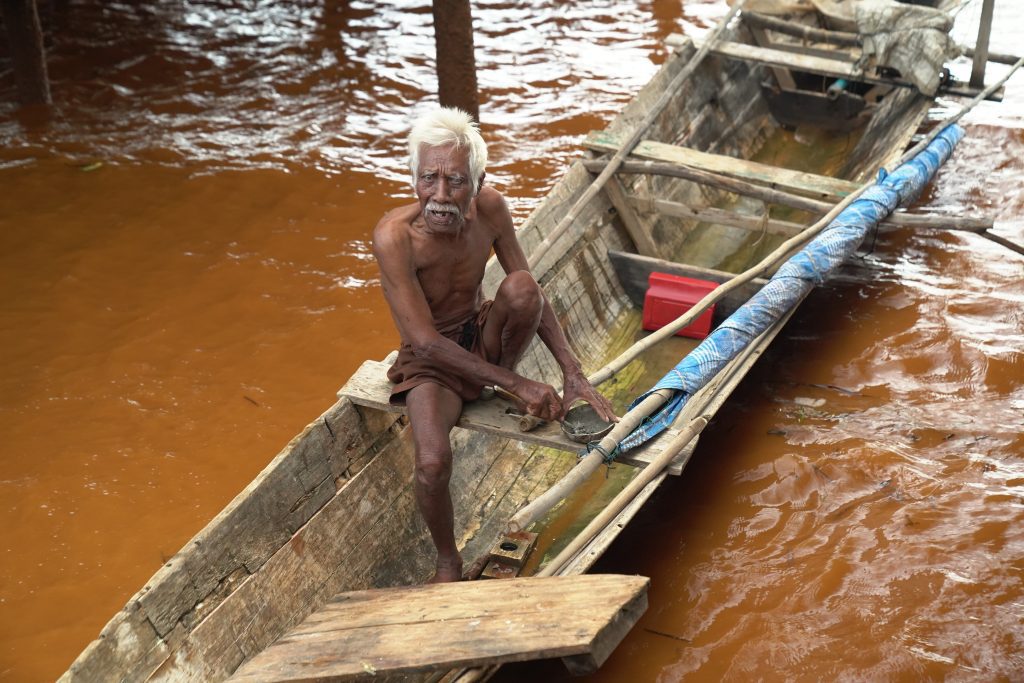
The oldest Bajau fisherman in Baliara drifts along the polluted shoreline in his small wooden boat. Forced to sail farther into the open sea to escape the murky waters and find fish, he has seen his income fall by nearly 80 percent. © Satya Bumi (2024) / Faiz Zulfikar
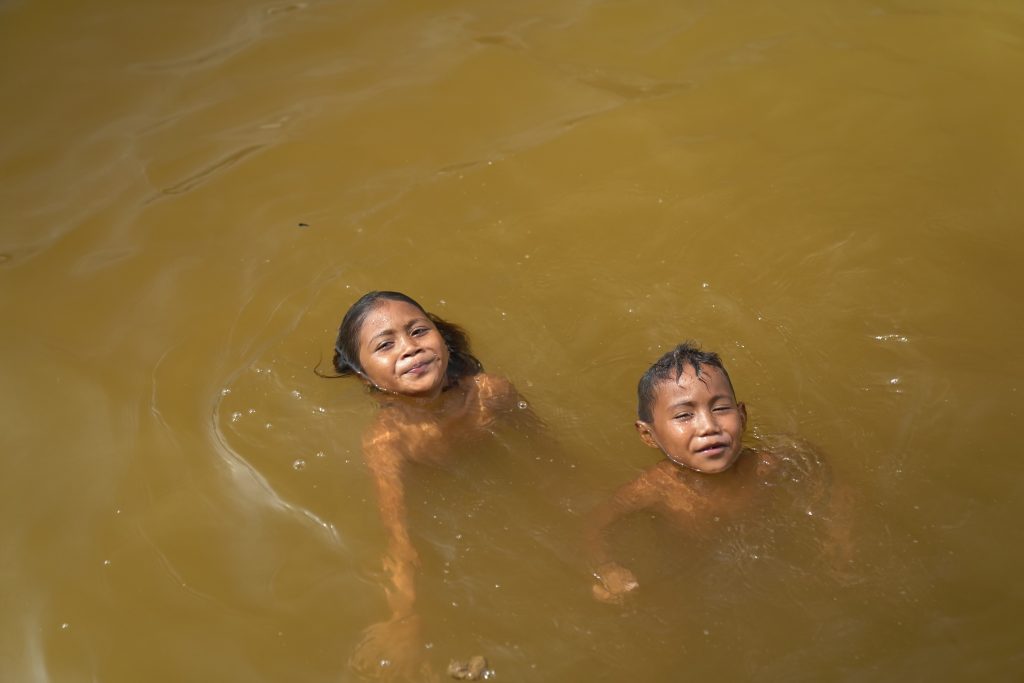
Bajau children swim in the sea beside their stilt houses, unaware that the waters in which they play contain toxic heavy metals that can accumulate in their bodies for a lifetime. Tests in 2025 have already found higher levels of cadmium in the urine of Kabaena’s children than in other age groups. © Satya Bumi (2024) / Faiz Zulfikar
In Libjo, Dinagat, communities face additional pressures from noise pollution linked to heavy transport activity and declining access to safe drinking water due to spring contamination[7]Lazarte et al (2025, March 2). Perceived Health Impacts of Surface Mining: Local Perspectives from the Mining Communities in Libjo, Dinagat Islands, Philippines. International Journal of … Continue reading. The encroachment of mining tenements into watershed areas further increases risks to clean water sources used for drinking, cooking, and daily needs. In both areas, communities have reported respiratory issues linked to dust from transport activities and declining air quality, with children among the most affected[8]Alfalah, D., Afra, S. & Hardiana, D. (2024, October 4). Report: How the Nickel Rush Ravaged Kabaena Island and the Bajau People’s Livelihood. Satya Bumi. Report: How the Nickel Rush Ravaged … Continue reading[9]Gaa, C., Rao, P. & Calanas, D. (2022). Mining Away Freedoms: Testimonies from Communities Fighting for their Rights in the Philippines. FORUM-ASIA. … Continue reading.
‘For [Dinagat communities], the watershed is very important because it is the source of their life, their source of everything.’
-Christel, Alyansa Tigil Mina
Impacts on fishing livelihoods
Nickel mining also significantly affects the livelihoods of coastal communities in Kabaena and Dinagat. Runoff containing harmful particles – often increased by siltation from surface excavation – can contribute to ecotoxicity, eutrophication, acidification, and photochemical oxidation, harming marine ecosystems and species groups such as fish and shellfish that many coastal households depend on.
In Kabaena, fishers report travelling up to 20 miles, much further than before, to catch sufficiently. In Dinagat, large vessels transporting ore and materials may disturb fish that are drawn to vessel lights, forcing fishers to operate dangerously close to these ships. Communities in both areas report declining fish stocks since mining operations began[10]Gaa, C., Rao, P. & Calanas, D. (2022). Mining Away Freedoms: Testimonies from Communities Fighting for their Rights in the Philippines. FORUM-ASIA. … Continue reading, potentially linked to contaminated runoff affecting marine ecosystems and species, vessel traffic, and propeller disturbance during loading seasons.
Procedural injustices faced by communities
Beyond the impacts of nickel mining on their livelihoods, coastal communities in Kabaena and Dinagat have also faced challenges related to consultation processes and compensation mechanisms associated with mining operations. In a study by Satya Bumi, 73.7% of interviewees reported that mining companies had not obtained free, prior, and informed consent (FPIC)[11]From personal correspondence, despite this being a legal requirement. In other cases, community members received inconsistent information in consultations. In one instance, around 20 people were invited to a consultation meeting and given compensation of only 50,000 Indonesian rupiah (approximately 3 euros), while others received neither information nor compensation. Similar unclear and uneven consultation and compensation practices were reported in several coastal areas of Kabaena.
In Dinagat, the island’s mining reserve status has enabled the national government to enter into direct agreements with mining companies, limiting the role of local communities in decisions over if, where, and how mining takes place. Under this arrangement, formal notification is only required at later stages, when plans are already largely developed. After finally having been informed of the mining, local leaders are then responsible for informing their communities. This leaves people further from village centres and those less engaged in the community unaware of the operations. In some cases, residents only become aware through the arrival of mining infrastructure and transport vehicles.
Community response in Kabaena
Despite these conditions, communities have found ways to adapt to, or resist mining. For example, to raise awareness of injustices linked to nickel mining in Kabaena, communities have organised peaceful protests and marches, while numerous reports and articles have documented testimonies from affected residents. In addition, several organisations involved in community responses to mining attended the 2025 OECD Forum in Paris, where they discussed issues related to nickel extraction and its impacts[12]Satya Bumi’s Wrapped 2024. (2024, December 23). Satya Bumi. https://satyabumi.org/wrapped_2024/. Among them is the Sagori Institute, founded by Kabaena resident Sahrul Kabi Killa.
Communities have also collaborated with organisations such as Satya Bumi to document and expose (environmental) human rights violations linked to mining operations through interviews and community-based research. In addition, community members have responded to the mining by adapting their lives to their shifted conditions. Some have moved away from Kabaena, whereas others have entered the mining industry. For the Bajau Indigenous people however, working on land represents not merely a change in occupation, but the loss of their maritime traditions, cultural identity, and primary livelihoods.
Although communities have organised responses and resistance to mining, these efforts have taken place in a challenging context. In Indonesia, a national drive to expand nickel mining and processing can make it difficult for critical organisations to speak out or hold mining companies accountable. Some have expressed feelings of hopelessness and powerlessness against mining actors. Resisting mining comes with obstacles and danger as well – for instance, some Bajau people are not legally recognised as citizens and do not have government issued IDs, making them more legally vulnerable when speaking out about mining and lowering visibility of their acts of resistance.
Community response in Dinigat
Communities in Dinagat have also organised collective action in response to mining activities on their islands. TuPeCo, or the Tubajon people’s council, was created from almost two decades of local organising and mobilisation. The council brings community concerns to the municipality and attends committee hearings[13]Gaa, C., Rao, P. & Calanas, D. (2022). Mining Away Freedoms: Testimonies from Communities Fighting for their Rights in the Philippines. FORUM-ASIA. … Continue reading Communities have launched a watershed protection campaign to preserve one of the island’s remaining watersheds from mining encroachments.
Organisations such as Alyansa Tigil Mina support them in their response to mining by providing funding, workshops and support to community-led initiatives. Bantay Kita offers legal support, livelihood opportunities, and training for environmental human rights defenders, among other forms of assistance to address mining-related challenges. Both organisations emphasise the importance of community autonomy in determining their response to mining activities.
‘We are very conscious that we will not in any way influence the community to do something that is not their own decision… We would always ask, what kind of assistance would you want? Communities should think of the solutions that are best for themselves.’
-Beverly Basmanos, Bantay Kita
Communities in Dinagat have also found ways to adapt their livelihoods to nickel mining. Some have found alternative sources of income such as ecotourism. In the province of Libjo, fishers responded to declining fish catches by building a floating cottage to stimulate fish reproduction[14]Thom, C. (2024, March 11). Forging strength: Dinagat Islands communities’ resilience against the ongoing challenges of mining. Bantay Kita. … Continue reading
In Dinigat, Bantay Kita helps women organise and gain skills to resist mining and demand accountability from their local governments. © Bantay Kita
Resistance to mining on Dinagat has involved several challenges. One key issue is legal barriers related to formal land ownership. Filing complaints about mining on land that is already inhabited or used requires a land title or tax declaration; however, many inhabitants do not formally own their land and therefore do not have access to these documents. Those living in Dinagat are also not legally considered Indigenous and as a result, legislation relating to Indigenous peoples’ rights does not apply, eliminating another helpful tool that can be used to secure what communities need.
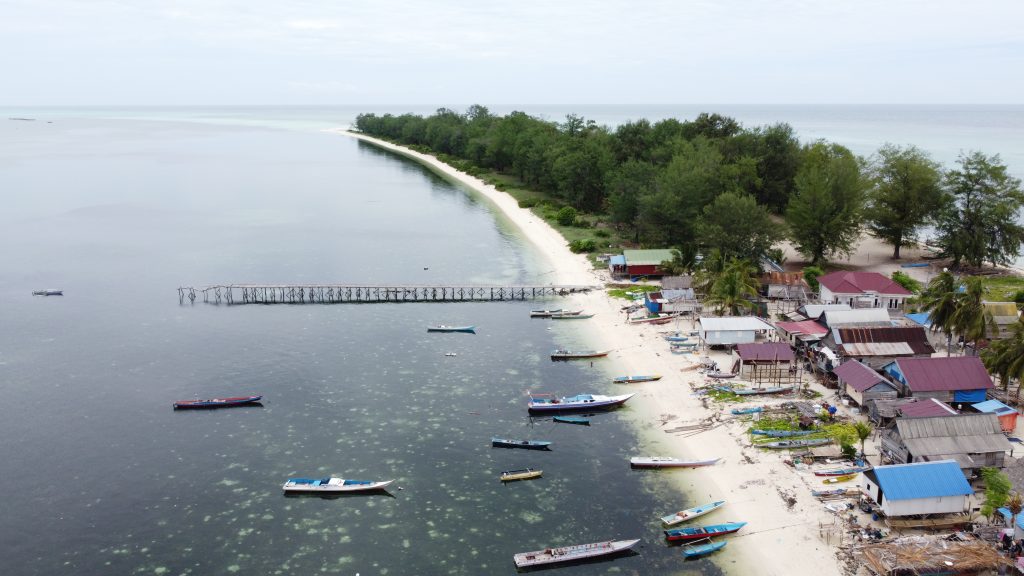
At first glance, Sagori Island is a paradise untouched. But beneath this mask of purity lies a heartbreaking reality: the fish are disappearing. The distance from the Kabaena nickel mines provides visual clarity, but it offers no sanctuary for the marine life that has been decimated since the industry’s arrival two decades ago. © Satya Bumi (2024) / La Ode Ari Marsha Putra
Importantly, the island’s status as a mineral reserve is a major obstacle in communities’ search for justice. The state’s power over the island through its complete ownership makes it extremely difficult for communities to have a stake in decision making in mining procedures and delineations.
Repression of mining-critical voices in Indonesia and the Philippines
Community responses to mining in Kabaena and Dinagat are not isolated but reflect broader national contexts. In both Indonesia and the Philippines, state and company-related pressure on protesters, journalists, environmental defenders, and others critical of mining has been widely documented[15]Human rights in Indonesia. (n.d.) Amnesty International. https://www.amnesty.org/en/location/asia-and-the-pacific/south-east-asia-and-the-pacific/indonesia/report-indonesia/[16]Gaa, C., Rao, P. & Calanas, D. (2022). Mining Away Freedoms: Testimonies from Communities Fighting for their Rights in the Philippines. FORUM-ASIA. … Continue reading. Reported cases include intimidation, physical violence, killings, and disappearances involving security forces, as well as assaults, digital harassment, and other forms of abuse by non-state actors[17]Monitoring of Indonesian environmental human rights defenders in 2024. (2025, November 29). Satya Bumi. … Continue reading[18]How mining threatens Indigenous defenders in the Philippines. (2024, December 3). Global Witness. … Continue reading. In Indonesia, resistance to mining can often be framed as contrary to national interests, creating additional pressure on those who question or oppose mining developments[19]Warburton, E. (2023). Resource Nationalism in Indonesia: Booms, Big Business, and the State. Cornell University Press. https://www.jstor.org/stable/10.7591/j.ctv35k74tp. In the Philippines, efforts to fast-track mining permitting processes, alongside large US aid packages supporting mineral extraction and processing and the continued expansion of mining projects, have increased the sector’s national strategic importance and, in turn, the risks faced by those speaking out against mining[20]How mining threatens Indigenous defenders in the Philippines. (2024, December 3). Global Witness. … Continue reading[21]Razote, R.B.C. (2022, January). History of the Philippine Mining Industry-A Political Ecology Framework. University of the Philippines System. (PDF) History of the Philippine Mining Industry-A … Continue reading.
Sulawesi, the peninsula where Kabaena is located, and North Maluku contain around 90% of Indonesia’s national nickel reserves[22]Indonesia’s Minerals, Coal, and Geothermal Resources and Reserves 2022. (2022). Ministry of Energy and Mineral Resources Indonesia. … Continue reading, while the Caraga region (including Dinagat) hosts the Philippines’ largest nickel deposits[23]MGB13. 2021. Caraga Region Mineral Profile. Philippines Mines and Geosciences Bureau Region 13. Retrieved from … Continue reading. These concentrations of resources have made mining in these areas a key focus for both states.
A transition leaving no one behind
These accounts of destruction, injustice, repression, and unwavering resilience do not exist in a vacuum. The events seen unfolding in small islands like Kabaena and Dinagat are closely related to the push for renewable energy, partly driven by European markets. The transition to renewable energy sources without respecting the autonomy and decisions of communities is an incomplete and unjust transition. If the promise of a sustainable future for certain people necessitates the oppression of others, that “sustainability” must be questioned and reconsidered.
This highlights the importance of an environmental justice approach, ensuring that sustainability transitions also respect community rights, autonomy and decision-making, as well as the protection of critical ecosystems and planetary health – including in contexts where civic space and conditions for speaking out may be constrained.
Widespread attention and solidarity can help address mining impacts in Kabaena and Dinagat. Small-island coastal communities face particular challenges, making it important for diverse actors and individuals to stand with those affected through awareness, support, and action, while recognising the wider links to their own contexts.
Further reading
Want to know more? Contact:

Index
| ↑1 | Monteleone, D. (2024). Critical Minerals. Critical Minerals. Critical Minerals |
|---|---|
| ↑2 | Asuncion, A. (2023, March 29): MINING IN DINAGAT ISLAND: The plight for community agency and livelihood. Bantay Kita. https://www.bantaykita.ph/updates1/mining-in-dinagat-island-the-plight-for-community-agency-and-livelihood |
| ↑3, ↑4 | Jong, H. N. (2025, July 23). Nickel boom on an Indonesian island brings toxic seas, lost incomes, report says. Mongabay Environmental News. https://news.mongabay.com/2025/07/nickel-boom-on-an-indonesian-island-brings-toxic-seas-lost-incomes-report-says/ |
| ↑5 | Gaa, C., Rao, P. & Calanas, D. (2022). Mining Away Freedoms: Testimonies from Communities Fighting for their Rights in the Philippines. FORUM-ASIA. https://www.lilak.net/blog/mining-away-freedoms-testimonies-from-communities-fighting-for-their-rights#:~:text=This%20publication%20documents%20the%20lived%20experiences%20of%20communities,and%20struggles%20for%20survival%20brought%20by%20large-scale%20mining. |
| ↑6 | Jong, H. N. (2025, July 23). Nickel boom on an Indonesian island brings toxic seas, lost incomes, report says. Mongabay Environmental News. https://news.mongabay.com/2025/07/nickel-boom-on-an-indonesian-island-brings-toxic-seas-lost-incomes-report-says/. |
| ↑7 | Lazarte et al (2025, March 2). Perceived Health Impacts of Surface Mining: Local Perspectives from the Mining Communities in Libjo, Dinagat Islands, Philippines. International Journal of Environmental Research and Public Health, 22(3), 365. https://doi.org/10.3390/ijerph22030365 |
| ↑8 | Alfalah, D., Afra, S. & Hardiana, D. (2024, October 4). Report: How the Nickel Rush Ravaged Kabaena Island and the Bajau People’s Livelihood. Satya Bumi. Report: How the Nickel Rush Ravaged Kabaena Island and the Bajau People’s Livelihood – Satya Bumi |
| ↑9, ↑10, ↑13, ↑16 | Gaa, C., Rao, P. & Calanas, D. (2022). Mining Away Freedoms: Testimonies from Communities Fighting for their Rights in the Philippines. FORUM-ASIA. https://www.lilak.net/blog/mining-away-freedoms-testimonies-from-communities-fighting-for-their-rights#:~:text=This%20publication%20documents%20the%20lived%20experiences%20of%20communities,and%20struggles%20for%20survival%20brought%20by%20large-scale%20mining. |
| ↑11 | From personal correspondence |
| ↑12 | Satya Bumi’s Wrapped 2024. (2024, December 23). Satya Bumi. https://satyabumi.org/wrapped_2024/ |
| ↑14 | Thom, C. (2024, March 11). Forging strength: Dinagat Islands communities’ resilience against the ongoing challenges of mining. Bantay Kita. https://www.bantaykita.ph/updates1/forging-strenght-dinagat-islands-communities-resilience-against-the-ongoing-challenges-of-mining. |
| ↑15 | Human rights in Indonesia. (n.d.) Amnesty International. https://www.amnesty.org/en/location/asia-and-the-pacific/south-east-asia-and-the-pacific/indonesia/report-indonesia/ |
| ↑17 | Monitoring of Indonesian environmental human rights defenders in 2024. (2025, November 29). Satya Bumi. https://satyabumi.org/en/report-monitoring-of-indonesian-environmental-human-rights-defenders-in-2024/ |
| ↑18 | How mining threatens Indigenous defenders in the Philippines. (2024, December 3). Global Witness. https://globalwitness.org/en/campaigns/land-and-environmental-defenders/how-the-militarisation-of-mining-threatens-indigenous-defenders-in-the-philippines/ |
| ↑19 | Warburton, E. (2023). Resource Nationalism in Indonesia: Booms, Big Business, and the State. Cornell University Press. https://www.jstor.org/stable/10.7591/j.ctv35k74tp |
| ↑20 | How mining threatens Indigenous defenders in the Philippines. (2024, December 3). Global Witness. https://globalwitness.org/en/campaigns/land-and-environmental-defenders/how-the-militarisation-of-mining-threatens-indigenous-defenders-in-the-philippines/. |
| ↑21 | Razote, R.B.C. (2022, January). History of the Philippine Mining Industry-A Political Ecology Framework. University of the Philippines System. (PDF) History of the Philippine Mining Industry-A Political Ecology Framework |
| ↑22 | Indonesia’s Minerals, Coal, and Geothermal Resources and Reserves 2022. (2022). Ministry of Energy and Mineral Resources Indonesia. geologi.esdm.go.id/storage/publikasi/r27Mld7QWMfhjbtCdhQCtmqjUUM7C0MZqZPLSyQi.pdf |
| ↑23 | MGB13. 2021. Caraga Region Mineral Profile. Philippines Mines and Geosciences Bureau Region 13. Retrieved from https://www.mgbr13. ph/wp-content/uploads/2021/04/Caraga-Regional-Mineral-Profile- Quickfacts-2020-Infographics.pdf |
14 April, 2026
Report: Interweaving waters, forests, and communities – Strategies and lessons for water justice
Water lies at the heart of healthy ecosystems and resilient communities. Yet across many forest landscapes, water sources are increasingly…
13 April, 2026
What did IUCN NL do for nature in 2025? Read our annual report
We all want a thriving, healthy planet for generations to come. Yet, as in previous years, 2025 has presented significant…