A decade of strengthening environmental defenders in the Peruvian Amazon: Lessons and recommendations

Critical minerals and the western chimpanzee: how bauxite…
24 March, 2026
Tuesday 16 december 2025
A decade of collaboration between IUCN NL and SPDA in the Peruvian Amazon’s Madre de Dios region – supported by the French Development Agency (AFD) – has yielded a gender-sensitive, intersectional framework to protect environmental defenders facing escalating threats such as illegal activities, land grabbing, and deforestation. Key insights and lessons from the collaboration highlight the urgent need for inclusive protection strategies amid rising violence and shrinking civic space globally and in Peru.
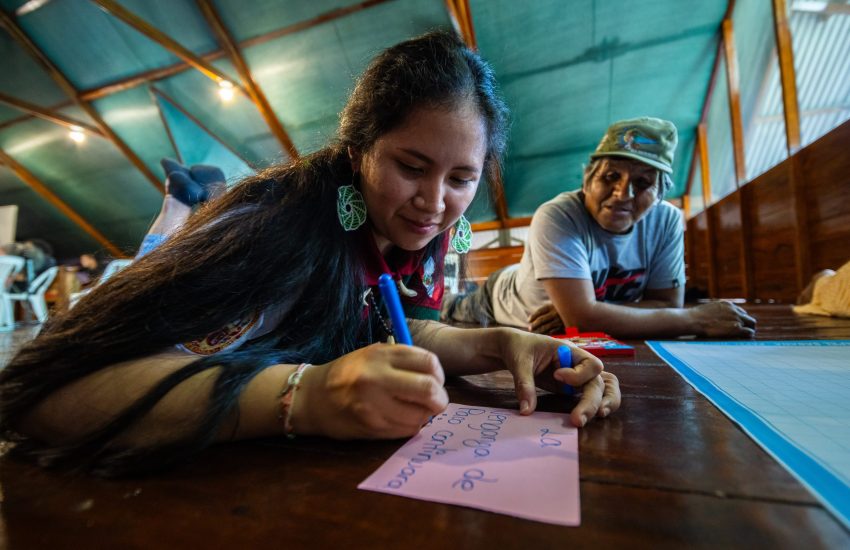
Header photo: (c) Diego Perez – SPDA
In the Peruvian Amazon, environmental defenders face escalating threats from illegal activities, land grabbing, and deforestation[1]Bille Larsen, P., Le Billon, P., Menton, M., Aylwin, J., Balsiger, J., Boyd, D., & Wilding, S. (2021). Understanding and responding to the environmental human rights defenders crisis: The case … Continue reading. Women, youth, Indigenous people, and local communities bear the greatest burden, standing on the frontlines with limited protection and constant exposure to intimidation and violence. Against this backdrop, IUCN NL and SPDA have been collaborating since 2016 to jointly develop strategies that address insufficient protection mechanisms and strengthen existing ones for defenders in Peru’s Madre de Dios region. Their latest efforts, undertaken through the PIDDA Rights project financed by the French Development Agency (AFD), distils nearly a decade of lessons into a gender-sensitive and intersectional grounded framework to better protect environmental defenders. This approach holds potential for adoption and replication in other regions.
Standing on the frontline
Environmental defenders stand on the frontline, protecting ecosystems, territories and the communities that depend on them. They include women and men, Indigenous and non-Indigenous people, young leaders, park rangers, community members, and journalists – a wide spectrum of voices united by the commitment to protect their territories and their human rights. In Madre de Dios, the term of environmental defender is interpreted in different ways. Some recognise its importance in international discussions, while others consider that their daily actions speak for themselves and do not require labels. What is clear, however, is that the risks they face are only growing.
The figures on shrinking civic space and ongoing attacks on environmental defenders worldwide are alarming. According to a recent Global Witness report, 146 environmental defenders were killed in 2024[2]The actual number of cases is likely higher than reported., bringing the total number of recorded deaths since 2012 to 2,253[3]Global Witness (2025). Roots of resistance: Documenting the global struggles of defenders protecting land and environmental rights. Available here.. The Amazon, one of the planet’s most biodiverse regions, has become a particular hotspot for these threats, underscoring the urgent need for more inclusive protection efforts[4]Ojo Público (2023). Amenazas contra defensores en la Amazonia se incrementan: 145 casos de riesgo en 4 años (2023). Available here.. Peru was no exception in 2024, ranking among the ten most dangerous countries worldwide for environmental defenders. In Madre de Dios alone, six defenders have been killed over the past decade.
‘In the current context in Latin America, where civil society faces increasing obstacles to acting freely, it is essential that organisations working to protect environmental defenders adopt innovative and collaborative approaches.’
- SPDA Team Representative
Building protection
Responding to this urgency and precarity, IUCN NL and SPDA have joined forces to develop protection measures that strengthen defenders’ rights to information, participation, and justice. While earlier phases of the collaboration introduced essential tools such as incident reporting systems, emergency funds, and legal support, the efforts under PIDDA put emphasis on tailor-made trainings from a gender and intersectional approach, as well as on visibility and advocacy efforts spanning local to global scales. The inclusive approach recognised the distinct risks faced by women – particularly Indigenous women – and other vulnerable groups and promoted locally-grounded and culturally-appropriate protection strategies.
‘A next step… is to gather lessons learned from experience to produce materials that really make sense to communities. Most existing materials follow formats that are heavily influenced by urban or Western cultures, even when these are intended to be accessible.’
- International expert on protection and security
Through these experiences, IUCN NL and SPDA gathered valuable lessons for the integral protection of environmental defenders. As nearly 10 years of collaboration come to an end, IUCN NL has led the capitalisation of lessons and recommendations, meant to inform related initiatives in other contexts.
Intertwined protection pathways
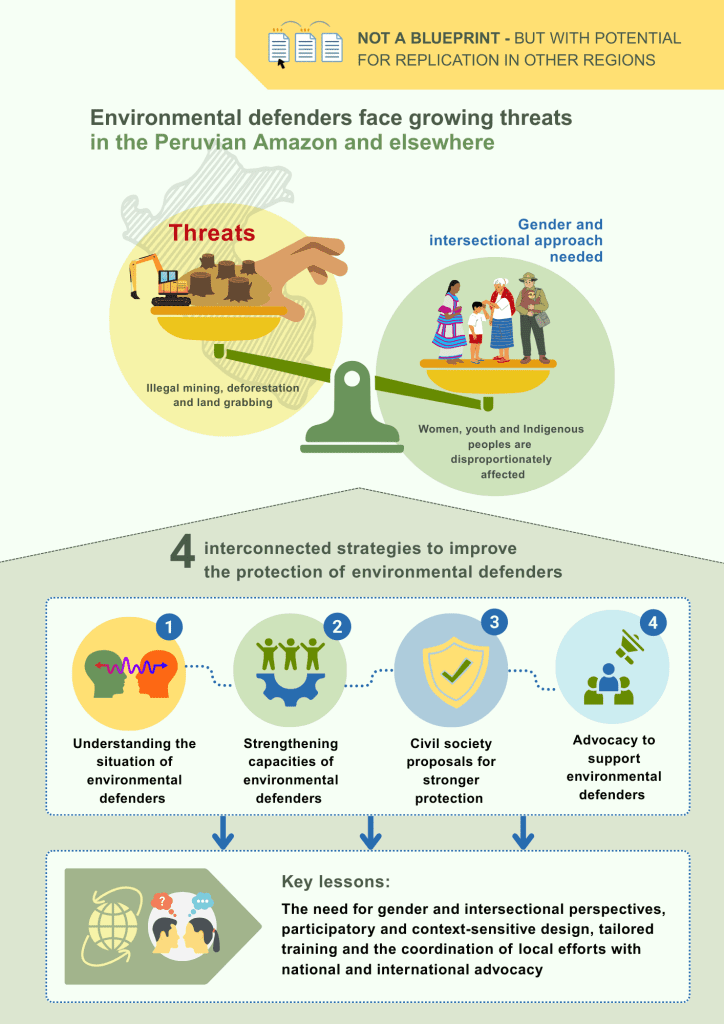
The capitalization crystallises four interconnected strategies that offer a practical, adaptable and replicable model for protecting environmental defenders in high-risk areas:
- Understanding the real situation of environmental defenders: Participatory territorial analyses identified key risks, gaps, and needs of environmental defenders, generating gender- and intersectional-sensitive evidence to guide protection measures. This evidence also informed tailored capacity-building programmes.
- Strengthening the capacities of environmental defenders: Through itinerant training and protection programs, defenders strengthened their knowledge, leadership, and security practices. This allowed them to engage more effectively with protection mechanisms and suggest concrete ways to make these systems work better.
- Collaborative proposal development for stronger protection: Environmental defenders and civil society organisations jointly developed legal proposals to strengthen Peru’s national protection system, ensuring inclusion, legitimacy, and sustainability. This process empowered defenders to take part in policy dialogue and shape advocacy efforts.
- Advocacy to support environmental defenders: National and international advocacy efforts raised awareness, mobilised public support, and brought defenders’ protection onto policy agendas.
‘Improving conditions for environmental defenders requires creating conditions that enable women, Indigenous people, and young people to participate in designing public policies that guarantee the full exercise of their rights.’
- IUCN NL Director Liliana Jáuregui
Lessons and ways forward
A decade of collaboration between IUCN NL and SPDA cumulating in PIDDA show that – when collaborations are both cross-regional and rooted in local realities – small steps toward better protection are possible. The joint experience offers lessons for others seeking to strengthen protection for environmental defenders:
- Differentiated information and context sensitivity: Participatory approaches allow for the design of more effective protection policies and measures that are sensitive to local realities.
- A gender and intersectional approach are essential: Incorporating intersectional perspectives ensures that actions respond to the specific needs of women, Indigenous peoples, and diverse communities, strengthens the legitimacy and effectiveness of protection measures.
- Methodologies make a difference: Tools such as adapted training programs make it possible to address sensitive issues and strengthen actual protection capacities.
- Multi-level advocacy amplifies: Coordinating territorial work with national and international advocacy ensures greater visibility and impact on the public agenda.
- Partnerships multiply effects: Building strategic networks between local, national, and international actors ensures sustainability of protection efforts.
- Systematise to replicate: Documenting and converting experiences into practical knowledge allows other territories to adapt and replicate these approaches.
Facing complex realities
It goes without saying that the context in which environmental defenders operate and where protection takes place remains difficult. Violence and threats against environmental defenders persist; in Peru and across the globe. There is a clear need for broader structural and political change, prioritising environmental protection, and Indigenous and human rights.
In Peru specifically, this includes advancing the ratification of the Escazú Agreement, strengthening of intersectional and territorial rights, supporting civil society organisations that support environmental defenders, and protecting civic space to safeguard human rights and the environment.
‘Peru’s delay in ratifying the Escazú Agreement highlights the systemic barriers that hinder progress in access to rights, environmental justice and the safety of defenders.’
- Mariel Cabero, IUCN NL environmental justice expert
No single blueprint
There is no single model that can fully address the complex challenges environmental defenders face. But the insights and tools developed as part of the collaboration between IUCN NL and SPDA point to practical ways forward. As violence and restrictions on civic space intensify in Peru and beyond, these lessons provide a pathway for protecting those who protect the Amazon and the ecosystems we all depend on.
About PIDDA Rights
Environmental defenders take many risks protecting nature. Globally, every week people get killed because they stand up for their natural environments and human rights. Women are often at the forefront of defending environmental human rights, while at the same time being more at risk. With the support of the French Development Agency, Sociedad Peruana de Derecho Ambiental and IUCN NL strengthen the work of environmental defenders in Madre de Dios in Peru, applying a gender and intersectional approach.
Want to know more? Contact:





Index
| ↑1 | Bille Larsen, P., Le Billon, P., Menton, M., Aylwin, J., Balsiger, J., Boyd, D., & Wilding, S. (2021). Understanding and responding to the environmental human rights defenders crisis: The case for conservation action. Conservation Letters, 14(3), e12777. |
|---|---|
| ↑2 | The actual number of cases is likely higher than reported. |
| ↑3 | Global Witness (2025). Roots of resistance: Documenting the global struggles of defenders protecting land and environmental rights. Available here. |
| ↑4 | Ojo Público (2023). Amenazas contra defensores en la Amazonia se incrementan: 145 casos de riesgo en 4 años (2023). Available here. |

27 March, 2026
Engaging Stakeholders to Advance Ecosystem-based Adaptation in Mauritius
Madagascar and the Indian ocean islands are a biodiversity hotspot - a group of islands with incredible species diversity and…
24 March, 2026
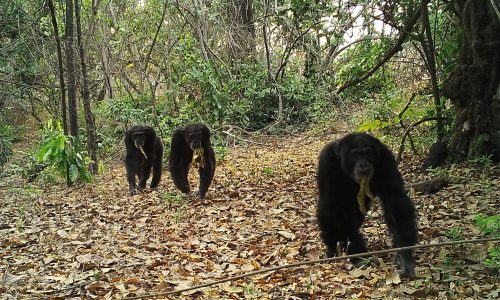
Critical minerals and the western chimpanzee: how bauxite mining threatens one of West Africa’s last strongholds
In West Africa, the global scramble for critical minerals’ is putting immense pressure on unique ecosystems. As the demand for…