The energy transition revisited: the case of lithium extraction in the Andes

Critical minerals and the western chimpanzee: how bauxite…
24 March, 2026
Thursday 03 july 2025
The planetary crisis that came with the extraction and burning of fossil fuels has demanded a radical shift; a transition towards renewable forms of energy production. The energy transition, one of the most promoted solutions to today’s climate and energy challenges, has sparked demand for transition minerals, such as lithium. The “Lithium Triangle” is in south America, within the Argentinian, Bolivian and Chilean territory.
Although the need for an energy transition is widely recognized, there is no global consensus on how to achieve it in a just and sustainable way. Its current trajectory often reinforces historic power imbalances between the Global North and South, while mining practices impact local communities and ecosystems—deepening instability in already fragile regions.
There’s a lot at stake in the shift to a new energy system. What’s crucial is avoiding the same mistakes that have long marked resource extraction—human rights abuses and environmental damage, especially in the Global South.
This article explores the socioenvironmental impacts of lithium extraction in the salt flats of the Andes. For this we interviewed two of our partners, CEDIB and Aka Pacha.
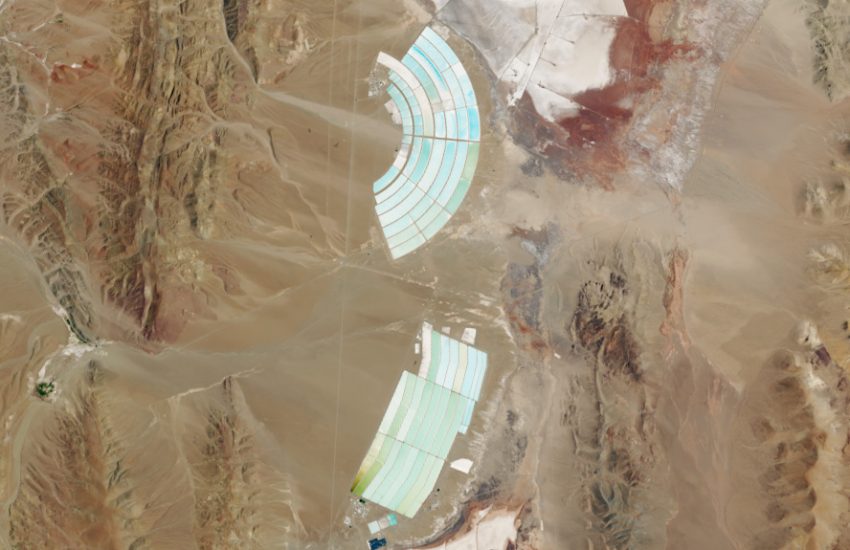
Header photo: Salar de Olaroz lithium mine in the Jujuy province , Argentina © Image courtesy of NASA
This article is written by our intern Nefeli Nisioti and does not necessarily reflect the position of IUCN NL.
Energy Transition Minerals
Facilitating the energy transition requires large quantities of the so-called Energy Transition Minerals[1]Is mining for clean energy minerals sustainable?. These will be used for the manufacturing of batteries, such as those needed in electric vehicles, but also for other advanced digital technologies. Lithium is one of the most important minerals for this process and it can be found in three types of deposits, brines[2]A large reservoir of mineralised water formed through erosion processes and the inflow of underground water into the salt flats; these waters carry many minerals. The brines are the raw material for … Continue reading, hard-rock, or sedimentary-volcanic[3]Lithium Brines: Origin, Characteristics, and Global Distribution | Economic Geology | GeoScienceWorld. The three biggest lithium producers in the world are Australia, Chile and China, with Australia accounting for 52% of the global hard-rock lithium production alone.
According to the U.S. Geological Survey the quantities of lithium extracted globally have increased by 40% within five years, with 85,000 million tons in 2018 to 130,000 million tons in 2022[4]Lithium Statistics and Information | U.S. Geological Survey. This exponentially growing demand in such a short period of time points to an equally rapid development of mining projects across the globe. It is projected that lithium production will increase by 500% by 2050[5]CI_EN_GFB-Strategic-Minerals.pdf.
Lithium Triangle
Latin America has the largest amount of brine lithium deposits in the world, concentrated in three countries, Bolivia, Chile and Argentina; also known as the “Lithium Triangle”[6]See Image 1: Three South American countries hold over half the world’s lithium. Despite their differences in lithium exploitation rates, environmental and socioeconomic conditions, together these three countries account for nearly 60% of the world’s brine lithium resources hidden within their salt flats[7]Lithium extraction and industrialization: opportunities and challenges for Latin America and the Caribbean.
In the plurinational state of Bolivia most of lithium is found in the Salar de Uyuni; it is the world’s largest lithium resource and is located in the Altiplano[8]Altiplano – Wikipedia. In Chile, lithium is primarily exploited in the Atacama Desert, and in Argentina at the Olaroz salt flat[9]extraccion-de-litio-y-derechos-de-los-pueblos-indigenas.pdf. These regions also have cultural and ecological importance for local communities.
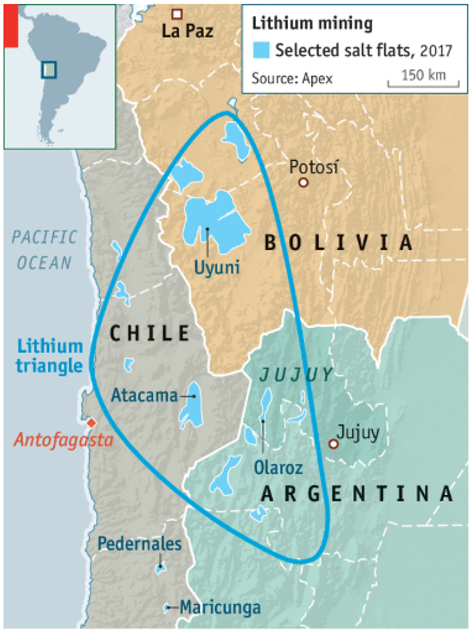
The “Lithium Triangle”
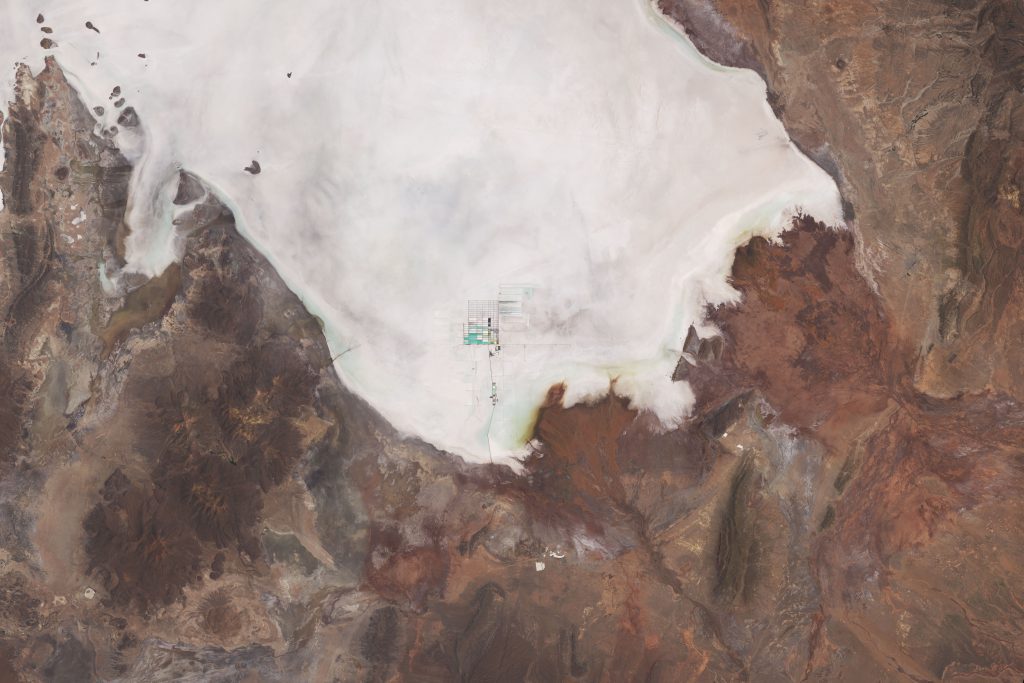
Lithium mine in Salar de Uyuni, Bolivia © Image courtesy of NASA
Transition minerals: who profits?
Even though most of these minerals are found in countries of the Global South, the industry of transition minerals is dominated by countries of the Global North, such as Australia, China, and the United States. An element that can explain this fact, is that accessing and extracting lithium necessitates financial capacity combined with specific technical and technological support, which often countries in the Global South don’t have. These requirements, result to agreements between extractive companies – often from the Global North – and national governments, in order to capacitate the extraction.
Unfortunately, the procedural and practical ways through which extraction is done, as well as the framework of benefiting from these reserves, do not seem to guarantee an ethical, equitable or responsible extraction[10]What does the Critical Raw Materials Act mean for nature and human rights? | IUCN NL. Neither for the people, nor for the planet.
Countries of the Global South are often marked by unstable economies, structural inequalities and governments that do not prioritize the environment. At the same time, countries of the Global North, in an aspiration to advance in the transition mineral industry, take advantage of these fragile conditions to capture and privatize mineral resources. Consequently, this reinforces power imbalances that have historically existed between Global North and Global South.
At the same time, it drives countries of the Global South into a competition for revenues, creating conditions of tension and conflict between them. The Lithium Triangle is one such example where countries are competing for China’s mining investments[11]CI_EN_GFB-Strategic-Minerals.pdf. Such dynamics further perpetuate socioeconomic vulnerabilities and inequalities that are already tormenting these societies.
To explore this deeper, we had the opportunity to speak to people from the civil society organization CEDIB, in Bolivia and the Aka Pacha foundation, in the North of Chile. They shared with us their views on how the expansion of the lithium industry is impacting the stability of the salt flats and the communities that depend on them; as well as their efforts to defend these. Their narratives provided great insights regarding the realities of lithium extraction in these two countries.
No empty lands
The areas of the Lithium Triangle are not empty lands[12]extraccion-de-litio-y-derechos-de-los-pueblos-indigenas.pdf. The salt flats in the Andean region are not only resources of lithium, but also vital ecosystems with ecological, cultural and livelihood importance; and they have been a home to people for 13,000 years.
The increase and intensification of lithium mining in these areas, as a result, has serious consequences for the populations living around the salt flats. Indigenous peoples and local communities are disproportionately affected in multiple ways. From the direct consequences on their landscapes, like ecosystem degradation and increased water scarcity, all the way to the threat in the viability of their cultures, the protection of their territories, and their socioeconomic security.
‘in the future, we will have lithium, we will have electric cars, but we won’t have water’
- Román Guitián, an Indigenous Argentinian activist
Impact of lithium extraction on the stability of salt flats
Water connectivity and availability
The process of accessing and extracting lithium relies on invasive and ecologically disruptive methods[13]The Lithium Triangle: Where Chile, Argentina, and Bolivia Meet. To begin, holes are drilled in the ground for the mineral-rich water to be pumped to the surface. This water is then left to dry for months, to finally be reduced to the desired mineral[14]THE LITHIUM TRIANGLE on JSTOR. But the Lithium Triangle is one of the driest places on Earth and its salt flats are very fragile ecosystems that rely on the balance of scarce resources to maintain their stability.
As Gonzalo from CEDIB explained, the waters in and around the salt flats are connected. So in the process of pumping underground water from beneath the brines, fresh water from the surrounding area will flow into the brines to replenish what has been extracted. As a result, the availability of fresh water in the surrounding area will go down. This has serious implications on the overall water availability and hence the hydrologic stability of the ecosystems[15]Environmental Organizations Call for More Information on Lithium Contracts and Their “Consequences” | In the sun and shade (17.02.25) – The new CEDIB.
Natalia from the Aka Pacha foundation shared with us how the lithium strategy that the Chilean government has recently proposed and implemented has had a great impact on the water connectivity of the salt flats.
“They [the government] spoke very little about the hydrologic connectivity between the acuiferos[16]an underground layer of water-bearing material, consisting of permeable or fractured rock, or of unconsolidated materials which are also part of the salt flats, and the bofedales[17]Bofedales (singular bofedal), known in some parts of Peru as oconales, are a type of wetland found in the high Andes. which also have the potential of delivering water downstream to the entire area, which is desert, and then to the coastal cities”.
Climate and ecosystem threats
As different ecosystems, such as the acuiferos and the bofedales, are connected to the salt flats via water circulation, disturbing the hydrologic connectivity through water depletion has serious consequences on their stability. These ecosystems play a fundamental role in climate regulation and for that they depend on water availability[18]Declaration of the Alliance for Andean Wetlands to promote their protection and preservation – The new CEDIB. For example, the bofedales in Bolivia, as Gonzalo explained, store water in their biomass (i.e. their flora) and that reduces its evaporation by 110 to 10 times. This water is then slowly released over the course of about 8 to 10 months when rain is scarce.
Although water availability in the salt flats is primarily decreased by mining, changes in evapotranspiration induced by climate change could exacerbate it. As global temperatures are increasing, water precipitation in the Andes is projected to decrease[19]Projecting Rainfall Changes over the South American Altiplano in: Journal of Climate Volume 24 Issue 17 (2011). This means that water availability in the salt flats will face multiple pressures[20]Climate change and lithium mining influence flamingo abundance in the Lithium Triangle | Proceedings of the Royal Society B: Biological Sciences. In the regions of Atacama and Antofagasta lithium mining accounts for 70% of water extraction[21]CI_EN_GFB-Strategic-Minerals.pdf while at the same time their local arid climate already creates high rates of water evaporation. With climate change, this is projected to worsen. This will primarily impact Indigenous peoples and local communities as well as local biodiversity.
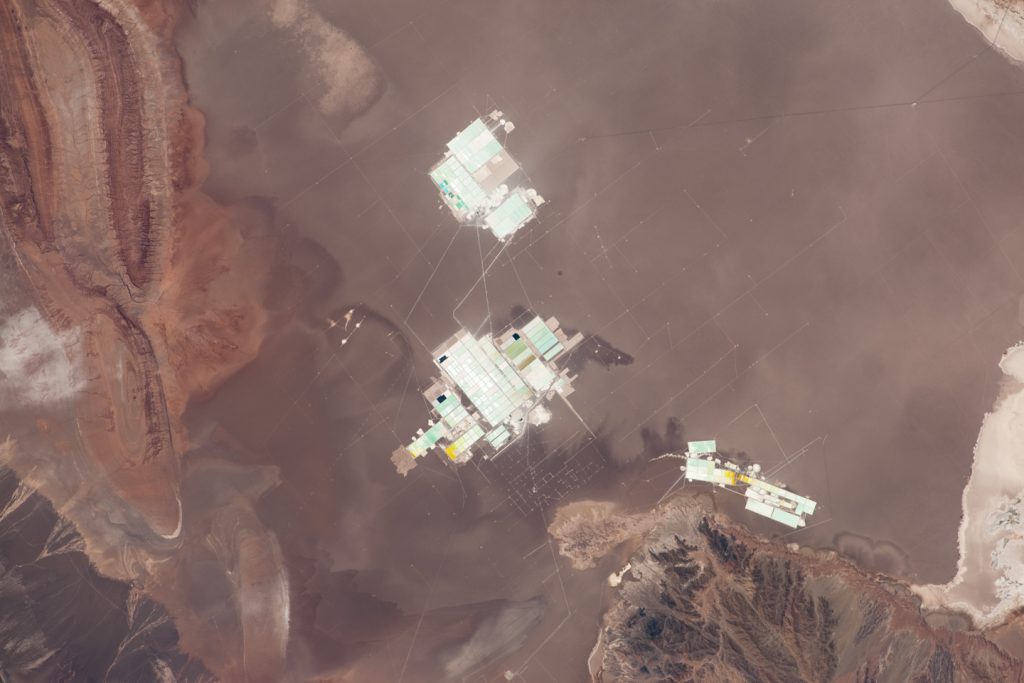
Lithium mine in Salar de Atacama, Chile © Image courtesy of NASA
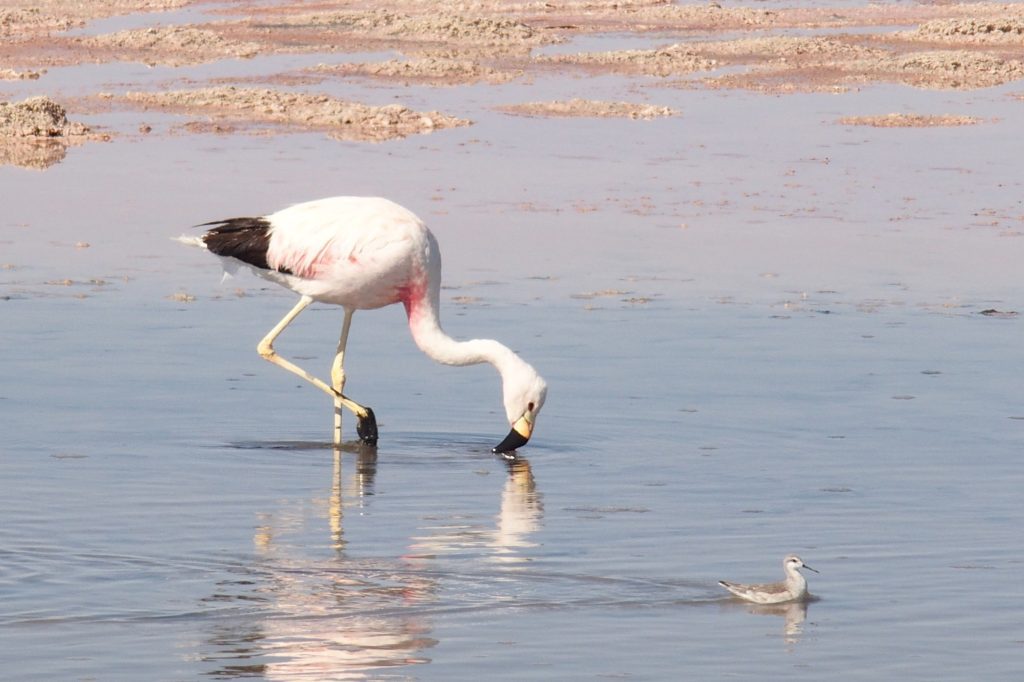
Andean Flamingo (Phoenicoparrus andinus) at Salar de Atacama © Haplochromis via Wikimedia Commons
Biodiversity threats
The degradation of salt flats is increasingly leading to habitat loss for species like flamingos which use these ecosystems to breed; impacting their population numbers[22]Climate change and lithium mining influence flamingo abundance in the Lithium Triangle | Proceedings of the Royal Society B: Biological Sciences2. Combined with fluctuations in evapotranspiration and water scarcity induced by mining, the availability of surface water levels is decreasing; posing a risk to their survival[23]Climate change and lithium mining influence flamingo abundance in the Lithium Triangle | Proceedings of the Royal Society B: Biological Sciences.
Lastly, the runoff of chemicals used in the extraction process of lithium also disturbs the soil and ground health. As a result, overall ecosystems health is compromised[24]Briefing on lithium mining in the Andes of South America : No to water mega-mining – Wetlands International.
Impacts of lithium extraction on Indigenous peoples
Historically, indigenous groups of the Andes have suffered the consequences of labor and resource exploitation, land grabbing, and cultural genocide[25]Raphael Lemkin, Culture, and the Concept of Genocide | The Oxford Handbook of Genocide Studies | Oxford Academic very often for the extraction of minerals (i.e. salt). Coming to recent times, the same regions and their peoples are experiencing similar conditions. But this time for the extraction of lithium.
Lithium mining will often take place within Indigenous territories without their former, prior and informed consent, violating their constitutionally declared rights. These mining megaprojects, usually supported by the country’s government, create conditions of insecurity and conflict for the communities. Their stories show that lithium extraction has rarely been a fair deal.
Sebastian from Aka Pacha explains how even though the areas in the North of Chile are designated as Indigenous territories and hence any extractive project formally requires peoples’ consultation prior to its establishment, in practice the situation is very different.
“Here in Chile there is a “Mining Code” which gives power to the state to decide where they want to locate a mining company to do lithium extraction, and there is nothing, no other tool of the state or tool of the communities themselves, that they can defend that place over the Mining Code, as this Mining Code would be above everything else. So, at this moment in Chile, the state owns the subsoil; the state owns everything that is below the surface”.
Gonzalo highlights that the same lack of consideration towards Indigenous peoples has also been the case in Bolivia throughout the trajectory of lithium extraction.
Water scarcity
Apart from the decrease in water availability that comes as a default due to the overexploitation of brines, the new extractive technology that is being applied requires an additional use of water, in immense amounts: 2.2 million litres of water are used for the extraction of one ton of lithium. In Chile, the mines use approximately 65% of the water resources of the Atacama salt flat, while in Bolivia the mine of San Cristobal consumes 50,000 litres of water daily[26]Litio: por qué América Latina es clave para la transición energética mundial | Foro Económico Mundial.
In an ecosystem where water is scarce, its excessive use puts people in a state of austerity[27]Neoextractivism and Indigenous Water Ritual in Salar de Atacama, Chile – Sally Babidge, Paola Bolados, 2018. In the words of Gonzalo, ‘direct lithium extraction, with methods that are very efficient and very fast for the brines to process, has a much stronger effect on the hydrological system as a whole. This makes the groundwater less accessible for the communities. And this is the heart of the problem.’
Román Guitián an Indigenous Argentinian activist states, ‘in the future, we will have lithium, we will have electric cars, but we won’t have water’[28]“En el futuro tendremos litio, tendremos coches eléctricos, pero no tendremos agua” – pv magazine Mexico.
‘They didn’t really consider what people wanted and only included them at the end of the process. The truth is very questionable because it’s like they only wanted to tick the box that they considered the communities, but it’s not something that was really included in the lithium strategy.’
- Natalia Gutierrez Salgado, Aka Pacha
Culture and territory
The communities have strong connections with these lands, which for them have ancestral and spiritual importance. In the countries of Bolivia, Chile and Argentina this relationship is a constitutionally declared right under the Convention 169 for Indigenous and Tribal Peoples (OIT)[29]Convenio sobre pueblos indígenas y tribales, 1989 (169) | OHCHR which aims to protect Indigenous peoples’ right to land, self-determination and autonomy. But although these rights have been declared, they are not substantially protected.
Indigenous peoples often find themselves excluded from the decision-making process of who gets to operate in their territories and in what ways. As Aka Pacha highlighted, peoples’ spiritual and cultural needs towards these areas have so far not been taken into account in the country’s lithium strategy. People not only aren’t meaningfully or equally included in this process, but they also receive very little benefit from these activities.
Natalia highlights that in Chile the consultation of Indigenous communities has been just for the sake of appearance. ‘They didn’t really consider what people wanted and only included them at the end of the process. The truth is very questionable because it’s like they only wanted to tick the box that they considered the communities, but it’s not something that was really included in the lithium strategy.’
These conditions of disregard greatly affect the empowerment and sovereignty of the communities. There is therefore a growing fear among Indigenous peoples, that the energy transition is threatening the viability of their cultures and autonomy[30]3.7 La minería de litio está dejando a las comunidades indígenas de Chile altas y secas (literalmente) – Paisajes.
Social fragmentation
In the case of Bolivia, as Gonzalo explained, the state has systematically ignored Indigenous communities. Natalia highlights how the lithium strategy has led to social fragmentation within communities in Chile. ‘These new strategies that are introduced, they aren’t properly implemented in the territory, and they always divide the communities. I feel that in this region [Arica y Parinacota], everyone was very clear that they didn’t want mining, but in the region of Iquique or Antofagasta and Atacama, they end up dividing the communities. Who wants lithium mining and who doesn’t? So, they generate a very important problem of social fragmentation,’ Natalia says.
Livelihood security
As explained, water is the most important element in these deserted areas, both for the hydrological stability of the salt flats but also for the food and livelihood security of Indigenous peoples and local communities. As the mining activities affect water availability, this in turn impacts the ways people can maintain and practice their traditional ways of living. Young people and women find themselves disproportionately exposed to these conditions[31] INFORME_LITIO_FINAL_PARA_WEB.pdf. Gonzalo highlights that Indigenous peoples in Bolivia deeply depend on the availability of groundwater for agricultural practices and the traditional livestock herding of camelids[32]Camelids are members of the biological family Camelidae. The seven extant members of this group are: dromedary camels, Bactrian camels, wild Bactrian camels, llamas, alpacas, vicuñas, and guanacos.. Natalia also explains that in Chile where similar traditional ways of living exist, these have been completely disregarded in the lithium strategy.
‘Traditional knowledge is not considered within the [lithium] strategy,’ she says. ‘There are many uses related to the salt flats that are particularly important for the communities. Where there are wetlands, bodies of water associated with livestock farming, a very old form of livestock farming, and in some cases agriculture; and these uses, as ancestral practices, were not considered in the strategy, nor was the impact that lithium extraction would have on these practices.’
Economic security, for whom?
If we wish to explore lithium extraction in terms of economic benefit and security, again the communities are the ones that reap the least. Overall, the highest amounts of profit are made further down the value-chain, specifically in the manufacturing of lithium and selling of related products. These stages are primarily performed in Asian countries[33]Litio: por qué América Latina es clave para la transición energética mundial | Foro Económico Mundial and dominated by economies of the Global North. Even though countries of the Lithium Triangle provide the raw material, without which no other part of the value-chain would be feasible, they are disproportionately included or compensated[34]Indigenous people are left poor as tech world takes lithium from under their feet – Washington Post. This is particularly visible when contrasted to the profits that are made in countries of the Global North from the lithium industry.
Both Sebastian and Gonzalo shared that none of their countries gain much from the lithium industry. ‘Many of these extracted resources have historically been leaving the country. As in the case of copper, lithium also leaves the country as raw material and returns as cars from China,’ Sebastian says.
Therefore, for the countries of the Lithium Triangle, becoming powerful actors in the industry could empower their economies, and hence improve peoples’ quality of life. But as national governments are striving to advance in the other stages of the value-chain, their approach has often taken the form of a state-owned project. Lithium resources are capitalized and commercialized by governments, while people are seeing very little benefit from this development.
In terms of economic security that mining could theoretically offer through the creation of job opportunities, this is still a controversial and context-specific issue. Jobs are still limited, unstable or often described as non-suitable for all (i.e. excluding Indigenous peoples). Or even in times that people do get employed, they are paid extremely little[35]CI_EN_GFB-Strategic-Minerals.pdf.
Mining in Sami territory
The Indigenous Sami people, residing in northern Scandinavia and parts of Russia also face the detrimental impacts of mining activities, impacting Sámi lands and further marginalizing their voices in decision-making processes. The lack of enforceable land ownership laws has led to ongoing conflicts between Sámi communities and industries seeking access to natural resources. Additionally, national courts often side with government and corporate interests, undermining Indigenous land claims.
Rethinking the transition
The perspectives of our local partners raise serious concerns about the current energy transition. While countries in the Global North profit and advance, communities and ecosystems in the Lithium Triangle face exploitation, environmental destruction, and growing insecurity. Latin American governments, in their push to join the green economy, often prioritize extraction over people’s rights and wellbeing—while institutions fail to offer meaningful protection.
The shift away from fossil fuels is essential, but the mining of transition minerals brings serious risks. If not managed equitably, it can deepen global inequalities, destroy vital ecosystems, fuel conflict and human rights abuses.
This article argues that the energy transition must not become a new conflict for resources. Real climate action must be rooted in justice—ensuring that no community, culture, or ecosystem is marginalized. A just transition means rethinking not only what we extract, but how we do it.
Contributing to a just energy transition
IUCN NL has been extensively involved in promoting a just energy transition, primarily through the Bottom Line! project. The project, recognising the necessity for an energy transition to happen, focuses on how this can be achieved making sure that this shift as fair as possible; minimising the negative impacts it can have on people and nature. Bottom Line! focuses on three forest landscapes which are indispensable for global biodiversity as well as the fight against climate change. They also supply food and water and hold important cultural value for Indigenous peoples and local communities.
Along the same lines, through the Land Aquisition Fund (LAF), IUCN NL has enabled nature organisations around the world to safeguard their biodiversity. Its financial support to locally led conservation has contributed to the protection of endangered ecosystems as well as the empowerment of bottom-up initiatives. Aka Pacha foundation in Chile is one such conservation initiative that through the help of LAF has managed to protect and preserve the fragile ecosystems in the northern parts of Chile.
More information?


Index

27 March, 2026
Engaging Stakeholders to Advance Ecosystem-based Adaptation in Mauritius
Madagascar and the Indian ocean islands are a biodiversity hotspot - a group of islands with incredible species diversity and…
24 March, 2026
Critical minerals and the western chimpanzee: how bauxite mining threatens one of West Africa’s last strongholds
In West Africa, the global scramble for critical minerals’ is putting immense pressure on unique ecosystems. As the demand for…