Investing in the next generation of conservationists
24 September, 2026
Investing in the next generation of conservationists
24 September, 2026
Growing corals is only half the work
23 September, 2026
Friday 02 january 2026
The global demand for gold is skyrocketing, driving up prices, and making gold extraction and trade a highly profitable business [2]https://www.cedib.org/biblioteca/la-geopolitica-actual-y-sus-impactos-en-biodiversidad-articulo-en-revista-le-monde-diplomatique/. Gold is considered a crisis-proof investment and is also elemental for many technological devices [3]https://www.theguardian.com/business/2025/oct/09/the-debasement-trade-is-this-whats-driving-gold-bitcoin-and-shares-to-record-highs?CMP=Share_AndroidApp_Other.
In Bolivia’s northern Amazon region, this high demand for gold fuels artisanal and small-scale alluvial gold mining. This means that gold is extracted – mostly illegally – from riverbeds, sediments, and floodplains, going together with environmental degradation and severe human rights violations.
The Bolivian government promotes gold extraction as part of its economic agenda and extractive imperative, passing laws that encourage mining, even in ecologically sensitive and Indigenous territories [4]https://www.cedib.org/biblioteca/la-geopolitica-actual-y-sus-impactos-en-biodiversidad-articulo-en-revista-le-monde-diplomatique/. This trend reflects Bolivia’s long-standing “open veins” – as Eduardo Galeano described – referring to a history of extraction shaped by (neo)colonial pressures and capital interests.
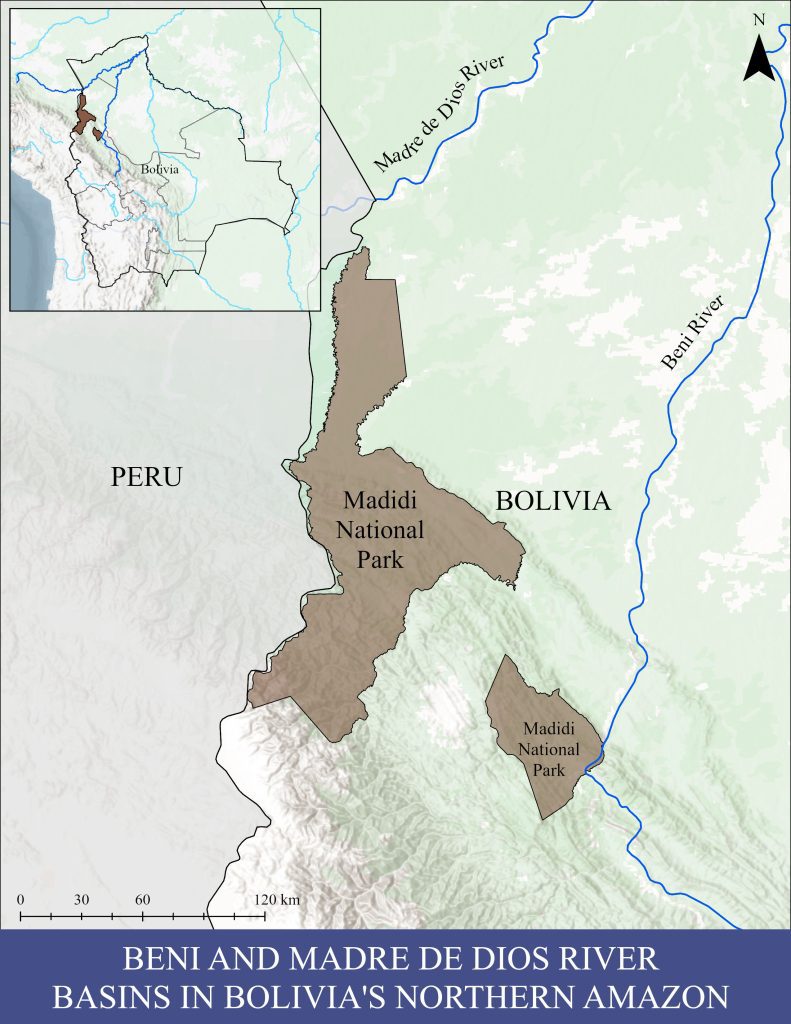
Alluvial gold mining heavily relies on mercury use. Miners perceive mercury as a low cost and accessible means to extract gold. At the same time, it is extremely toxic for the environment and humans who depend on it, due to its persistence and ability to bioaccumulate (i.e., become concentrated in bodies of living beings). In the Beni and Madre de Dios river basins, mercury contamination exceeds the international safety limit of 1 ppm, reaching levels between 1.9 and 9.7 ppm[5]https://www.cedib.org/biblioteca/la-geopolitica-actual-y-sus-impactos-en-biodiversidad-articulo-en-revista-le-monde-diplomatique/. Parts per million (ppm) are a concentration measure, where 1 ppm equals 1 milligram of mercury per litre of water or per kilogram of fish.
The elevated levels of mercury use, and concentration is a long-standing and deliberately ignored problem: scientific studies documenting mercury in water, sediments, and fish of the Beni River [6]Half of the Beni River’s numerous tributaries have had gold mining since the 1960s and its tributaries date back to at least 2001[7]https://www.cedib.org/wp-content/uploads/2024/12/03-ADHMA-Informes-EPU-Mujeres-Mercurio.pdf. Despite decades of evidence, mercury use continues unregulated, perpetuating environmental harm and exposing riverine and Indigenous populations to serious risks[8]https://www.cedib.org/wp-content/uploads/2024/12/03-ADHMA-Informes-EPU-Mujeres-Mercurio.pdf.
The reliance on mercury reflects a wider Bolivian trend. Mercury is central for gold extraction. Gold mining alone accounts for 82.3% of mercury emissions. The scale is also reflected in other numbers: from 1952 to 2000, more than 330 tons of mercury were released into the Bolivian environment. Since 2015, Bolivia has become the world’s largest legal importer of mercury [1].
In the Northern Bolivian Amazon, water and humans are strongly interdependent. Most of the territories affected by alluvial gold mining belong to Indigenous peoples whose lifeways are closely interwoven with the rivers, forest and biodiversity that surround them. Mercury contamination and the disruption of river flows from alluvial gold mining thus severely impact the environment and people. In other words, environmental destruction and human rights violations go together.
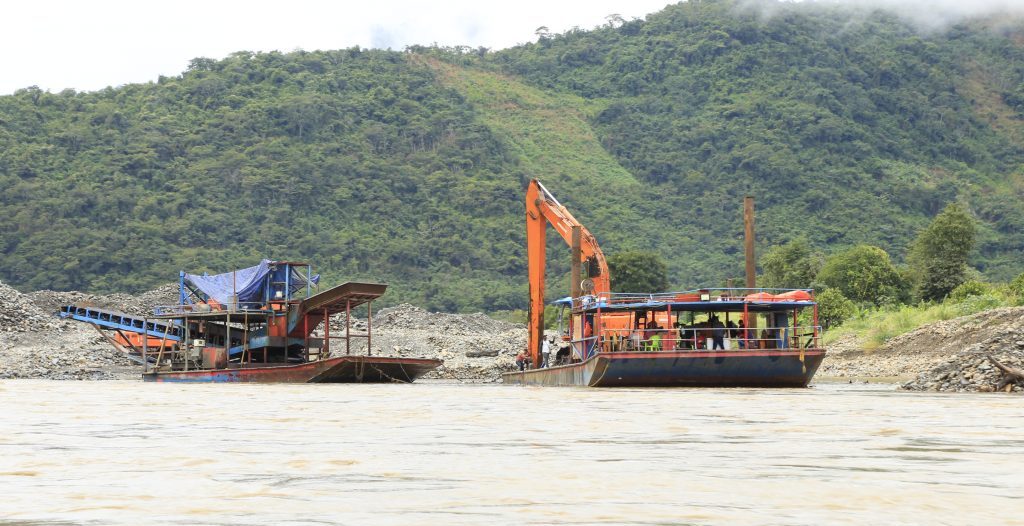
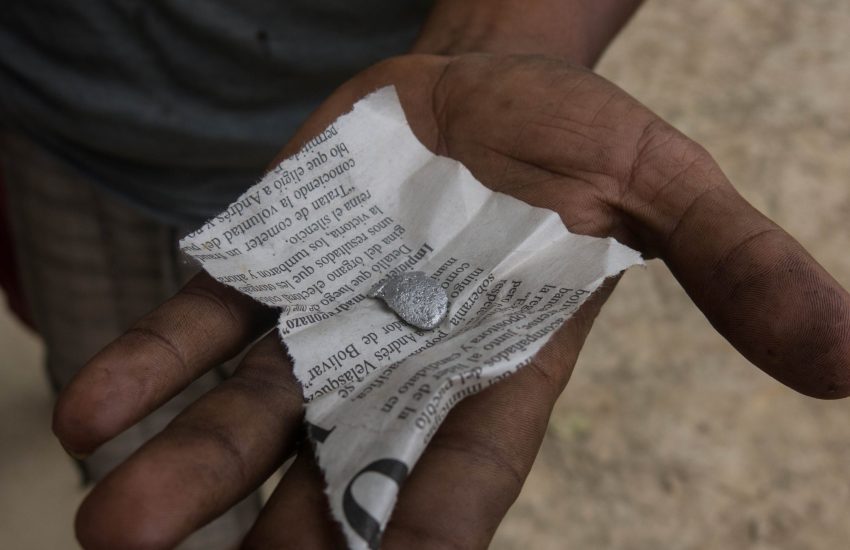
Alluvial gold mining in Indigenous territory © Mauricio Durán, La Brava – CEDIB
Alluvial gold mining, water contamination, and the related interventions in riverbeds ecologically impact waters, soils, vegetation, and biodiversity. Alluvial gold mining reshapes rivers and riverine lives by removing sediments, diverting water, and destabilizing riverbanks, leading to long-term alterations of riverine landscapes [1].
The consequences for local communities are devastating. Mercury contamination of their water sources severely impacts their health, causing severe neurological, developmental, and cardiovascular damage. Drinking water has become unsafe, which deprives communities of one of their most basic needs and rights. River disruption and contamination also undermine livelihoods, particularly related to fishing. Mercury contamination impact fish reproduction and availability and increases pressure on hunting resources. At the same time, soils have become toxic and are unusable for agricultural practices, further straining food security. Transportation routes via riverboats that are important for daily life, fishing, and emergency access are obstructed by severe changes in the river landscape. Extractive pressures on the territory also heighten levels of threats and physical risks for community members and environmental defenders [1].
Women bear a disproportionate burden of these impacts. They are severely affected by their physical and psychological health. Alluvial gold mining and mercury contamination increase women’s exposure to violence, poverty, and illness, while also intensifying their unpaid care work for family members who fall sick due to mercury contamination. Recent studies have revealed some of the highest concentrations of mercury in women’s bodies. This poses a serious public health threat as mercury is known to cause profound neurological, immunological, and reproductive damage. Moreover, women face additional barriers when seeking justice and adequate remedies for these harms, reflecting wider structural discrimination and institutional ignorance [9]https://www.cedib.org/wp-content/uploads/2024/12/03-ADHMA-Informes-EPU-Mujeres-Mercurio.pdf [10]https://www.cedib.org/destacados/nota-de-prensa-informe-al-epu-mujeres-indigenas-sufren-impactos-diferenciados-por-el-mercurio/.
Under the Green Livelihoods Alliance, IUCN NL and Bolivian-based CEDIB joined forces to tackle the issue of alluvial gold mining and mercury contamination as well as its interconnected environmental and human rights impacts. To confront it, the approach has combined research and advocacy to address a crisis manifested in toxic water, widespread pollution, deteriorating health, loss of livelihoods, food insecurity, increased violence, and gendered vulnerabilities.
It has been important to rigorously document the impacts of mercury contamination, as it occurs in a context where knowledge hierarchies undermine and marginalise the lived knowledge of affected communities. Generating robust evidence is important to reinforce multi-level socio-legal struggles and reveal the full extent of the crisis. In 2025, for instance, CEDIB conducted studies on mercury contamination linked to alluvial gold mining which mapped mercury supply chains and their use in gold mining, and a pilot biomonitoring study with the University of Cartagena and the Higher University of San Andrés, measuring mercury levels in hair and blood samples of Indigenous women in the Beni and Madre de Dios river basins. The findings were alarming: 9 out of 10 Indigenous women of childbearing age exceeded safe mercury limits, with concentrations reaching up to 22 ppm. Building on this evidence, CEDIB produced thematic reports and actionable data for international mechanisms, highlighting mercury contamination’s impacts on Indigenous peoples and ecosystems as well as the gendered health consequences of gold mining.
Building on this evidence, the partners strategically framed water contamination as a human rights violation. This enabled them to engage more effectively with international human rights reporting mechanisms and elevate these violations to the global stage. A key opportunity came during Bolivia’s Universal Periodic Review (UPR) before the UN Human Rights Council in 2025, where mercury contamination emerged as one of the five principal issues submitted for review.
CEDIB, together with more than 60 civil society organisations, prepared thematic reports documenting and analysing these abuses, ensuring that water contamination, environmental destruction, and the gendered effects of mercury exposure were formally recognized as urgent human rights concerns. This recognition strengthened grassroots’ demands for accountability and opened new pathways for systemic change. Beyond the UPR, CEDIB also engaged through presentations at universities, submissions to the Inter-American Commission on Human Rights, and reports to the UN Special Rapporteur on Toxic Waste, amplifying the issue across multiple global platforms.
The efforts by CEDIB and IUCN NL have led to significant achievements after a decade of advocacy against illegal mercury trade. Bolivia adopted Supreme Decree 4959 (2023) regulating mercury trade, closing loopholes that fuelled illicit supply chains. Legal mercury imports were reduced to zero, marking a major policy shift. The Bolivian state began developing a national action plan under the Minamata Convention, aligning domestic measures with international obligations. Most notably, Bolivia accepted five UPR recommendations explicitly related to mercury reduction in gold mining, creating a clear roadmap for future reforms. These milestones demonstrate how evidence-based advocacy and strategic framing can effectively strengthen local struggles and connect them to global arenas. At the same time, this also shows that long-term partner support and combined territorial and international engagement are essential to achieve lasting change.
IUCN NL has actively supported the generation of evidence and the scaling of local struggles to international reporting mechanisms, helping make visible the link between mercury contamination and human rights violations. This support has included financial resources, strategic connections with key organizations and allies, and the dissemination of reports to amplify community voices internationally. In addition, IUCN NL has emphasised and accompanied the gendered dimensions of alluvial gold mining and mercury contamination, ensuring that the specific vulnerabilities and experiences of Indigenous women are recognized and addressed.
Complementing the efforts under the Green Livelihoods Alliance, IUCN NL and CEDIB have also jointly participated in broader initiatives to address mercury-related challenges[11]https://www.iucn.nl/en/publication/iucn-nl-sheds-light-on-the-formal-and-informal-mercury-trade/. For example, IUCN NL, together with local partner organisations across Africa, Asia, and Latin America, has worked to expose mercury trade routes and the mechanisms sustaining its use in artisanal and small-scale gold mining. Within this framework, CEDIB conducted extensive research in Bolivia, uncovering illegal mercury trade networks and supply chains that perpetuate this harmful practice. These efforts reflect a long-standing partnership and a shared commitment to tackling mercury-related issues and addressing human rights and environmental violations more broadly.
In the Forests for a Just Future programme of the Green Livelihoods Alliance, IUCN NL contributed to more sustainable and inclusive governance of tropical forests, in a way that promoted climate mitigation, water provisioning, biodiversity and human rights and that safeguards the livelihoods of Indigenous peoples and local communities (IP&LCs).


24 September, 2026
Madagascar and the Indian ocean islands are a biodiversity hotspot - a group of islands with incredible species diversity and…
23 September, 2026
With new support from BESTLIFE2030, marine biologist Kelly Latijnhouwers and her foundation REACT are realizing an idea on Curaçao: the…
