Nature’s Heartbeat expands support for locally led conservation…
23 October, 2026
Nature’s Heartbeat expands support for locally led conservation…
23 October, 2026
Monitte Lantas wins 2026 Irene Dankelman Young Ecofeminist…
22 October, 2026
Thursday 23 july 2026
How the Caribbean Cetacean Society, with the support of BESTLIFE2030, aims to translate scientific knowledge into policy, and why this is more urgently needed than most people realise.
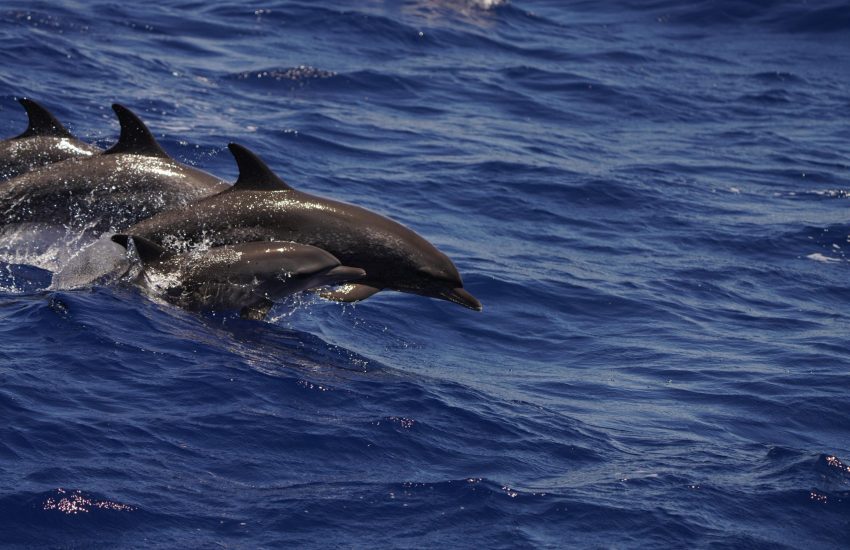
Header photo: Dolphins near the ABC Islands © CCS (2026)
Stacey Mac Donald grew up on Curaçao. Today, she devotes her career to protecting the creatures that swim in the waters around the island. Animals that many people never see, but on which the ecosystem is entirely dependent: whales and dolphins. As Strategy & Programme Manager at the Caribbean Cetacean Society (CCS) and owner of her own consultancy firm on Bonaire, she has been at the forefront of cetacean research in the Caribbean region for many years. Since 2023, she has been conducting systematic field research around the ABC Islands in collaboration with the CCS.
A new phase is now beginning. A two-year project, co-funded by BESTLIFE2030, was launched on 1 June 2026. Through IUCN NL as one of its regional hubs, this EU programme supports biodiversity projects across the EU’s outermost regions and Overseas Countries and Territories, which host exceptional biodiversity but face significant threats from climate change and other environmental pressures.
The project Stacey works on, builds on existing research but has one clear ambition that goes beyond simply collecting data: to translate scientific knowledge into better-aligned policy and sustainable management, across island borders.
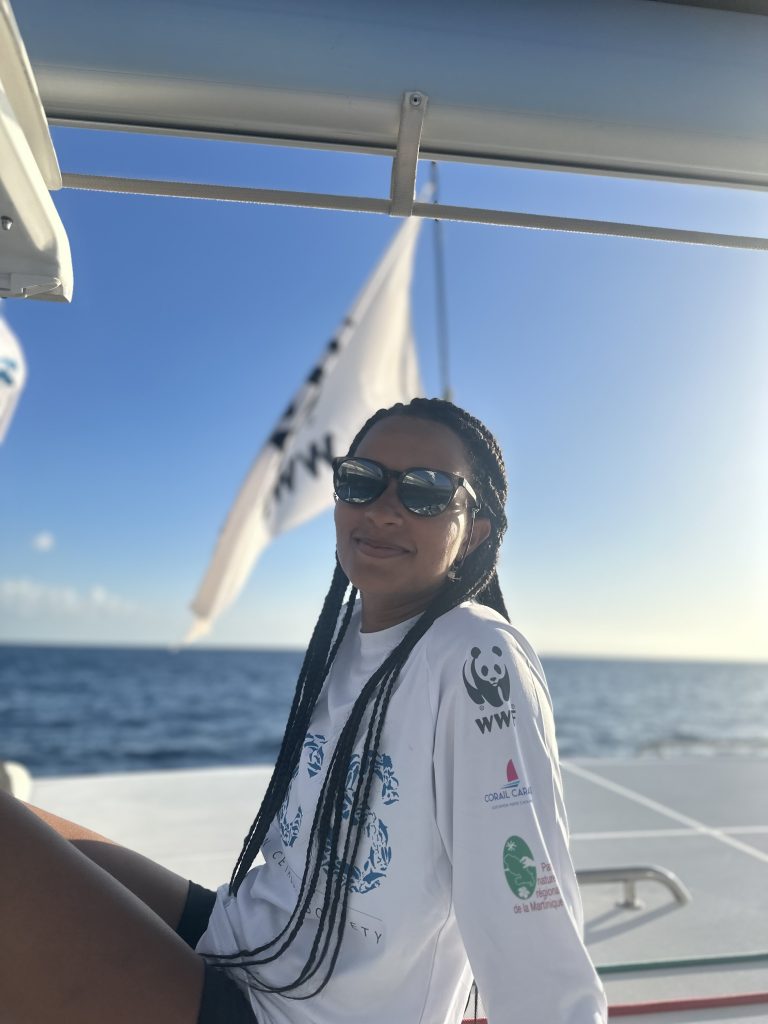
Stacey Mac Donald © CCS (2026)
Whales and dolphins are not an easy subject for an awareness campaign. You don’t just happen to spot them from the coast on any given morning. They live in an environment that most people perceive as abstract and far removed from their daily lives. ‘Marine conservation is always complicated because it’s so far away; it feels so intangible,’ says Stacey. ‘It’s complex; there are so many dynamics at play.’
And yet the threat is very real. CCS carried out three major expeditions around the ABC Islands, during which 60 participants from fourteen local organisations were trained. Over a three-year period, they observed 85 groups of nine different species of whales and dolphins. But alongside this abundance, the researchers also recorded warning signs: scars on animals that had come into contact with propellers or fishing nets. And equally worrying, active sonar detected in underwater recordings off Aruba, which can disrupt the communication, navigation and foraging behaviour of whales and dolphins.
Whales and dolphins depend on sound for everything. They use it to navigate, communicate and hunt. Underwater noise from shipping, military sonar or seismic surveys is therefore not merely a minor nuisance; it is a direct threat to their survival. And then there are the ship strikes. Sperm whales can rest on the water’s surface like floating logs, says Stacey, and are particularly vulnerable at such times: ‘They sometimes don’t react quickly enough, and ships approach very fast.’
What further complicates the situation is that there is hardly any baseline data available for the Caribbean. The Ti Whale An Nou programme is the only systematic study of whales and dolphins in this region. Only when you know where the animals are, how they move and what threats they face can you protect them effectively. That principle lies at the heart of CCS’s work.
CCS’s field research is meticulous and methodical. Spending around one week on each island, the researchers sail through the waters of Aruba, Bonaire and Curaçao, observing, photographing and listening. The dorsal fins of dolphins and the tails of whales act as fingerprints: unique to each individual, and, with the help of the AI-powered online database Flukebook, can be linked to previous sightings elsewhere in the region.
This has made it possible to establish that some bottlenose dolphins move between Bonaire’s Yarari Reserve and the waters of Aruba and Curaçao, indicating an important ecological link between these islands. It has also been found that pilot whales living in the waters off Bonaire migrate towards the coast of Venezuela.
In addition to visual observations, the researchers also measure underwater sound using hydrophone systems and map shipping routes via AIS data. Distribution maps show which species are most commonly found in which areas – information that is directly applicable to policy-making. But the project does not stop at the data. Translating this into policy and conservation measures is at least as important. Stacey and her team deliver masterclasses to civil servants, present findings to politicians and actively contribute to the development of marine protected areas.
The focus within this BESTLIFE2030 project is particularly on Curaçao, where the political will to take action is strongest. At the same time, the local community is actively involved. Local residents, fishermen, divers and tour operators are all invited to take part in expeditions, trained to identify species and encouraged to report their sightings.
On Bonaire, this approach has already yielded a tangible result: a year-round monitoring programme for dolphins along the coast, led by a volunteer who, after taking part in an expedition, simply couldn’t stop. ‘She built up a citizen science community. Divers and local residents send her a message via the app when they spot dolphins, and she heads out with a telephoto lens.’
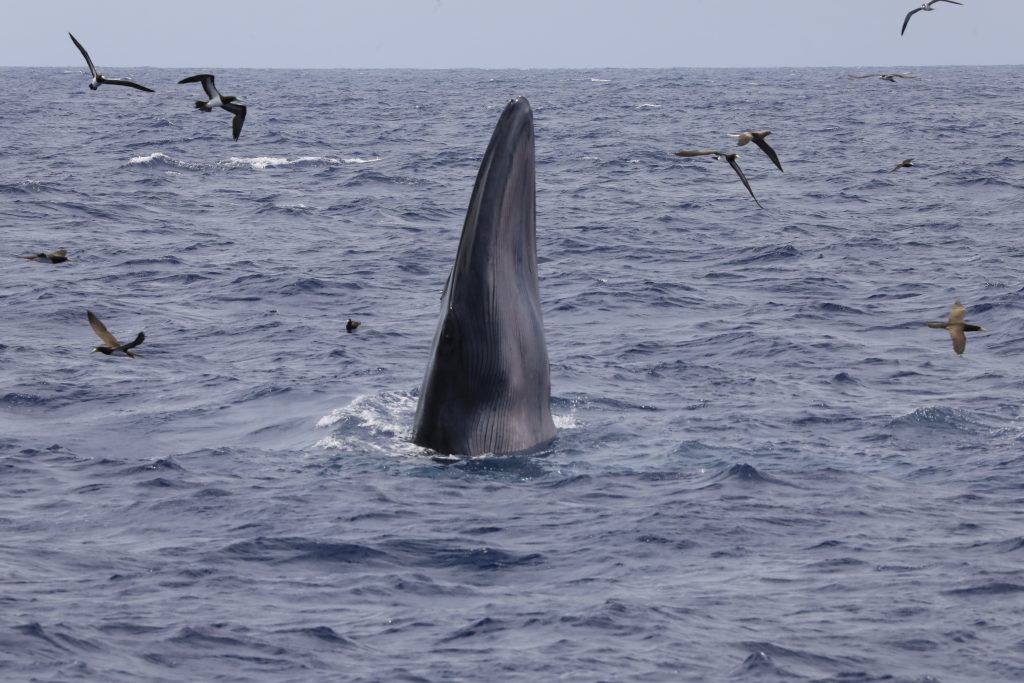
A whale breaks the surface after swallowing a school of fish © CCS (2026)
Stacey is open about what makes the work difficult. Perhaps the biggest obstacle is time. Policy changes slowly, politicians come and go, and the urgency of whale conservation is easily overshadowed by other issues on the daily agenda. ‘We try to play a role in ensuring that this issue remains in the spotlight and to keep the conversation going’.
On top of this, there is a fundamental methodological challenge: whales and dolphins reproduce slowly, have long lifespans and are difficult to count. Within the timeframe of this project, it is virtually impossible to confirm population trends. What you can observe, however, are changes in the level of human activity on the water, increasing noise disturbance, or, in a worst-case scenario, strandings that point to a deeper problem. ‘Then you’re definitely having a different conversation,’ says Stacey, ‘but of course I certainly hope it doesn’t come to that.’
Cooperation across island borders also presents coordination challenges. Aruba, Bonaire and Curaçao each have their own administrative structures and policy priorities. A dolphin that travels back and forth between Bonaire and Curaçao pays no heed to those boundaries, but conservation measures do. ‘There’s no point in having strict rules on one island when anything goes on the other,’ says Stacey. ‘These are migratory species. Management must be coordinated.’
During the most recent 21-day scientific expedition, a total of ten species of whales and dolphins were spotted. On the very first day, just a few kilometres off the coast, the researchers encountered more than 200 dolphins of two different species.
Striped dolphins have been recorded twice in the waters around Bonaire, including an exceptionally large group of more than 300 animals. This was the first confirmed sighting of this species near the island. Sperm whales, one of the world’s most endangered species, were recorded around Curaçao and Bonaire. And off Aruba, researchers using acoustic monitoring equipment detected beaked whales, a species that lives so deep that it is almost never seen at the surface.
But perhaps the most tangible success has been political. During the last expedition, Curaçao’s Minister for Health, the Environment and Nature announced that a marine reserve would be established. This was a concrete step, partly the result of years of lobbying, sharing data and deliberately inviting a minister to join us on a day’s sailing trip. ‘He saw the dolphins and immediately expressed his support.’ The minister has since left office, but the draft legislation for an offshore reserve is in place, and progress has advanced far enough for Stacey to be cautiously hopeful.
Capacity-building plays a crucial role in this: dozens of people from the islands have now been trained in identifying species and using professional cameras to record their characteristics. Policymakers, fishermen, marine biology students, STINAPA rangers – knowledge is spreading.
When Stacey looks ten years ahead, one thing is crystal clear to her: the waters around Aruba, Curaçao and Bonaire must all be designated as a marine reserve, with a management structure linking the three islands. ‘A reserve doesn’t mean that nothing is allowed anymore. But it sets the tone. It means that careful consideration is given to what activities take place in those waters and what impact they have on the species that live there.’
The Yarari Reserve, which covers the entire Exclusive Economic Zone of the Caribbean Netherlands, already provides a legal basis for Bonaire, St Eustatius and Saba. The aim is to extend this protection to Curaçao and Aruba, thereby creating a contiguous protected area large enough to encompass the migration routes of all species.
CCS can play a central role in this as a regional research centre: a single hub from which monitoring is coordinated, data is analysed and knowledge is shared. This is more efficient, cheaper and scientifically sounder than if each island were to keep reinventing the wheel.
‘As a child of this island,’ says Stacey, ‘it is my mission to ensure that future generations in Curaçao can continue to enjoy the riches of our sea.’ With the support of BESTLIFE2030 and the growing political will across the islands, this is no longer just a pipe dream. It is a plan in action.
The ‘Harmonisation of Cetacean Management in the ABC Islands’ project is being carried out by Mac & Field and the Caribbean Cetacean Society, with IUCN NL as the implementing partner.
The IUCN BESTLIFE2030 programme is co-funded by the European Union. Views and opinions expressed are however those of the author(s) only and do not necessarily reflect those of the European Union or CINEA. Neither the European Union nor the granting authority can be held responsible for them.
Further information about the programme and the projects can be found on the BESTLIFE2030 page.


23 October, 2026
Nature’s Heartbeat protects Key Biodiversity Areas through trust-based, locally led nature conservation. Building on a successful first year with numerous…
22 October, 2026
October 21st, COP17 Yerevan - Monitte Lantas, is presented the winner of the 2026 Irene Dankelman Young Ecofeminist Award, recognising…