Statement: Invest in local leadership for tropical forest…
20 March, 2026
Statement: Invest in local leadership for tropical forest…
20 March, 2026
Meet the conservationist: Dr. Amelaid follows in the…
12 March, 2026
Thursday 25 september 2025
Header photo: Forest patrol on Sumatra © Stephanie Broekaerts / IUCN NL
Of all the cases documented in 2024, 120 (82%) took place in Latin America. Colombia is the deadliest country for environmental defenders, in line with previous years: 46 were killed in 2024, with Guatemala (20), Mexico (19) and Brazil (12) following after. For every three people killed, one was Indigenous or Afro-descendant.
Although the numbers of 2024 are lower than previous years, Global Witness notes that this does not necessarily indicate that the situation for defenders is improving. Year-to-year fluctuations in the overall number of killings and disappearances are not always representative of trends in violence at country level. Moreover, underreporting remains an issue globally, particularly across Asia and Africa. Obstacles to verify suspected violations also present a problem, particularly documenting cases in active conflict zones, such as in Palestine. Additionally, restrictions on civic space coincide with a heightened fear among communities of speaking out against those causing damage to land or the environment.
Civic space is the physical or digital environment that allows people to come together, express their opinions, and take action on issues that matter to them. It includes freedoms like speaking out, protesting, joining or creating groups and organisations, and accessing information[1]https://civic-forum.eu/our-work/civic-space. Across the world, these freedoms are increasingly being limited.
In 2024, research by the Green Livelihoods Alliance, of which IUCN NL is part, found that in all countries in which GLA members work, civic space is diminishing. The report showed that GLA partners experience difficulties in all their civic freedoms, in particular Access to Information, (Women) Environmental Human Rights Defenders ((W)EHRDS) Protection, Freedom of Expression and Freedom of Assembly. GLA partners and communities experienced all types of retaliation, ranging from physical attacks to political repression.
As in 2023, mining and the extractive industry remained the deadliest industry for environmental and land defenders, with 29 people killed. This is a sharp increase from last year. With land affected by mining concessions increasing, largely due to a growing demand for minerals for the energy transition, more and more people are forced to stand up for their rights and defend their land. In this context, agreeing to the conditions in which mining can take place is crucial.
IUCN NL advocates for stronger standards for mining through the project Bottom Line!. Bottom Line! promotes socially and ecologically sound mineral governance, reinforcing national policies to protect ecosystems, water, biodiversity and IP&LC rights, whilst enhancing mining sector transparency and accountability. This way, the energy transition occurs with minimal impact on people and nature.
Global Witness also notes an alarming trend in policy on environmental and human rights, which are being watered down, delayed or abandoned all together. For instance, the US has abandoned the Paris Agreement and the Human Rights Council, while the EU’s Green Deal is being deprioritised as a growing far-right influence within EU institutions resists the transition to a green economy. The EU has also recently weakened legislation to protect defenders from environmental and human rights abuses caused by companies. The report notes that these shifts undermine the potential for transformative action to protect the planet and those who defend it, leaving defenders more isolated and vulnerable to attack than ever.
Leaders are also failing to implement existing policies designed to protect defenders. In Latin America and the Caribbean, almost 1,000 defenders have been murdered or disappeared since the adoption of the Escazú Agreement – a regional treaty that is designed to protect them – on 4 March 2018.
At the same time, the report notes the potential of law and policy to build a safer environment for environmental defenders, such as the EU Corporate Sustainability Due Diligence Directive. Although the CSDDD was agreed upon in 2024, the directive was reopened in 2025 for adjustments, which would heavily reduce corporate responsibilities.
Violence against environmental defenders emerges in a complex and interconnected system that disempowers those who stand up to defend their land (see image). At the root of this system are issues such as environmental harm, lack of land rights, corruption, corporate harm and conflict. In turn, the risk for environmental defenders is enabled by weak legal systems, ineffective protection mechanisms and toxic anti-defender narratives. These ultimately lead to reprisal against environmental defenders, resulting in killings, disappearances or criminalisation.
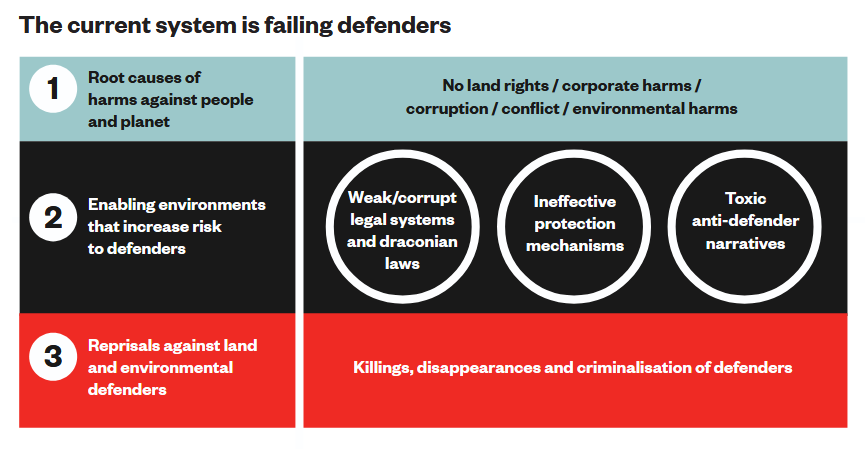
Image: the system that harms defenders. © Global Witness
On the other hand, this system, when changed, can also support defenders. At its core, it must protect community land rights, promote responsible business, and allow for adequate environmental protection and peace. This, combined with supporting environments which mitigate risks allows defenders to speak out without consequences.
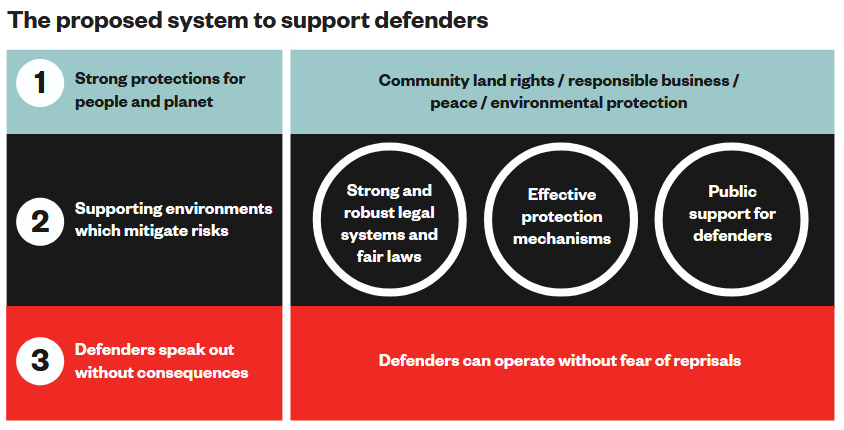
Image: the proposed system to support defenders. © Global Witness
IUCN NL is committed to the safety of conservationists as part of our Forests for a Just Future and PIDDA projects. Within these projects, we work on both creating a safer environment for defenders to do their work as well as supporting and enabling them to stand up for their rights.



20 March, 2026
The undersigned organisations call on the Dutch government to supplement its policies and legislation with investments in inclusive, locally led…
12 March, 2026
Amelaïd Houmadi grew up on an island in the Comoros. At his parental house, nestled at the foot of a…