Call for proposals for NGOs and CSOs protecting nature under threat

Critical minerals and the western chimpanzee: how bauxite…
24 March, 2026
Friday 30 january 2026
The IUCN NL Land Acquisition Fund calls on local conservation NGOs and CSOs worldwide to submit proposals to acquire threatened nature, create safe reserves, and connect habitats for endangered species. The fund supports land purchase, long-term lease of land, and other effective area-based conservation measures (OECMs) in Africa, Asia, Latin America, and the Pacific region. The deadline for applications is Friday, 1 May, 2026.
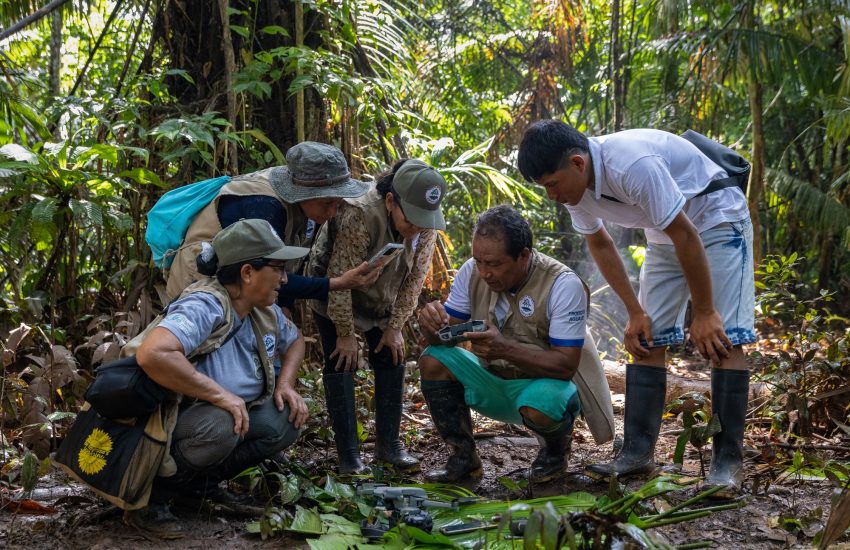
Header photo: AMPA team at work in Tocache in Peru © AMPA
Smaller projects, huge impact
The Land Acquisition Fund enables local nature organisations around the globe to secure important wildlife habitat by purchasing or long-term land leasing. By protecting, expanding, and connecting the habitat of endangered and vulnerable species, these species have a second chance. Since its foundation in 2001, the fund has enabled the safeguarding of over 320,000 hectares of threatened nature.
Marc Hoogeslag, coordinator of the Land Acquisition Fund, explains why this is important – especially now. ‘Because of the 30×30 target of the International Biodiversity Convention, many donors focus on protecting large areas. But we should not overlook the smaller projects, which often have a huge impact at crucial locations, on the frontline of conservation. In addition, funding reforestation projects is currently popular, while preserving existing forests is the important first step.’
Main criteria for proposals
The general objective of a proposed project must be in line with the main objective of the Land Acquisition Fund: providing funds to local NGOs and CSOs to acquire threatened nature, create reserves, and connect habitats for vulnerable and/or endangered species. Potentially successful proposals contribute directly to tangible conservation outcomes and include local participation in the conservation and management of the area.
In order to be eligible for LAF grants the applicant must:
- be locally registered as a non-profit organisation, non-governmental organisation (NGOs) or civil society organisation (CSOs) in Africa, Asia, Latin America, or the Pacific;
- be directly responsible for the preparation and implementation of the grant project;
- have a bank account in the name of the organisation and in the place where the organisation is established or where the project is carried out; and
- have proven experience and capacity in managing conservation areas, including project management, financial management, and financial control.
LAF cannot grant financial assistance to:
- private individuals;
- commercial (for profit) organisations;
- governmental institutions; and
- projects or organisations with a primary focus on sustainable agricultural systems, education, rescue, or rehabilitation centres.
The Land Acquisition Fund does not use Artificial Intelligence (AI) in the review process and expects applicants to develop their proposals without AI assistance. If you do choose to use AI, please disclose how and why it was used in your proposal.
Please read the Criteria and Guidelines 2026 document carefully for the full criteria and information on the application process.
Submit your proposal by Friday, 1 May 2026.
Guidelines for privately protected areas
In 2022, together with American Bird Conservancy, the Land Acquisition Fund has published a manual with guidelines for people managing privately protected areas. This practical manual draws on lessons learnt from managers and other experts and provides practical steps to guide readers from the creation phase through the development of management tools.
Applicants are advised to read the manual:
About the Land Acquisition Fund
For 25 years, the IUCN NL Land Acquisition Fund has been enabling the protection of the habitat of endangered and vulnerable species. Through the work of the local conservation NGOs and CSOs, safeguarding important ecosystems creates a win-win for biodiversity, the climate and human well-being. The Land Acquisition Fund is supported by a growing number of private donors.
More information? Contact:




27 March, 2026
Engaging Stakeholders to Advance Ecosystem-based Adaptation in Mauritius
Madagascar and the Indian ocean islands are a biodiversity hotspot - a group of islands with incredible species diversity and…
24 March, 2026
Critical minerals and the western chimpanzee: how bauxite mining threatens one of West Africa’s last strongholds
In West Africa, the global scramble for critical minerals’ is putting immense pressure on unique ecosystems. As the demand for…