Survey results underscore continued pressures on civic spaces

Critical minerals and the western chimpanzee: how bauxite…
24 March, 2026
Wednesday 17 december 2025
Worldwide, nature organisations are working hard to protect remaining patches of biodiversity and to strengthen the rights of the people living there. However, many face difficulties in doing their jobs properly as the space to hold power accountable and advocate for change is shrinking.
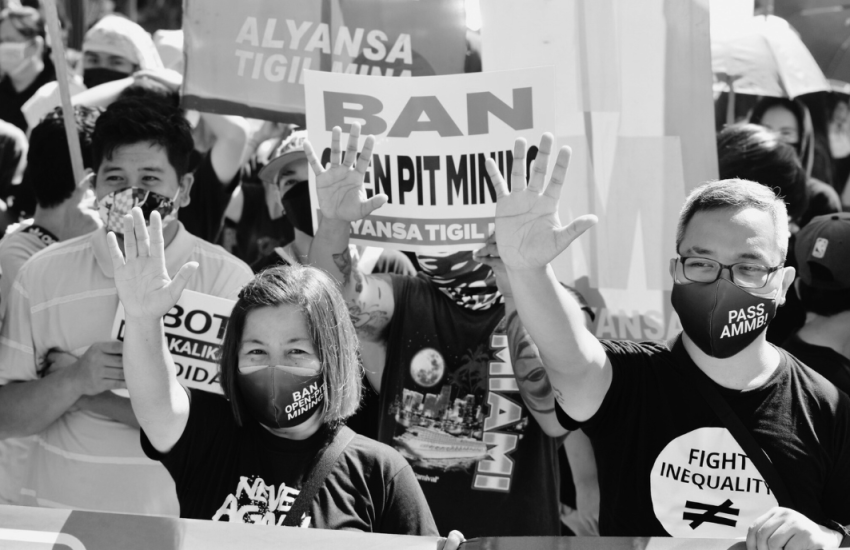
Header photo: Protest mining in the Philippines © ATM
That is the conclusion of a survey conducted by the University of Geneva, with support from IUCN NL, among IUCN’s membership and partners of the Land Acquisition fund. Some 85 NGOs working locally, nationally and globally responded over a three-month period to the survey conducted in English, French and Spanish.
The responses highlight the growing challenge of shrinking civic spaces amongst many conservation NGOs. These findings confirm earlier trends.
Key findings
- Respondents emphasised that conservation work is becoming more dangerous, policies are becoming more restrictive, and threats and violence in general are increasing.
- Key challenges are
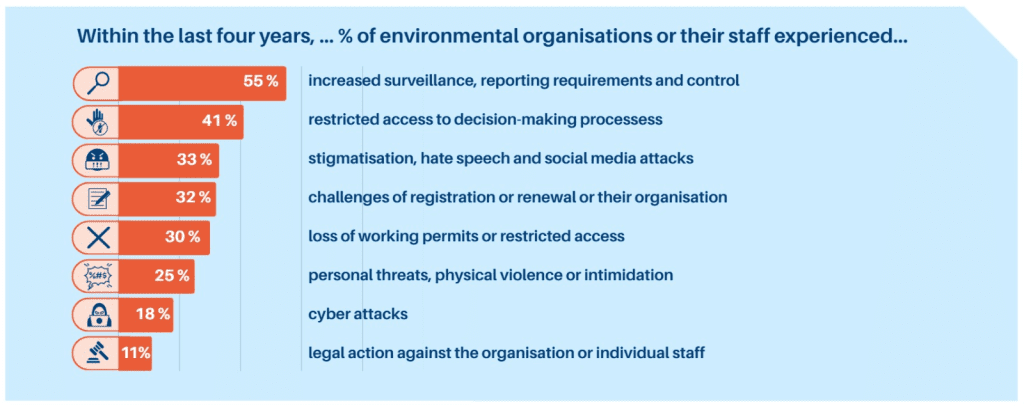
- increased surveillance, reporting requirements and control
- restricted access to decision-making processes
- stigmatisation, hate speech and social media attacks
- difficulties with registration.
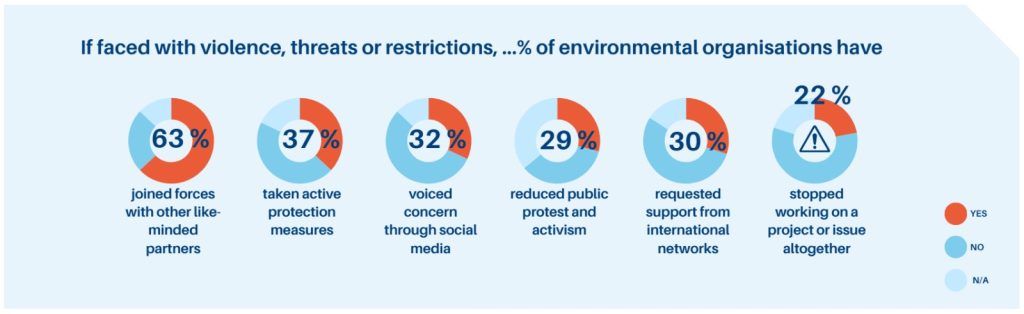
- As a result of these challenges, one fifth of respondents were forced to halt work on a project or issue entirely.
‘Democracy is being constrained around the world, and the effects are very evident in affecting the activities of NGOs.’
- Latin American IUCN member
Shrinking civic spaces
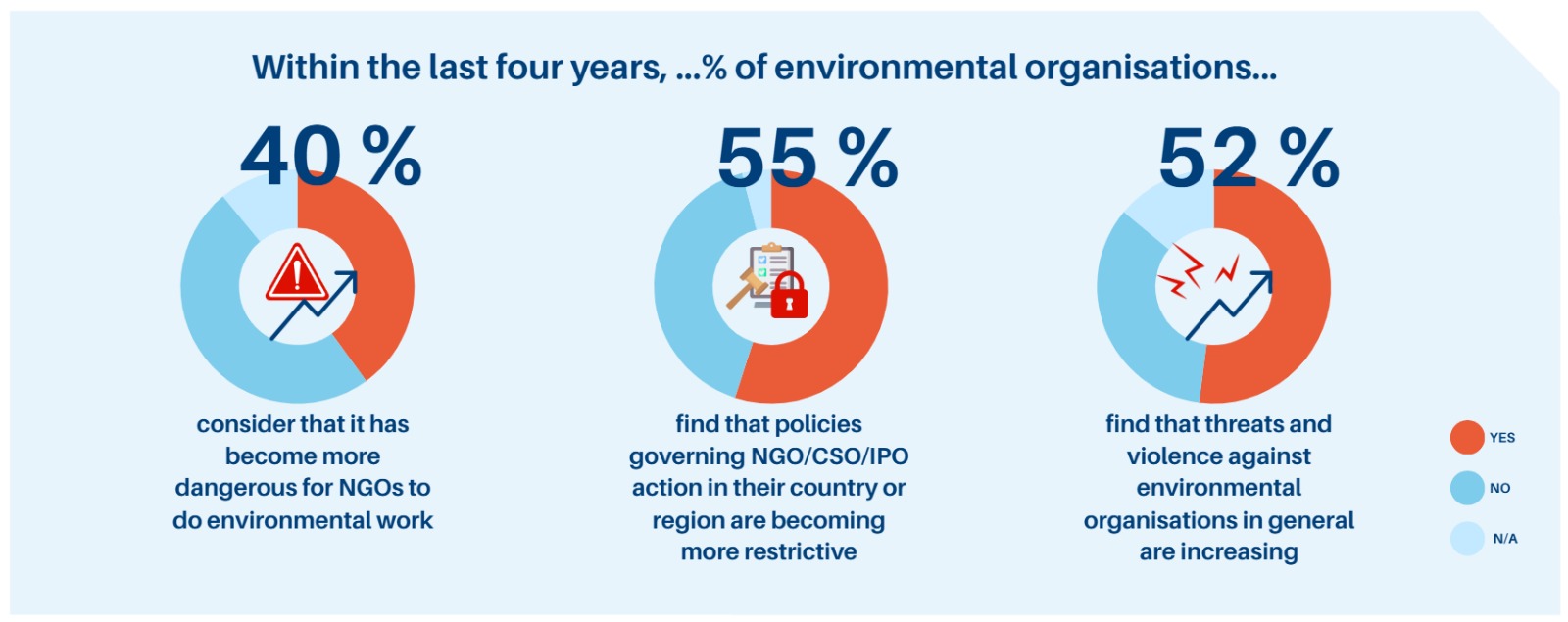
Four in ten survey respondents say conservation work has become more dangerous over the past four years. The risks vary widely, but many point to one major driver: the steady shrinking of civic space. More than half report that the rules governing NGO activity in their countries have grown increasingly restrictive. Among respondents, half also observe a rise in threats and violence. These are clear signs that the environment for conservation work is becoming more hostile.
‘Today, working for nature conservation has become a challenge. Threats are increasingly abundant. Illegal activities, despite so much technology, continue unabated, and political decisions endorse them, defending criminals and passing laws that benefit illegality.’
- Latin American IUCN member
Key challenges
When asked how risks have changed over the past four years, respondents painted a troubling picture of tightening oversight and control. More than half reported a surge in surveillance, heavier reporting obligations, and stricter state monitoring. These pressures take many forms; from direct government scrutiny to limits on receiving international funding. Nearly half of respondents say they now face restrictions on foreign financial support, including “foreign agent” laws in several countries that make such funding increasingly difficult.
Even the basic ability to operate is under strain. Many environmental organisations struggle to register as conservation NGOs or to renew the licenses they need to function. Some groups have been forced to close or change their legal status entirely, all against the backdrop of environmental institutions being weakened or dismantled.
‘In my country basically anything that requires any level of government engagement, even just permits, has become like walking on eggshells.’
- Latin American IUCN member
The risks extend well beyond institutional pressure; many respondents report direct personal harm. Within the past four years, a quarter have faced personal threats, physical violence, or intimidation. A third report increasing levels of stigmatisation, hate speech, and social‑media attacks, patterns that often go unmonitored and unrecorded. Working in conservation is often unsafe for individuals or their organisations. Around 11% specifically cite legal attacks targeting people and groups, while nearly one fifth say they have experienced cyber‑attacks such as hacking.
Taken together, these trends reveal a sector operating in an increasingly hostile civic environment, one where both organisations and the people who power them are being placed at growing risk.
Environmental organisations’ coping strategies
When confronted with violence, threats, or restrictive measures, many organisations turn to collective strength. Around 63% of respondents said they joined forces with likeminded groups to coordinate responses and find safe ways forward. The survey highlights how resourceful conservation actors can be: mobilising social media campaigns, seeking international backing, and using networks to draw attention to the pressures they face.
Some organisations are taking direct steps to protect themselves. About 37% have introduced active protection measures, such as safety protocols for staff. Yet the data also shows that a significant number of conservation NGOs still operate without adequate security in place, leaving people and projects dangerously exposed.
For others, the pressure has forced them to scale back. Nearly one third of respondents reported reducing their public protests and activism, while almost a fifth said they had stopped working on a project or issue altogether due to the risks.
At a moment where more, not less, conservation action is needed this trend is deeply problematic.
What can IUCN and international actors do?
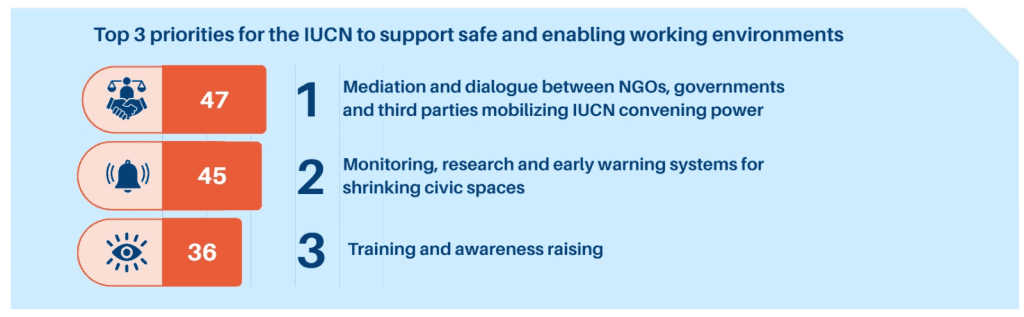
Nearly half of the respondents call for stronger mediation and dialogue between NGOs, governments, and other stakeholders, making use of IUCN’s convening power to ease tensions and find solutions. There is also a clear demand for better monitoring, research, and early‑warning systems to track shrinking civic spaces, along with more training and awareness‑raising to help organisations navigate these challenges.
‘INGOs and other institutions can support smaller organisations with field activities by providing additional resources to implement safety safeguards, as well as any necessary extensions for local NGOs to carry out their projects when timelines are affected by security concerns.’
- Latin American IUCN member
IUCN World Conservation Congress
During the IUCN World Conservation Congress last October, a motion was adopted to generate more action towards strengthening civic spaces: ‘Strengthening safe civic spaces to fulfil the Kunming-Montreal Global Biodiversity Framework’.
This motion calls on IUCN to create standards, protocols, and early‑warning systems to protect civic space and support Members facing threats. It asks for policies and campaigns to defend environmental human rights defenders and whistleblowers, research on civic space and conservation, and stronger national codes of conduct. It also urges donors to invest in safeguarding capacities, governments to guarantee safe civic environments and uphold rights, and the private sector to respect civic spaces and human rights standards.
IUCN NL’s work on civic space
IUCN NL is committed to supporting our partners and the Dutch Members in the face of challenges, strengthening civic spaces and protecting the safety of conservationists and environmental defenders.
Want to know more? Contact:





27 March, 2026
Engaging Stakeholders to Advance Ecosystem-based Adaptation in Mauritius
Madagascar and the Indian ocean islands are a biodiversity hotspot - a group of islands with incredible species diversity and…
24 March, 2026
Critical minerals and the western chimpanzee: how bauxite mining threatens one of West Africa’s last strongholds
In West Africa, the global scramble for critical minerals’ is putting immense pressure on unique ecosystems. As the demand for…