Nature’s Heartbeat expands support for locally led conservation…
23 October, 2026
Nature’s Heartbeat expands support for locally led conservation…
23 October, 2026

Monitte Lantas wins 2026 Irene Dankelman Young Ecofeminist…
22 October, 2026
Wednesday 13 may 2026
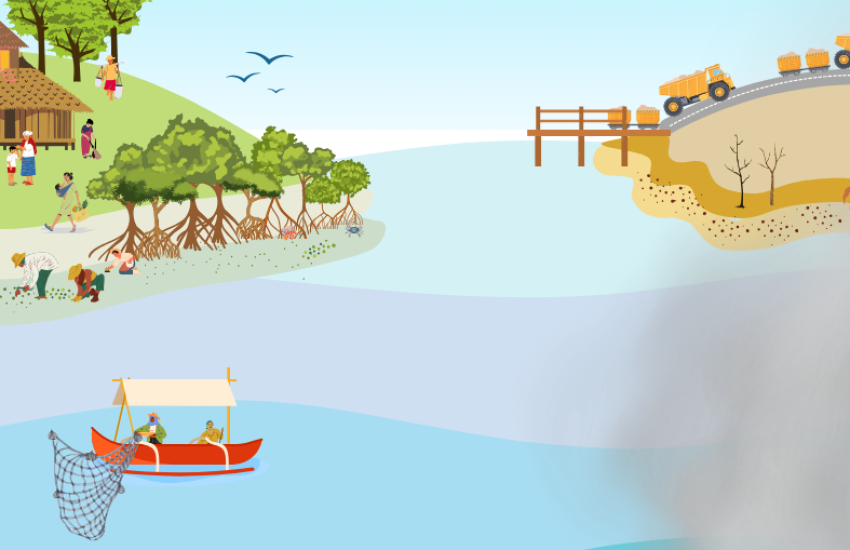
Header photo: Graphic by Daphne van den Heuvel © IUCN NL
An emerging issue highlighted in the report is shallow-water seabed mining for magnetite (‘black’) sand, a source of iron ore and other heavy minerals. Magnetite sands occur along volcanic coastlines in countries including the Philippines, Indonesia, Japan, New Zealand, parts of Africa and Latin America. Because minerals on land are becoming scarcer and harder to mine, marine resources are increasingly considered to help meet rising demand.
Shallow-water seabed mining takes place close to productive coastal ecosystems and fishing grounds. Extraction can damage seafloor habitats, disrupt sediments, and harm coral reefs and seagrass beds. It also disrupts fisheries that support local livelihoods and food security. Recovery can take years and ecosystems may never fully recover.
Representing IUCN NL, Maartje Hilterman contributed to the UNEP report, shedding light on this issue and its risks. “Large-scale shallow-water magnetite mining is set to take off in the Philippines, largely overlapping with Marine Key Biodiversity Areas and small-scale fisheries. These operations have a large socio-ecological footprint, making strong governance safeguards essential to protect marine ecosystems and coastal livelihoods”, says Maartje.
The Philippines is currently the first country where large-scale commercial shallow-water magnetite sand mining appears set to take off, with 11 ‘offshore’ mining contracts approved and more than 100 applications covering over 625,000 hectares. Many proposed mining areas overlap with Marine Key Biodiversity Areas and small-scale fisheries zones.

Malabuyoc in Cebu, the Philippines © Josephus Bajo via Unsplash
The UNEP report highlights major governance gaps around sand extraction, including limited baseline data, lack of cumulative impact assessments, poor transparency and insufficient community engagement. It calls for treating sand as a strategic natural resource and recommends stronger policies, better spatial planning, improved environmental and cumulative impact assessments and greater corporate accountability. Financial systems and public procurement should better account for environmental and social risks, while incentives should support circular alternatives and reduced extraction pressures.
The report ultimately advocates a precautionary, ecosystem-based approach that balances development needs with the protection of biodiversity, ecosystems, water systems and local livelihoods.
In line with these recommendations, IUCN NL has started the project Exposing the Risks of Shallow-Water Seabed Mining. By filling critical awareness and evidence gaps and amplifying community voices, the project will help shift public, policy and community attention toward the risks of shallow-water seabed mining (SWSM) and the need to protect ecosystems, fisheries and coastal communities from irreversible harm while informing policy advocacy beyond this project’s scope.
The project will document and expose the risks of emerging shallow-water seabed mining based on the case of the Philippines. By exposing risks, amplifying coastal communities’ voices, and advancing no-go zones and marine protection, we work towards stronger seabed governance – applying a precautionary, ecosystem-based approach that is aligned with climate and 30×30 targets.

23 October, 2026
Nature’s Heartbeat protects Key Biodiversity Areas through trust-based, locally led nature conservation. Building on a successful first year with numerous…

22 October, 2026
October 21st, COP17 Yerevan - Monitte Lantas, is presented the winner of the 2026 Irene Dankelman Young Ecofeminist Award, recognising…