
From Commitments at the CBD COP17 to Action:…
12 November, 2026
From Commitments at the CBD COP17 to Action:…
12 November, 2026
Information Sessions for the 3rd BESTLIFE2030 Call
10 November, 2026
Wednesday 18 november 2026
On an uninhabited island of just two square kilometers, protected sea turtles come ashore each nesting season to lay their eggs, while hundreds of tourists arrive to enjoy the sun. With support of BESTLIFE2030, Sea Turtle Conservation Curaçao (STCC) is tackling the challenge of giving both enough space on this small island.
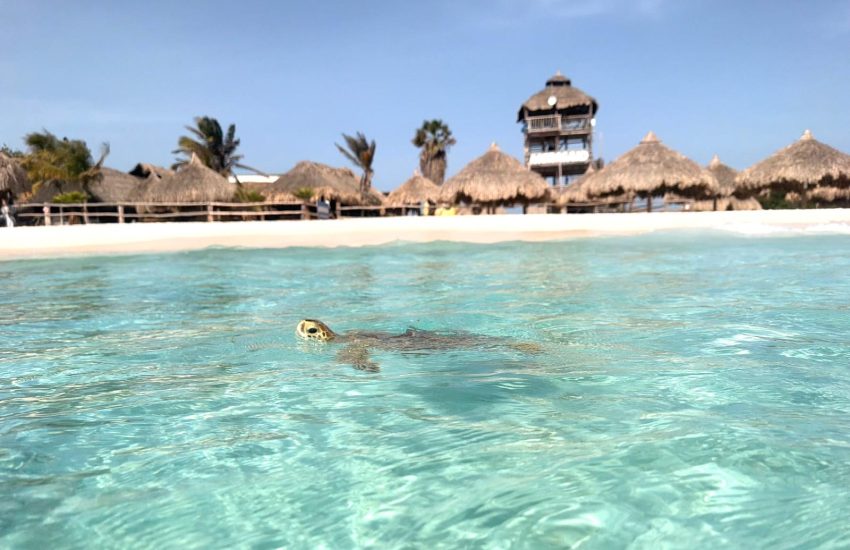
Header photo: juvenile sea turtle in front of Klein Curaçao © STCC (2026)
Klein Curaçao lies about 10 km off the southeastern coast of Curaçao. The island is uninhabited, has no electricity, no toilet facilities, and no on-site supervision. Yet an estimated 450 visitors arrive every day, alongside two protected sea turtle species: the hawksbill turtle (Eretmochelys imbricata) and the green sea turtle (Chelonia mydas).
STCC has been active on Klein Curaçao for 11 years and has now received new funding through the BESTLIFE2030-program. BESTLIFE2030 is an EU-funded biodiversity initiative coordinated by IUCN, with IUCN NL serving as the regional focal point for the Caribbean. This support will allow STCC to continue protecting the nesting grounds that generations of sea turtles depend on.
According to STCC, the very presence of sea turtles on the island is an important signal that this habitat needs to be respected. A sea turtle returns to the same beach where she was born to lay her eggs. “So, in a way, they have the first claim. It’s their birthright, their beach”, says Ard Vreugdenhil, STCC’s field coordinator. He has been involved with the organization for twelve years, since the very beginning. Together with STCC volunteer Francis van Dijk, he coordinates and monitors everything related to Klein Curaçao.
Klein Curaçao wasn’t originally listed as a nesting beach of Curaçao. STCC’s involvement began by chance when tour operators alerted the team to the large number of sea turtles coming to the small island. When Ard and his colleagues arrived, they found the island covered in plastic. So, their focus for the first few years was on cleaning up the beaches. Right when this problem became manageable, another quickly appeared: Klein Curaçao was becoming increasingly popular. “They arrive with so many people”, says Francis. The island is becoming noticeably busier, particularly in the last five years. Now STCC has shifted their attention to the growing pressure caused by tourism.
On top of that, climate change is an ever-growing issue for the turtles of Klein Curaçao. Rising temperatures are causing the sand to become extremely hot. As a result, sea turtles often lay their eggs in the cooler sand close to the shoreline, leading to the loss of many nests. Sand temperature also determines the sex of the young sea turtles: the warmer the sand, the more females are born. Climate change is slowly shifting the sea turtle populations out of balance.
There is another issue. Two important nesting sites are covered with “palapas”, shaded huts for visitors. These create artificially cooler patches of sand, and those spots are exactly where the females are now laying their eggs. The result is that just a few hours later, tourists may be sitting directly on top of the freshly laid nests.
“We can’t simply close our eyes and ears. We have to do something here,” says Ard.
That is why STCC volunteers monitor the beaches. When needed, nests are carefully excavated and relocated to safer areas away from tourists. Nests can also be buried deeper or moved to a cooler location.
Perhaps the biggest problem, however, is accessibility. The team is currently on Klein Curaçao three days a week, with a three-hour journey each day just to get there and back. In the days between visits, anything can happen without anyone there to intervene.
“We miss nests”, says Ard. “People fill the holes or sit on top of the nests. Sometimes we are two days late in registering and protecting a nest.”
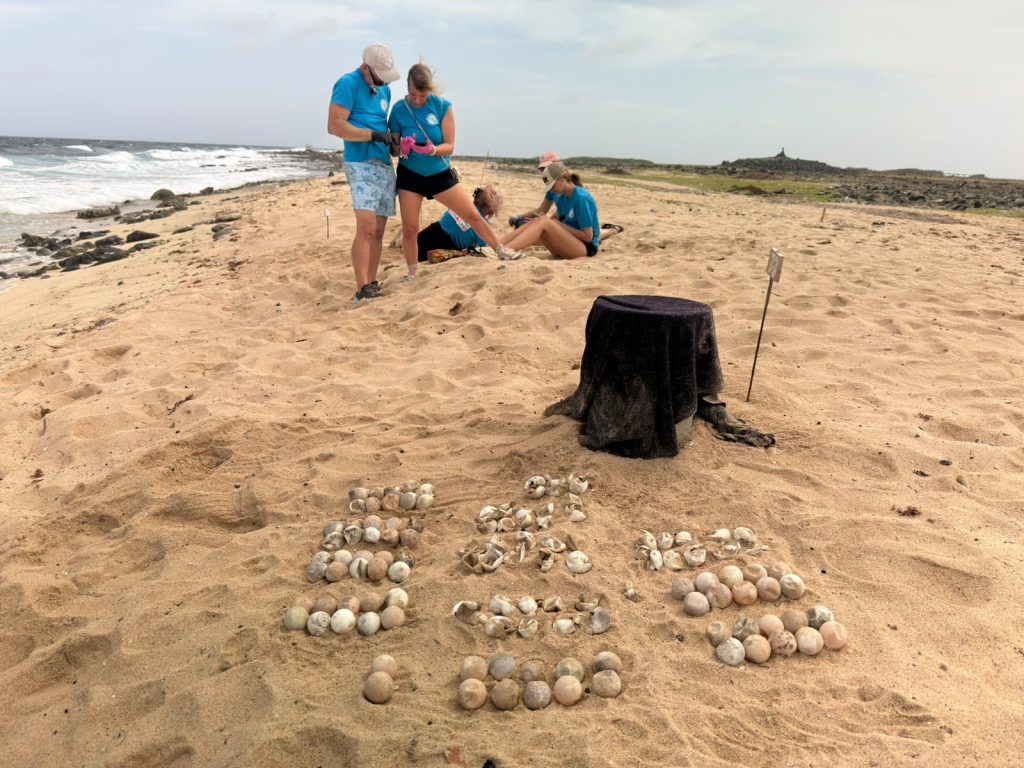
Ard and his team working on a nest ©STCC (2026)
One of the solutions that STCC is working on is a hatchery: a barricaded area where relocated nests can safely develop. “It’s important that we have a designated section where the tourists can’t come”, says Francis.
The hatchery ensures an optimal environment so the nests can safely hatch. The surrounding beach can be kept clean, and the hatchery has a roof to prevent the eggs from overheating. But the hatchery also serves another purpose: as an educational tool. People are curious and will often walk over to see what is happening. That creates an opportunity to explain the purpose of the hatchery and the work the organization does.
Still, Ard would ideally have a different solution. “I would rather not build a hatchery at all. But given the current circumstances, with climate change and the pressure from tourism, we need to move towards a more controlled set-up.” The team also wants to work more closely with the tour operators, for example by creating a short, informative video so visitors understand the situation before they even set foot on the island. “We’ve already come quite a long way, but we’re nowhere near finished,” Francis explains. “So, we’re really grateful that BESTLIFE is supporting us.”
What STCC really needs are people who can work independently. That is why the team is currently investing in intensive training weekends, including overnight stays on the island. The overnight experience is particularly important. Spending a night on the island gives volunteers a much better understanding of what happens when the sun sets, and it helps them become faster and more confident at identifying sea turtle tracks during the day.
These training weekends are not only good for team spirit, but the level of the volunteers is also already improving. “They’re much more confident in themselves and in explaining what they do. I already noticed that they enthusiastically step forward when tourists ask questions,” says Ard. “That’s already a very important result.” Motivated and well-trained volunteers are exactly what the sea turtles of Klein Curaçao need.
In the long term, the organization also wants to structurally involve more young people from Curaçao, for example by starting a junior ranger programme. Especially now that they are able to offer engaging activities.
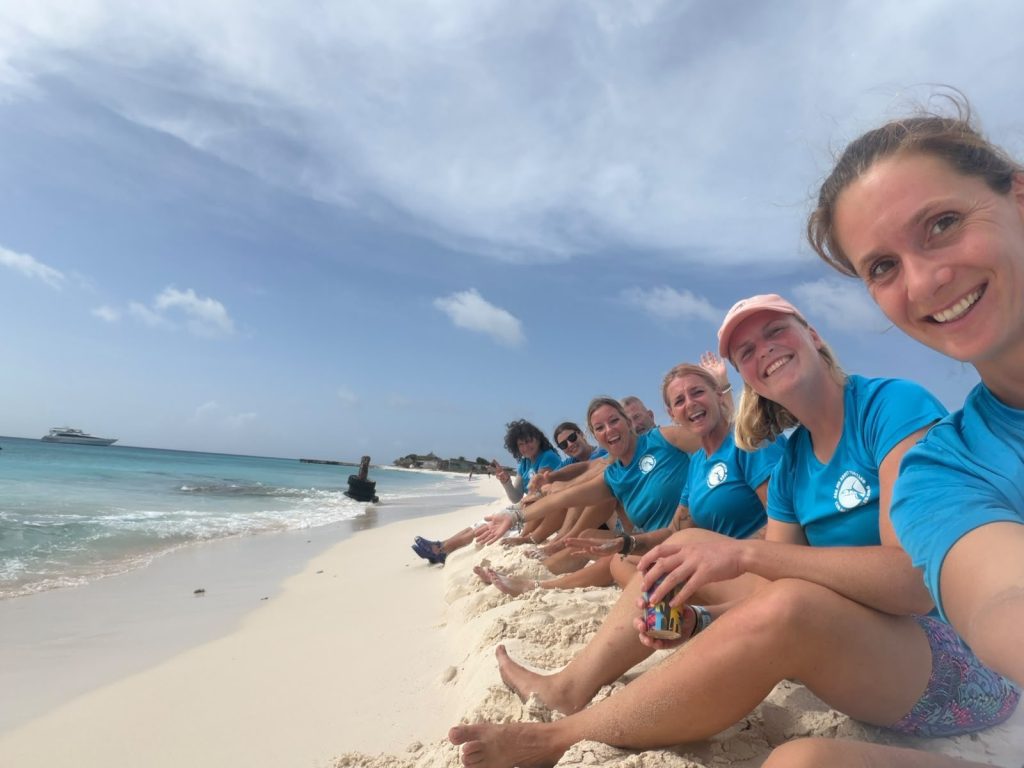
STCC volunteers on Klein Curaçao © STCC (2026)
The number of boats travelling to Klein Curaçao continues to increase. “Of course, ideally we would see fewer tourists, but that probably isn’t realistic anymore”, says Francis. Instead, the organization is focusing on educating both tourists and Curaçao residents. That is where they believe they can make the greatest difference. “We’re working on a mentality shift. And to make that happen, we need to be on the island”, says Ard.
More challenging than day visitors are those who stay overnight, which happens around two weekends a month. They are given a few rules to follow, including turning off lights, because young sea turtles can become disoriented by artificial light as they make their way towards the sea. There is currently no enforcement, however, and the message is not always well received. Therefore, Ard has chosen to focus on the much larger group of day visitors, trusting that the rest will follow.
The organization is also heavily dependent on the tour operators that bring them to the island. “We have a good relationship with the boat operators, but we would prefer to be on the island every day,” says Francis. However, that requires funding which is currently allocated to other priorities.
Formal protection for the island could solve a lot of these issues, but that protection does not yet exist. Klein Curaçao is not part of the marine park of Curaçao. The island has no regulations and is only protected as a Ramsar site, an internationally recognized important nature area. Ard himself was a consultant in the consortium that developed a plan for the island using European funding, commissioned by the Curaçao government. The plan is now with the minister. “We can’t let this just sit on a shelf,” he says. “Something needs to happen.”
The most visible result so far is the relationship STCC has built with the tour operators. “Of course, we sometimes bump into issues where people don’t agree with us,” says Francis. Fortunately, so far, they were always able to talk it out. Some operators are now actively supporting the organization and have even been listed as partners on the STCC website.
Just as important is the shift in behavior among visitors themselves. “People really do mean well. Often, it’s simply just that they are uninformed,” according to Francis. “When you explain what we’re doing and why, they are almost always enthusiastic. We often get told that it’s really great that we’re doing this.” She has never experienced someone reacting negatively. “We still have a lot to do,” Francis says. “But things are moving in the right direction.”
When asked what she dreams Klein Curaçao will look like in five or ten years from now, Francis doesn’t hesitate: “I would love to see Klein Curaçao become a true nature reserve.” Ard takes that vision a step further: protected status, park rangers, and a controlled environment, like the way Christoffel park is managed on Curaçao. Visitors would still be welcome, and overnight stays can continue, but there would be proper supervision, trash collection and first-aid on site. At present, the latter is still completely lacking on the island.
Neither of them acts as if these measures would rid them of all their worries. Ard prefers to not look too far ahead, because the shortage male sea turtles may not become truly visible for decades. Francis, however, is steadfast: “Give up? That’s not how I roll.”
The fact that so many sea turtles keep returning to Klein Curaçao to lay their eggs shows that this location is a historically important and high-quality nesting beach for these species. And that needs to stay that way. STCC believes that it’s possible to restore the balance between man and nature. Their slogan, “Enjoy nature, respect wildlife” captures that idea perfectly: enjoying nature goes hand in hand with respect for the animals that live there and the habitat they depend on.
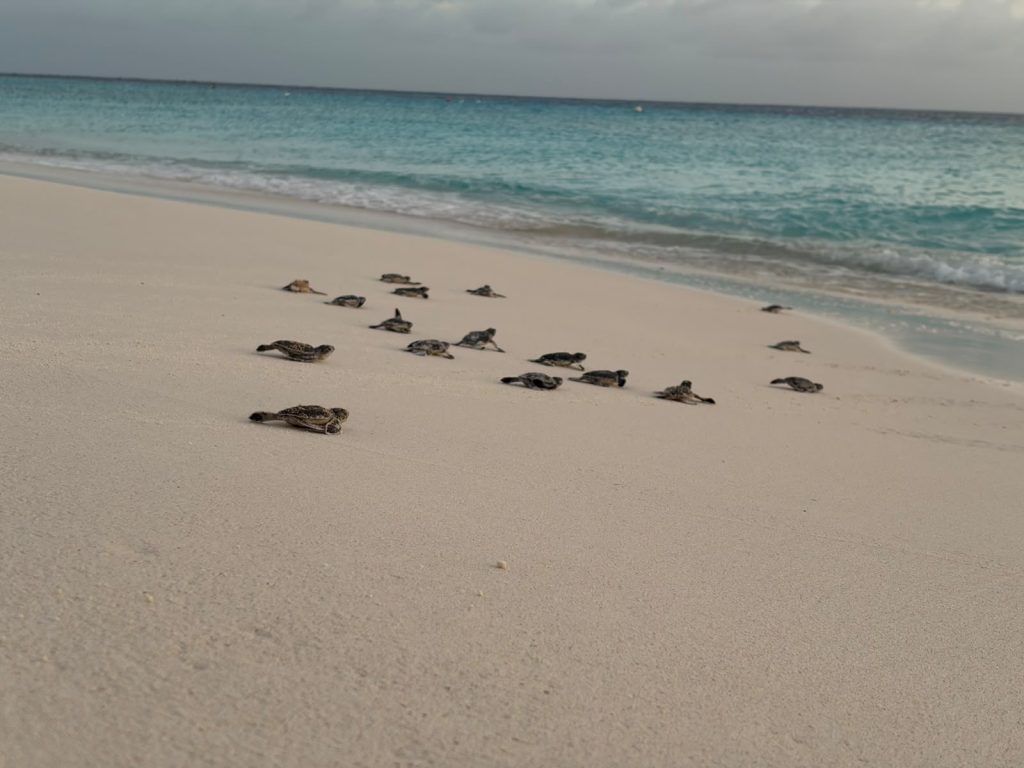
Newly hatched sea turtles on their way to the ocean © STCC (2026)
The project of Stichting Friends of Sea Turtle Conservation Curaçao on Klein Curaçao focuses on the protection of nesting sites under increasing tourism pressure. It is supported by BESTLIFE2030, an EU LIFE-funded programme coordinated by IUCN Europe. IUCN NL serves as the regional hub for the Caribbean Netherlands.
The IUCN BESTLIFE2030 programme is co-funded by the European Union. Views and opinions expressed are however those of the author(s) only and do not necessarily reflect those of the European Union or CINEA. Neither the European Union nor the granting authority can be held responsible for them.



12 November, 2026
After two weeks of negotiations, dialogue and exchange in Yerevan, Armenia, CBD COP17 has renewed global commitments for biodiversity, but…
10 November, 2026
To support applicants in preparing strong project proposals, BESTLIFE2030 is offering a series of information and guidance sessions for the…